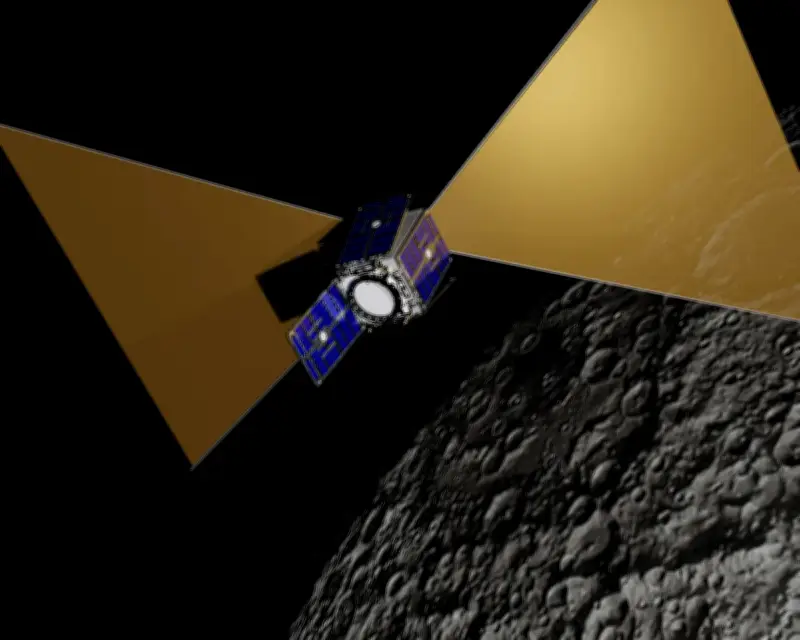
Scientists are planning to put a suitcase-sized satellite into orbit around the moon, using data collected as it passes the far side to search for a radio frequency signal emitted by neutral hydrogen atoms in the early universe.
Searching for the 21cm line
The satellite, nicknamed CosmoCube, will look for what is known as the 21cm line. The older the signal, the more its wavelength has been stretched, or redshifted, to longer wavelengths, providing a way for its strength to be tracked over time relative to the cosmic microwave background radiation.
“The main thing we track by looking at this signal is what’s the physical temperature of the gas during the early universe,” said Prof Eloy de Lera Acedo, the lead author from the University of Cambridge’s Cavendish Laboratory.

Studying the dark ages and cosmic dawn
With the 21cm signal acting like a thermometer, the team hopes to study events from the start of the so-called “dark ages”, about 380,000 years after the big bang, through the cosmic dawn, when the first stars and galaxies emerged, to the end of the epoch of reionization, approximately 1bn years after the big bang.
“The temperature of the gas is affected by the things happening in the universe at the time,” said de Lera Acedo. He noted that the amplitude and shape of the 21cm signal was expected to be influenced by dark matter, offering a way to investigate the nature of this mysterious component of the universe.
Avoiding Earth's interference
Researchers have attempted to detect the 21cm line before, but it is difficult using Earth-based instruments. Not only is the signal weak, but human-made technology – from FM radios to plane communication – can cause interference. Writing in the journal Nature Astronomy, de Lera Acedo and colleagues said other challenges included disturbances created by the Earth’s ionosphere.
While experts at the Edges (Experiment to Detect the Global EoR Signature) radio telescope in Australia claim to have found the 21cm line, questions have been raised over the results.
The team behind the CosmoCube mission, expected to last two years, said taking observations from the far side of the moon should avoid many challenges faced by Earth-based instruments.
Cost and timeline
“The total cost is estimated to be just under £50m and the launching date – we expect it to be about five years from now,” said de Lera Acedo, adding that CosmoCube had already been granted more than £2m of funding by the UK Space Agency.
Phil Bull, a professor of cosmology at the Jodrell Bank Centre for Astrophysics who is not involved in the project, welcomed the mission. “The CosmoCube measurements will help us understand the major ingredients of our cosmic origins – the processes that led to the formation of the first stars and galaxies, and lit up the Universe after a period called the cosmic dark ages,” he said.
But Bull noted that CosmoCube was not the only mission trying to make these measurements, and others may get there first. “More ominously, other planned lunar missions might bring with them exactly the type of human-generated radio noise that the mission is trying to escape,” he said, “making this a race against time.”