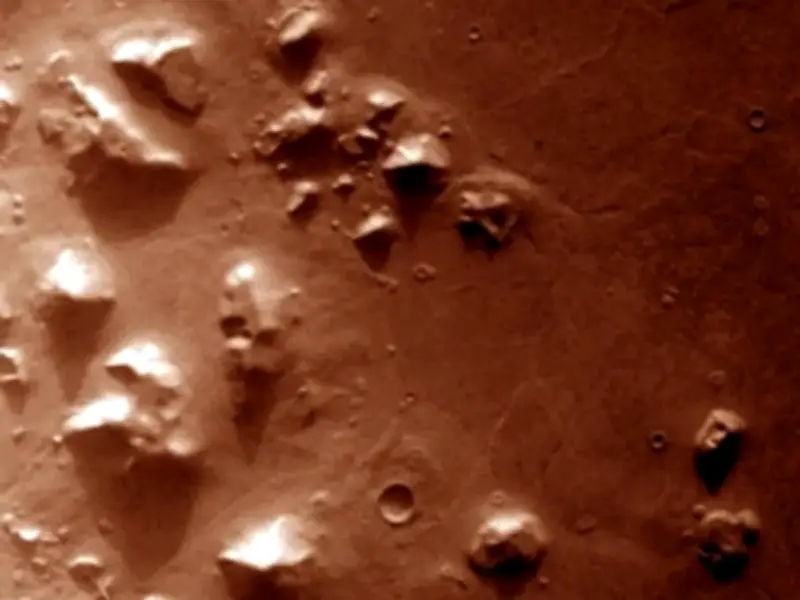
UFO researchers claim that ancient alien city ruins have been discovered along a long-lost ocean shoreline on Mars, complete with giant monuments. The theory centres on the Cydonia region, where strange hills have been likened to a giant human face, colossal pyramids, and crumbling city structures.
Claim of Waterfront City Layout
UFO researcher Jason Martell, a regular guest on the History Channel's Ancient Aliens TV show, argues that the arrangement of the Martian landforms mirrors the layout of waterfront cities built throughout human history. According to alien hunters, NASA orbital photographs show a clear dividing line between rugged highlands and a flat, smooth basin that may have once held a massive body of water millions of years ago.
Several of the region's most mysterious landforms, including the infamous "Face on Mars", the D&M Pyramid, and the sprawling "city" complex, appear to line up directly along this proposed ancient boundary. Martell claims the giant face might have been intentionally constructed as a monument, designed to overlook both the vast body of water and the sprawling alien settlement nearby.

Comparisons to Earth Cities
In a blog post detailing the theory, he compared the hypothetical Martian setup to famous Earth cities built along major coastlines and rivers, including Venice, Alexandria, Amsterdam, Singapore, Dubai, and Manhattan. He also pointed to ancient settlements like Memphis on the Nile and Ur beside the Euphrates as classic examples of humanity's instinct to settle near water.
He argued that just as human civilisations built along coastlines for vital access to food, trade, and transport, an ancient Martian race may have set up shop along the edge of a Martian sea.
Scientific Rebuttal
However, mainstream scientists and space experts insist the claims are just visual tricks and wishful thinking. They say the argument relies on visual interpretations of grainy orbital photographs rather than any physical evidence, proper sediment analysis, or detailed geological study. Experts point out that the supposed "shoreline" was traced onto the satellite image by hand.
Meanwhile, the flat, smooth basin is more likely to have been formed by standard geological processes like sweeping lava flows, ancient dust movement, or millions of years of wind erosion rather than long-lost oceans. Scientists also say that seeing complex buildings or human faces in distant rock formations is down to pareidolia - a common psychological phenomenon where the human brain tricks itself into seeing familiar, recognisable shapes in random patterns.
Even the theory's proponents admit they are not geologists, acknowledging that scientific specialists would need to examine the red planet's surface to prove water was present at the site.