TikTok Removes Israeli Ultranationalist's Account Over Hate Speech Violations
TikTok has taken decisive action by removing the account belonging to ultranationalist Israeli influencer Roi Star, citing clear breaches of the platform's hate speech and bullying regulations. This move follows an investigation by the Guardian, which flagged numerous videos documenting Star's harassment of activists and Palestinians in the occupied West Bank.
Viral Videos Document Harassment and Violence
The Guardian has reviewed dozens of videos that have gone viral across TikTok and Instagram, showcasing disturbing incidents of harassment targeting Palestinians as well as physical assaults on Israeli and international activists. These accounts have proliferated significantly since the onset of the Gaza war in October 2023, a period during which Israeli forces and settlers have been responsible for the deaths of over 1,000 Palestinians in the West Bank. Recent weeks have seen a marked escalation in violence, with repeated attacks on residential properties becoming increasingly common.
This burgeoning far-right digital ecosystem has emerged in parallel with the growing political influence of far-right parties and figures within Israel. Yuli Novak, executive director of the Israeli human rights organization B'Tselem, highlighted the mainstreaming of dehumanizing rhetoric, stating, "Dehumanising Palestinians is now mainstream in Israel. Influencers gain popularity through incendiary messaging."
Convergence of Online Platforms and On-Ground Violence
Professor Anat Ben-David, a digital media researcher at the Open University of Israel, pointed to a troubling synergy between social media dynamics and real-world aggression. "The circulation of videos showing settlers harassing Palestinians in the West Bank, alongside rightwing activists targeting journalists, points to a troubling convergence between platform dynamics and on-the-ground violence," she explained.
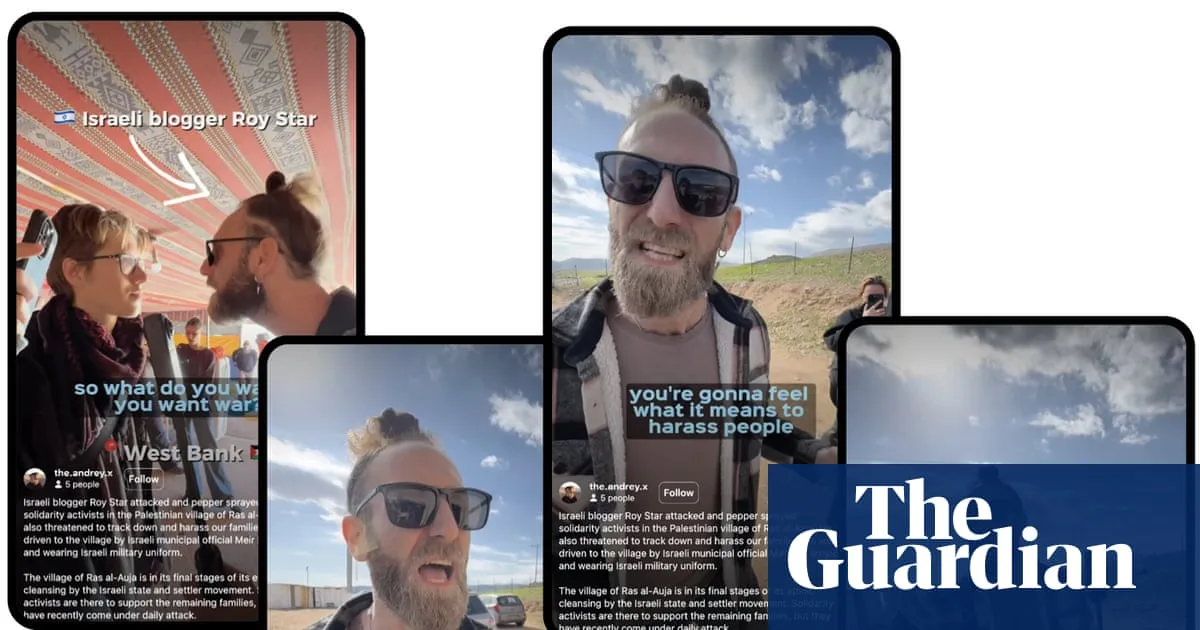
In one particularly egregious video posted by Star in January, he filmed himself entering a house used as a base by leftwing activists in Ras Ein al-Auja, located in the Jordan Valley. The footage shows Star pepper-spraying an activist who attempted to block his entry. The activists also recorded the confrontation, capturing Star yelling, "This is Judea, not fucking Palestine," and issuing threats against the activists and their families.
When contacted by the Guardian, Star defended his actions, claiming he had visited to "talk about peace" and asserting that Ras Ein al-Auja was Israeli public land, not Palestinian territory. He justified the use of pepper spray as minimal self-defense and dismissed his threats as mere acting, stating, "It's all acting... It was just the moment got heated up." Star further argued that it was his right as an Israeli citizen to walk in public areas of the West Bank, which he believes belongs to Israel.
Platform Response and Ongoing Challenges
TikTok confirmed the removal of Star's account, emphasizing that its community guidelines prohibit "the presence of violent and hateful individuals on our platform, including violent extremists, and do not allow praise or glorification of extremists." The platform also noted that it had taken down videos from other creators linked to Israeli far-right agitators, though specific details were not disclosed.
Despite TikTok's actions, Instagram continues to host numerous accounts associated with far-right Israeli agitators. Meta, the parent company of Instagram, has not responded to requests for comment on this matter. Professor Ben-David criticized the ambiguity of platform policies, noting, "While platform policies remain deliberately ambiguous on hate speech, they are explicit in prohibiting actions that threaten harm to individuals. Yet such content is routinely amplified without meaningful intervention."
Broader Implications and Activist Perspectives
Activist Andrey Khrzhanovskiy, who filmed one of the encounters with Star, remarked on the surreal nature of the conflict, saying, "This is not the first ethnic cleansing in history, but this is the first ethnic cleansing that you can watch live on TikTok. There is a certain irony in me denouncing this. Settlers film us, we film them – a parallel battle unfolding both on the ground and online."
Barak Cohen, an Israeli activist, warned of the dangerous mob dynamics fueled by such content, stating, "These far-right influencers have crossed a serious line. Violence against Palestinians feeds mob dynamics. The demand is for violence."
The use of social media to promote ultranationalist agendas is mirrored by actions from Israel's far-right politicians. For instance, National Security Minister Itamar Ben-Gvir faced condemnation last August after posting footage on X taunting imprisoned Palestinian leader Marwan Barghouti. Similarly, Knesset member Zvi Sukkot of the far-right Religious Zionist party was filmed in the West Bank denying settler violence, instead framing his actions as part of a fight against environmental terrorism.
Mohammad Hureini, a human rights activist from Masafer Yatta, where daily settler attacks occur, emphasized the profound psychological impact of these videos. "When people see this content, it heightens fear," he said, underscoring the real-world consequences of online hate speech and harassment.