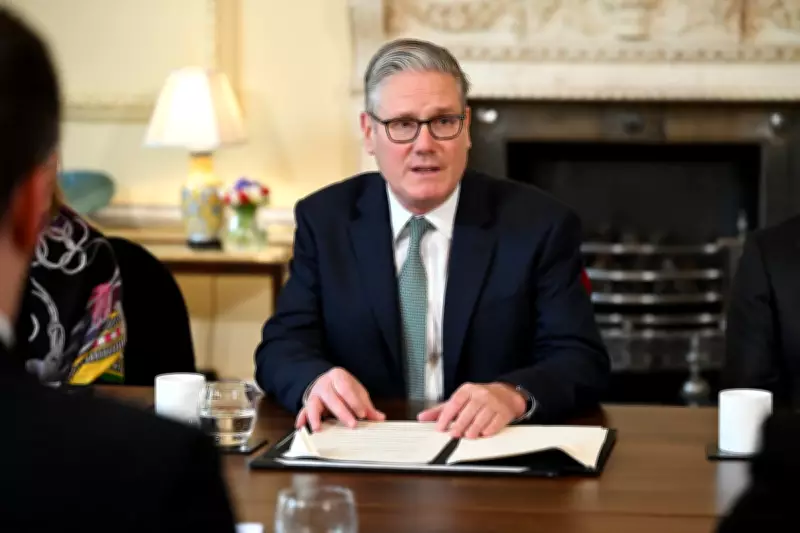
Prime Minister Sir Keir Starmer has issued a stark warning to the world's largest technology companies, declaring that the profound risks children face on social media platforms "can't go on like this" and must change immediately. In a high-stakes meeting at Downing Street on Thursday, senior executives from X, Meta, Snap, TikTok, and Google—which owns YouTube—were summoned to confront growing governmental pressure for enhanced protections for young users.
Urgent Call for Action Amid Mounting Concerns
The gathering represents a critical juncture in the government's ongoing consultation regarding online child safety, which is examining potential measures including an Australia-style social media ban for individuals under sixteen years old. Additional proposals under consideration involve imposing strict limits on addictive platform features and implementing stronger regulatory controls on artificial intelligence chatbots that interact with minors.
Prime Minister's Firm Stance on Restricting Access
Sir Keir Starmer articulated a clear vision during the discussions, emphasising that safeguarding children must take precedence, even if it necessitates restricting their access to certain digital environments. "In a world where children are protected, even if that means access is restricted, that is preferable to a world where harm is the price of participation," the Prime Minister asserted. He further expressed his determination to collaborate with technology leaders to construct a safer digital future, stating, "I am determined we will build a better future for our children, and look forward to working with you on this."

High-Profile Attendees and Parliamentary Context
The meeting convened prominent figures including Wifredo Fernandez, X's director of global government affairs; Alistair Law, TikTok's director of public policy and government affairs for Northern Europe; Markus Reinisch, Meta's vice president for public policy in Europe; and Kate Alessi, vice president and managing director of Google UK and Ireland. This dialogue occurs against a backdrop of parliamentary tension, as Members of Parliament recently rejected a second attempt by the House of Lords to introduce an immediate social media ban for under-sixteens through the Children's Wellbeing and Schools Bill.
Government Consultation and International Precedents
Education Minister Olivia Bailey defended the government's comprehensive consultation process, which concludes on May 26, arguing it enables a broader examination of services and features than the "narrow amendment proposed in the House of Lords." Internationally, pressure is intensifying for the United Kingdom to emulate Australia's pioneering policy, enacted last December, which became the first national legislation to block under-sixteens from specific social media platforms. Other nations, including Spain and Greece, are actively pursuing similar regulatory frameworks.
Advocacy and Criticism from Affected Families
Andy Burrows, chief executive of the Molly Rose Foundation, urged the Prime Minister to "decisively commit to strengthening regulation to make unsafe and addictive design a thing of the past." Conversely, Ellen Roome, whose fourteen-year-old son Jools Sweeney died while attempting an online challenge, condemned the Downing Street meeting as a mere "stunt." She criticised technology companies for repeatedly hearing testimonies from bereaved parents without implementing substantive changes, alleging the gathering was designed to distract from the government's instruction to its MPs to vote against raising the age limit.
Future Regulatory Directions
While Sir Keir Starmer has historically exhibited reluctance towards endorsing an outright social media ban, he has signalled a willingness to enact measures targeting specific platform features, such as infinite scrolling, which are known to foster addictive usage patterns among young people. The Prime Minister concluded the meeting on an optimistic yet resolute note, affirming, "I do think this can be done. I think the question is not whether it is done, the question is how it is done."