Caribbean Democracy Suffers as Stabroek News and Newsday Fold Amid Social Media Shift
Two major Caribbean newspapers have ceased operations this year, dealing a significant blow to regional democracy as readers increasingly turn to social media and advertising revenue collapses. Guyana's Stabroek News printed its final edition on Sunday and halted online publication, while Trinidad and Tobago's Newsday stopped publishing both print and digital editions in January.
Shifting Reading Habits and Financial Pressures
Media owners cite changing reader preferences as the primary cause for these closures. "Everything is on social media now. Whatever happens today, you don't have to wait to get the papers tomorrow," said Carlon Augustus, a 32-year-old from Trinidad and Tobago who represents the demographic shift away from traditional print media.
Newspapers across the Caribbean have struggled to compete with influencers and social media platforms, mirroring global print media challenges. Grant Taylor, managing director of Daily News Limited which published Newsday, described a "perfect storm of challenges" including a 75% decline in print advertising over the past decade.

Loss to Democratic Discourse
The closures are particularly damaging because both newspapers were independently owned, offering diverse perspectives less susceptible to advertiser or political influence. "That is definitely a loss to the country, to our democracy, where particularly in this age of social media, credible professional media houses are needed more than ever," said Judy Raymond, Newsday's former editor-in-chief.
Kiran Maharaj, president and cofounder of the Media Institute of the Caribbean, warned that "you have now a narrowing of that" independent voice in the region's media landscape.
Legacy of Independent Journalism
Stabroek News, established in November 1986, became renowned for solid, independent journalism that set regional standards. The paper blossomed into a platform for free speech after years of authoritarian rule in Guyana, covering the groundbreaking 1992 general election that ushered in democracy.
"Its letters page provided perhaps the most open and democratic public forum in Guyana," wrote lawyer Christopher Ram in a recent essay. "Over time that column became something of an informal national meeting place where academics, trade unionists, political figures, public servants, businesspeople and ordinary citizens debated, as equals, matters of public importance."
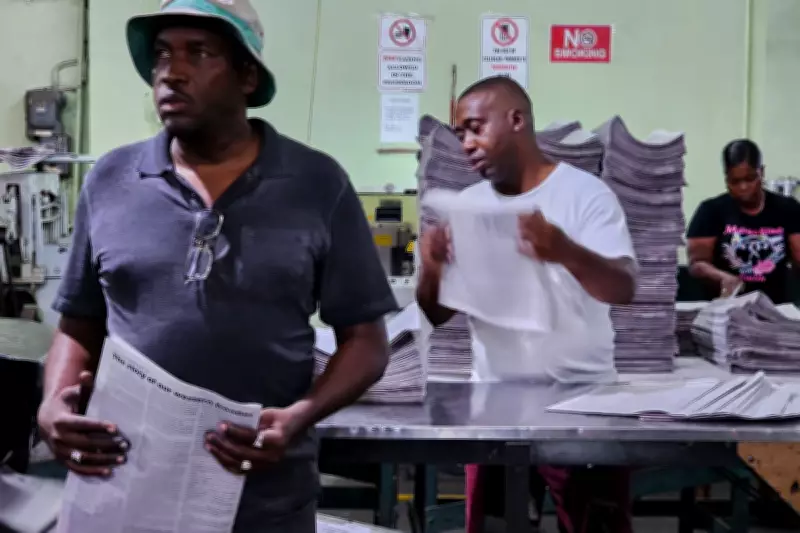
Newsday, which debuted in 1993, appealed to blue-collar workers and became a household name as journalists scooped other outlets and lawmakers referenced its articles in Parliament. The paper was particularly known for covering Tobago and amplifying voices of those struggling.
Financial Realities and Missed Opportunities
Stabroek News owners noted that while the government paid only $7.5 million toward a $90 million advertising debt, the primary reason for closure was changing readership patterns. "Readership patterns have changed dramatically, and fewer readers are willing to purchase printed editions — or even pay for electronic versions," the newspaper stated.
Raymond reflected that Newsday "could have worked harder at broadening the revenue stream from online publications" but questioned whether transforming into a digital-only outlet would have guaranteed survival, citing the closure of regional online news source Loop News last July.
Historical Context and Current Concerns
From the 1970s to mid-1990s, Caribbean newspapers enjoyed solid financial backing and served as status symbols. "People would be seen walking with a physical copy of newspapers," recalled journalist Wesley Gibbings, vice president of the Media Institute of the Caribbean. "It was almost a prestigious thing to be the one with the newspaper."
This changed as Big Tech platforms like Google attracted advertising revenue while mining mainstream media content. "The danger signs have been up for a very long time," Gibbings noted. "We are in a watershed period right now, and the crashes will continue."

The closures come at a particularly sensitive time for Guyana. In a published letter, Lurlene Nestor mourned Stabroek News' closure "especially during this period of Guyana's history, where allegations of massive public corruption are rife, coupled with a situation where the nation's important resources, such as gold and oil, appear to be either corruptly exploited or used as personal political bargaining chips."
Anand Persaud, Stabroek News' editor-in-chief, echoed these concerns while expressing pride in the paper's work: "We leave at this stage because we want to make sure our independence is not on the line."
Personal Impact and Future Implications
For longtime readers like Early Ward, a 76-year-old retired beverage company manager from Guyana, the closures represent a personal loss. "I have been reading newspapers since the 50s and prefer to have one in my hand to hold and to move around with and read anytime," he said, now relying on TV and social media for news.
With Stabroek News considered Guyana's top newspaper, the country now has three remaining papers: one state-owned, another closely linked to the ruling party, and a third recently beginning to ask web visitors about willingness to pay for online content.
The demise of these two independent voices raises serious questions about media diversity and democratic discourse in the Caribbean as the region navigates an increasingly digital information landscape dominated by social media platforms.