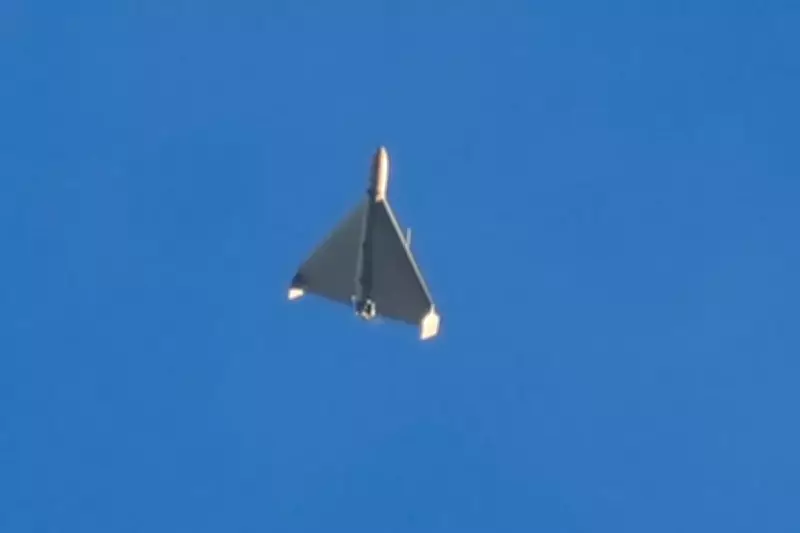
Iranian Drones Buzz Across Persian Gulf After Pivotal Role in Ukraine
The distinctive, low-pitched buzz of Iranian-designed drones has become an all-too-familiar sound over the battlefields of Ukraine for the past four years. Now, that same ominous hum is increasingly echoing across the skies of the Persian Gulf, as Tehran leverages these cheap but devastatingly effective weapons in retaliation for recent attacks by the United States and Israel.
The Shahed Drone: A Transformative Force in Modern Warfare
Shahed drones have fundamentally altered the landscape of contemporary conflict. Russia has deployed swarms of these lethal unmanned aerial vehicles on nightly missions over Ukraine, showcasing their ability to oversaturate and overwhelm sophisticated air defense systems. While ballistic and cruise missiles deliver greater speed and explosive power, they come with a multi-million-dollar price tag and are available only in limited quantities. In stark contrast, a single Shahed drone costs a mere tens of thousands of dollars—a tiny fraction of the cost of a traditional missile.
This affordability allows for their deployment in vast numbers, enabling forces to inflict significant damage at a remarkably low cost. The war in Ukraine has evolved into a gruelling war of attrition, increasingly dominated by drone technology. Both sides now rely heavily on longer-range drones to strike deep into enemy territory, supplementing the decisive role played by smaller tactical drones on the front lines.

Russian Adaptation and Escalation
Early in the conflict, Russia struck a deal with Tehran to import Shahed drones—"Shahed" meaning "witness" in Farsi—and swiftly moved to localize their production. Russian engineers have since enhanced the design, increasing its operational altitude, improving its resistance to electronic jamming, and fitting it with more powerful warheads. The Russian-produced replica, dubbed "Geran" or "geranium," is now manufactured at a plant in Tatarstan, which has exponentially increased output.
This scaled production has allowed Russia to launch attacks involving hundreds of drones in a single night—a volume that surpasses the total used during some entire months in 2024. By deploying these drones in massive swarms, Moscow aims to overwhelm Ukrainian air defenses, distracting them from more expensive and potent cruise and ballistic missiles often used in tandem to strike high-value targets.
Despite a relatively slow cruising speed of 180 kph (just over 110 mph), the Shahed boasts an impressive range of up to 2,000 kilometers (1,240 miles) and can carry a 40-kilogram (88-pound) explosive payload. Ukrainian forces, familiar with their distinctive acoustic signature, have nicknamed them "mopeds." In response, Ukraine has deployed mobile teams armed with machine guns as a cost-effective countermeasure, developed interceptor drones, and worked to ramp up domestic production, though the relentless scale of Russian attacks continues to strain defenses.
Retaliation in the Persian Gulf and Beyond
Following weekend attacks by the U.S. and Israel, Iran has launched retaliatory strikes against Israel and unleashed a barrage of hundreds of missiles and drones on targets across Saudi Arabia, Bahrain, Kuwait, Qatar, and the United Arab Emirates. These targets have included U.S. military bases, critical infrastructure such as ports and airports, oil facilities and tankers, and even high-rise buildings.
Officials in Dubai reported that over two days, air defenses engaged 165 ballistic missiles, two cruise missiles, and more than 540 Iranian drones. While authorities claimed to have intercepted all aerial threats on Saturday, falling debris from destroyed weapons ignited fires at several of Dubai's most iconic locations. The reach of these drones extended as far as a U.K. military base in Cyprus, where the runway at RAF Akrotiri was struck on Sunday, with sirens sounding again on Monday as two more inbound drones were intercepted.
State-of-the-art U.S. and Israeli air defense systems have proven effective against most ballistic missile threats. However, the use of large numbers of inexpensive drones has successfully struck softer targets lacking equivalent protection, highlighting a critical vulnerability.

Expert Analysis on the Drone Warfare Revolution
Patrick Bury, a professor of security issues at the University of Bath, emphasized that drones have revolutionized warfare by combining "persistent surveillance and high-precision strike" capabilities with advanced targeting systems and artificial intelligence. He noted the Shahed's logistical advantage, being easily concealable in the back of a truck.
"What's taken people by surprise... is the ferocity and the scale with which Iran has retaliated this time," Bury told The Associated Press, comparing the response to earlier incidents in June 2025. "What the U.S. and the Israelis are hoping, I think, and calculating, is that they can degrade that enough to basically then take some of the steam out."
Many observers argue that the U.S. and its allies should urgently incorporate defensive lessons learned from Ukraine's experience countering Russian drone swarms. Dara Massicot, a senior fellow at the Carnegie Endowment, underscored this point, stating on social media, "Our military must do more ASAP to institutionalize defensive lessons from Ukraine."
Jill Lawless in London contributed to this report.