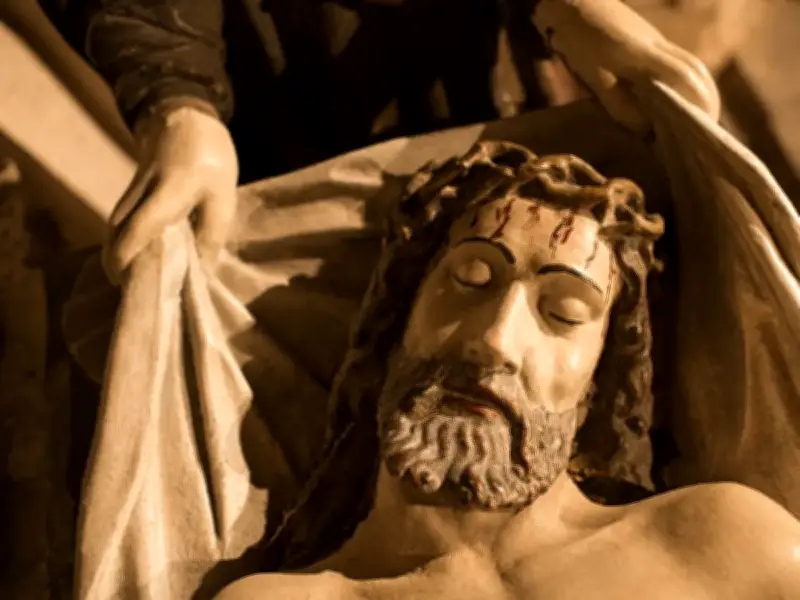
A new 3D simulation has deepened the mystery of the Shroud of Turin, suggesting the famous cloth's image would look markedly different if it had truly been wrapped around a human body. The findings have fueled claims that the Shroud may be an artwork rather than a genuine burial cloth.
The Shroud, kept in Turin, Italy, and believed by many Christians to have covered Jesus Christ after the crucifixion, has divided scientists, historians and believers for centuries.
Study Adds New Perspective
A study published in the journal Archaeometry by Brazilian 3D designer and forensics expert Cicero Moraes adds a fresh layer to the debate. The study argues that the markings behave more like an intentional reproduction than the result of a corpse laid beneath linen.
Moraes created a 3D digital simulation to see what kind of imprint fabric would produce when wrapped over a realistic human form and then laid flat.
Simulation Reveals Distortion
His findings suggest that if the Shroud had been in full contact with a real body, the resulting image would be far more robust and noticeably distorted than the crisp, flat, photograph-like face seen on the artefact.
The issue is the way cloth behaves over a three-dimensional object, as reported by Phys.Org. In Moraes' simulation, features such as the nose and the sides of the face spread outward once the fabric is flattened, producing a widened, mask-like distortion rather than a neatly proportioned visage.
The study says this is what you would expect from a genuine wrap over a human head and body, and that it does not match the Shroud's strikingly even contours.
Bas-Relief Test Offers Alternative
Moraes wrote: "The contact pattern generated by the low-relief model is more compatible with the Shroud's image, showing less anatomical distortion and greater fidelity to the observed contours, while the projection of a 3D body results in a significantly distorted image."
To explore how a cleaner-looking image might be produced, Moraes tested a different approach, pressing fabric over a bas-relief, a shallow sculpture rather than a fully three-dimensional body. That method, he says, successfully recreated a more uniform, non-deformed image, closer to what appears on the Shroud.
Based on the results, Moraes concluded the cloth is highly unlikely to have ever lain atop a human corpse at all, and that the image behaves more like an artistic transfer created using a low-profile carved form.
Moraes also encouraged others to replicate the work using the same free and accessible software, saying: "This work not only offers another perspective on the origin of the Shroud of Turin's image but also highlights the potential of digital technologies to address or unravel historical mysteries, intertwining science, art, and technology in a collaborative and reflective search for answers."