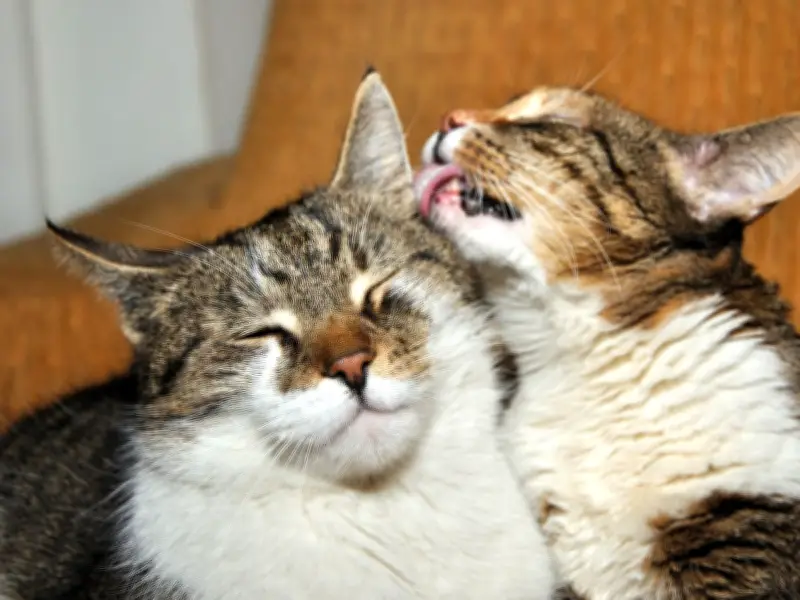
Cat owners often melt at the sight of two feline companions grooming each other, assuming it's a clear sign of friendship and affection. But researchers now believe those seemingly sweet moments may sometimes have a far more calculated purpose.
Grooming as a Covert Signal
A new study suggests that while cats do groom one another to strengthen social bonds and help with hygiene, the behaviour can also be used to quietly pressure a rival into giving up a prized resting place or avoiding a confrontation altogether.
According to The Times, the research began after Morgane Van Belle, an animal behaviour researcher at Ghent University in Belgium, noticed an unusual pattern between her own two cats. Whenever one cat settled into a favourite sunny spot, the other would approach and begin grooming him. The licking continued until the resting cat eventually became irritated and moved away, allowing the other to take over the space without a fight.
Study of 106 Cats
Intrigued, Van Belle and her colleagues investigated whether this type of behaviour was more common than people realised. Their findings, published in the journal Applied Animal Behaviour Science, were based on videos of 106 cats living in pairs across 53 households. Owners were asked to film everyday interactions, with researchers examining 23 different behavioural cues, including posture, movement, ear position and physical contact.
The team found that cats most often groomed areas their companion would struggle to clean alone, particularly the head, neck and ears. This suggests grooming can serve a practical purpose by helping another cat keep hard-to-reach areas clean.
Body Language Reveals Intent
However, the cats' body language revealed important differences between friendly and more tense encounters. When grooming was genuinely social, the cats typically sat or lay close together, often touching and mirroring each other's posture. They frequently stayed cuddled together afterwards, with some even falling asleep side by side or moving into playful wrestling.
In less harmonious interactions, though, one cat often stood over the other while the recipient showed signs of discomfort, such as flattening its ears, shaking its head, licking its lips, swiping, biting or attempting to walk away.
Subtle Conflict Resolution
The researchers concluded that grooming can sometimes be used as "a subtle agonistic signal to covertly solve conflict", allowing cats to gain an advantage without resorting to an outright fight. Van Belle said the findings highlight how much there is still to learn about feline behaviour. "Cat research is about 20 years behind dog research," she said, adding: "There are still a lot of questions to be answered."
She believes this behaviour should not be viewed negatively, arguing it demonstrates cats' intelligence rather than bad manners. "For me, it shows that they are quite elegant in the way they resolve conflict," she said. "They could walk over and swat another cat in the face to get the blanket it is lying on. Instead, they lick it a little and fuss around. They have these very subtle ways of resolving conflict. To me, that shows they are intelligent and flexible in their behaviour, rather than simply being jerks."