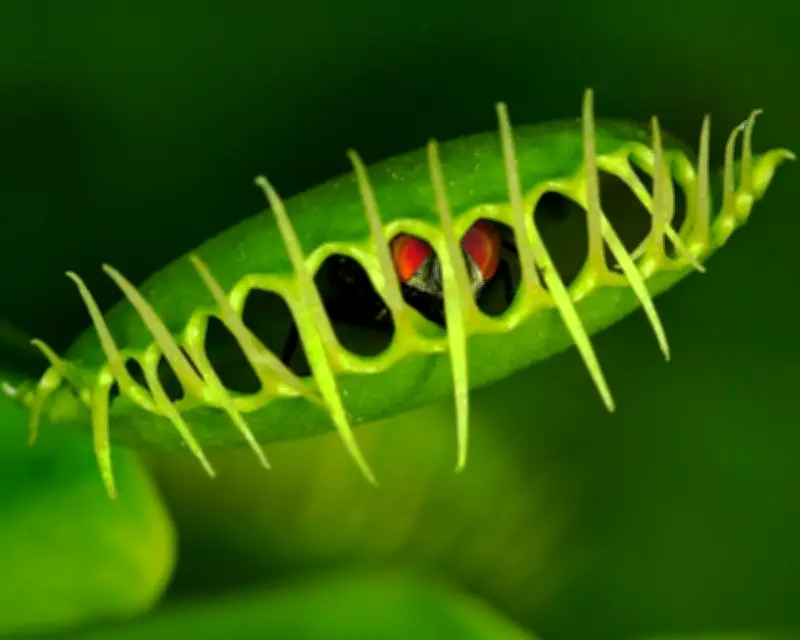
Scientists have uncovered the mechanism behind the Venus flytrap's lightning-fast snap, solving a mystery that puzzled Charles Darwin and generations of researchers.
Rapid Response Without Muscles or Nerves
In a series of intricate experiments, researchers found that hair-trigger detection causes cells on the outer surface of the leaf to soften, prompting the trap to close within a second of an insect landing. 'It's very surprising that plant cell walls can tune their mechanical properties so fast,' said Dr. Yoël Forterre, a physicist at the French National Centre for Scientific Research (CNRS) and Aix-Marseille University and senior author of the study.
Forterre noted that Darwin, observing the plant's rapid movement, believed it must have muscles, but plants lack both muscles and nerves. 'For more than a century there have been many hypotheses,' Forterre added.
Challenges in Measurement
A key challenge was making physical measurements of such a finely tuned system. 'As soon as you perturb it, it closes,' Forterre explained. The team carefully immobilised the leaves using dental glue, allowing the trap to be triggered while remaining stationary. Venus flytraps typically have three trigger hairs on each lobe; bending these hairs generates an electrical signal that spreads across both sides of the trap within one-tenth of a second.
Using a device called a nanoindenter, the researchers poked the outer surface of the leaf to measure its pressure. This revealed that the leaf's outer surface softened immediately after activation. Measurements of the leaf's topology showed that the softening resulted from cells becoming more flexible, not from water movement deflating them—the previously leading hypothesis. The mechanism resembles a dome-shaped rubber popper toy spontaneously flipping when placed on a surface.
Implications and Future Research
'I'm not aware of any other plants with this kind of very rapid change of mechanical properties of the cells,' Forterre said. He became intrigued by Venus flytraps 20 years ago when a colleague brought one into the lab. 'As a physicist, I thought we should understand the motor, the forces,' he recalled. 'I've been obsessed by this for 20 years.'
Forterre added, 'Plants are just amazing. It makes you realise how all plants can sense their surroundings, transport information, react, defend themselves, feed.' The findings are published in the journal Science.