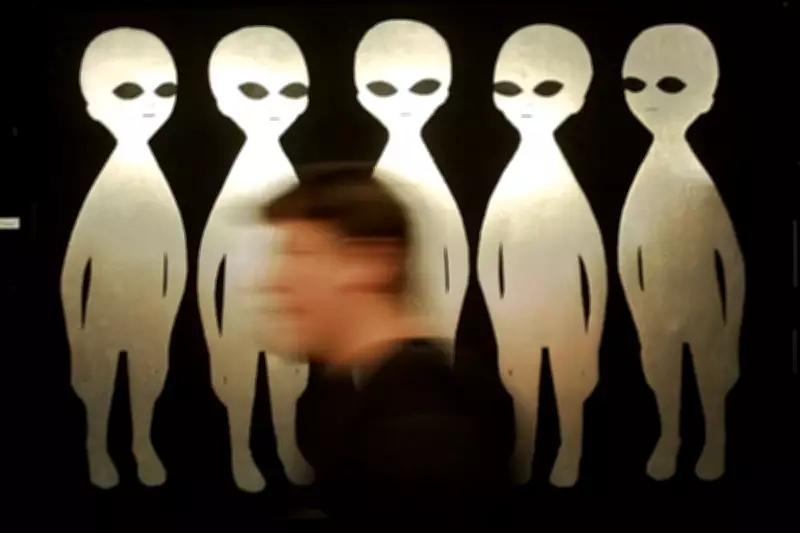
Trump Orders UFO Data Release: What Would Aliens Think of Humanity?
For generations, humanity has pondered the nature of alien life from distant planets. However, a rarely asked question now hangs in the air: If extraterrestrial beings exist, what would they think of us? This profound inquiry has gained renewed urgency following former President Donald Trump's announcement that he is directing the release of government UFO files due to "tremendous interest." The debate escalated earlier this year when former President Barack Obama stated that aliens are "real," though he clarified he "hasn't seen them" and "they're not being kept at Area 51."
Humanity Through Alien Eyes: A Disappointing Spectacle?
Theoretical physicist Avi Loeb offers a stark perspective: "If I were looking at Earth from a distance, I would be pretty disappointed. Most of our investing is dealing with conflicts to prevent other people from killing us or us killing others. Look at the Ukraine war over a little bit of territory. That is not a sign of intelligence." In a world riven by war, civil unrest, climate change, and divisiveness, it's easy to wonder what newcomers to Planet Earth might make of our struggles. Priscilla Wald, who teaches about science fiction at Duke University, suggests that popular culture often portrays aliens as aggressive because "it's a reflection on who we are, that we're projecting onto aliens the way we treat each other."
Public Fascination and Scientific Search
American fascination with extraterrestrial life dates back to the 1947 Roswell incident, where military officials initially claimed recovered debris was from a flying disc before reversing course to say it was a weather balloon. A 2021 Pew Research Center survey shows about two-thirds of Americans believe intelligent life exists on other planets, with half saying UFO reports from the military are "definitely" or "probably" evidence of such life. Bill Diamond, president of the SETI Institute, notes: "We don't want to think this is the only place in this extraordinarily and incomprehensibly large universe where life and intelligence and even technology have emerged. It sort of says about humans, 'We don't want to be alone.'"

Government Secrecy and National Security Concerns
Much government secrecy around UFOs and UAP (unidentified aerial phenomena) is tied to national security, according to Diamond. "We have pretty advanced technologies for various purposes, mostly national security and defense, that are pointing at the sky," he explains. "Sometimes these pick up objects. The technology behind it is sensitive and protected." Retired Rear Adm. Timothy Gallaudet, who participated in a 2024 congressional hearing on UAP disclosure, emphasizes that evidence shows UAP are "zipping around the airspace and in the oceans," with "nonhuman intelligence that operates them or controls them" being "absolutely real." He argues that government data, including a "trove" of UAP video held by the Navy, should be shared with scientists for research.
Personal Encounters and Unexplained Phenomena
Debbie Dmytro, a 56-year-old medical professional from Michigan, describes two separate sightings. In March, she saw a greenish object over Royal Oak that resembled neither plane nor helicopter. In 2023, she observed "four yellow lights, yellowish golden lights flying very, very low" about 100 feet up, moving in complete uniformity without noise. "Is it something man-made? Is it something that's not manmade? Who knows?" she wonders. Like many, Dmytro wants transparency: "I think there's more information out there. I'm open to learning more. I have an open mind. It's always about scientific proof."
The Scientific Perspective on Extraterrestrial Visitation
University of Michigan Astronomy Professor Edwin Bergin believes the likelihood of life developing elsewhere is high given billions of galaxies with billions of stars each. He suggests that if intelligent beings traveled vast distances to Earth, they would make themselves known despite humanity's chaos: "I would think that they would look at us like we were crazy... but they would come out. I mean, why come here otherwise unless you're going to sit and observe." Loeb adds that aliens "might be laughing at us" or "watching us... to make sure we will not become predators, that we will not become dangerous to them."

The Path Forward: Disclosure and Understanding
Gallaudet questions government secrecy: "When has ignorance ever been a good national strategy? Whether it be scary, harmful or not, or a mix, I think seeking the truth is in our best interest." He notes concerns about UAP having near collisions with aircraft, stating, "We are just not sure of what they are and what they intend to do with their interaction with humanity. That could be a national security threat, or not." Meanwhile, Diamond doubts any "true alien encounter could be kept secret," arguing that a civilization mastering interstellar travel would have technology beyond our comprehension, choosing whether to interact or remain hidden.
As the United States advances in space exploration with NASA's Artemis II mission launching astronauts around the moon, and with Trump's promised data release, the question of alien perspective remains poignant. Well over a majority of Americans echo the sentiment from "The X-Files": "The truth is out there." Whether that truth reveals cosmic neighbors observing our planetary drama with curiosity, concern, or contempt, the search continues to captivate the human imagination.