When Charlotte Lytton spotted her future home on Rightmove last year, she and her family nicknamed it “the funny blue house”. The shade, which defied description but was certainly eye-catching, was a quirk they thought was a terrible decision made long ago. It was a source of mirth for friends and neighbours.
When a relative staying with them over the summer offered to repaint it, they were suddenly faced with a conundrum: which colour to choose. Green was the first shade that sprang to mind. But after wandering through her east London neighbourhood looking for olive-based inspiration and finding none, she sought out a place where her idea would be championed: ChatGPT.
From AI refusenik to reluctant adopter
Lytton had gone from AI refusenik to reluctant adopter a few months earlier, while renovating her new house. Unable to afford an interior designer and needing to make a multitude of decisions each day, she turned to the chatbots. They did nothing for design inspiration or product sourcing. When she asked for suitable furnishings to match her walls and carpets, she was served a stream of hideous products and the words “Scandi cool” and “mid-century chic” on loop. Trying to find ideas for a headboard produced the same items she had found when googling. When she toyed with suggestions for lampshades, she was given an infinite list of options that failed to narrow things down. No matter the prompts she gave on colour, texture and price, no chatbot-generated results were of any use.
The visualisation apps, like IdealHouse and Homevisualizer AI, fared somewhat better. Granted, very few actually worked. But on the occasions they did manage to generate an image, being able to drag and drop the bedside tables she’d been eyeing up into a picture of her new loft bedroom was quite useful for thinking about which colours would work. Some stores, such as Ikea and DFS, offer visualisation tools where you can drag and drop furniture into a room; John Lewis provides renderings if you book an appointment with its Home Design team.
The funny blue house gets a makeover
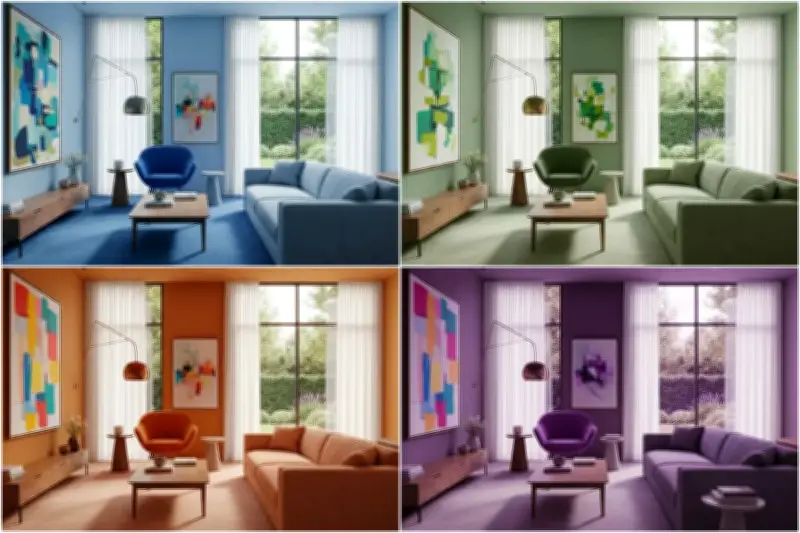
After poring over numerous colour charts, Lytton started running them through ChatGPT (which rarely managed to render an image) and Google Gemini, watching the exterior of her house reimagined in Farrow & Ball’s Bancha, Olive and Ball Green. The first — a mid-century inspired cross between a pea and an olive — was an easy winner. Yet there was one other problem: when she asked to see the house in that same shade on different occasions, each image was completely different from the last.
So back analogue she went, traipsing off to B&Q for an armful of testers. They looked nothing like any of the AI images she’d been given, prompting a crisis of confidence. With days to go before an event at home and the relative returning to the other side of the world, all they could do was pick their green — a far bolder shade than they’d initially imagined — and cross their fingers.
Free advice, costly mistake
“AI is brilliant at giving you 20 different ideas. It is less good at knowing which idea is the right one,” says Catherine Seagrave, design director and co-founder of online interiors agency the Living House. “It can help you get unstuck, find the words to describe your style and explore different directions. But it can also present a bad idea very confidently.”
Given the house was already a hideous shade and the offer of free labour was time-sensitive, they were perhaps more willing than most to bite the bullet. They are reasonably happy with the end result, although it certainly looks nothing like any of the renders. “But free advice can still lead to an expensive mistake,” says Seagrave. “Check every measurement, order samples and test colours. I would happily use AI for inspiration, but I wouldn’t let it make an expensive or permanent decision.”
Given the cost of hiring interior designers (as much as £450 per hour, according to London-based KDS Interiors) and the general lack of showrooms in which to see design ideas made flesh, it’s unsurprising that so many are turning to tech for help. Research published last month by furniture retailers Barker and Stonehouse found that some 61 per cent of UK adults have used AI for interior design inspiration, rising to 88 per cent among 25- to 34-year-olds.
Given how fallible this technology is, however, mistakes are inevitable. “One of our clients asked AI for a bathroom paint colour,” Seagrave says. “It missed the lilac undertone in her tiles and suggested an orange peach that completely clashed.” It also fails to understand the liveability of a place. AI “can make a room look beautiful on a screen. However an interior designer has to actually make it work in real life — on a wet Wednesday morning, with children, pets, schoolbags... AI can recommend a sofa but it doesn’t know whether it will fit through the front door, overwhelm the room or survive family life.”
The frequent mishaps caused by using this technology make it hard to imagine that chatbots will render IRL experts obsolete anytime soon. “AI isn’t going to replace good interior designers,” Seagrave thinks. At best, “it may replace a few hours of scrolling through Pinterest”.