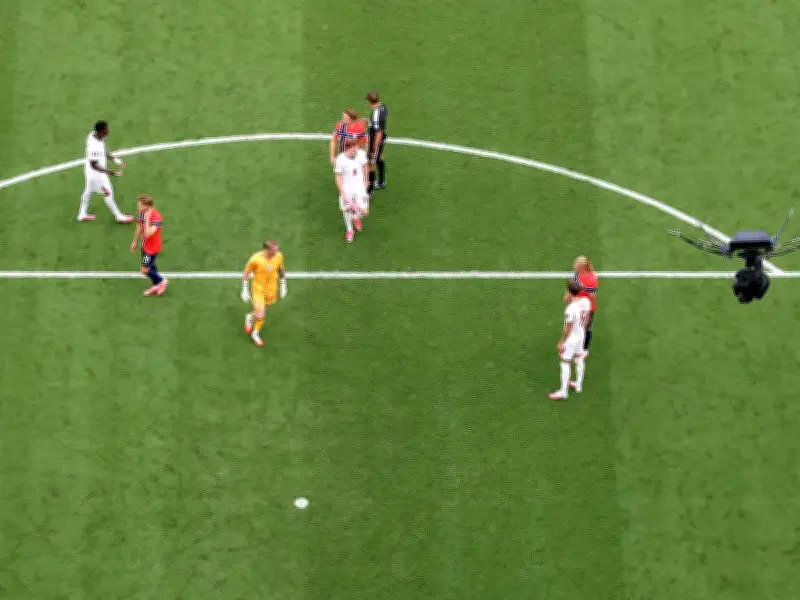
FIFA has concluded that Jude Bellingham's opening goal for England against Norway was correctly awarded, after reviewing fresh evidence including spidercam footage and ball sensor data. The controversy arose when Norway players claimed the ball struck a spidercam cable during the build-up, which would have required play to be stopped.
Incident Details
The goal came in first-half stoppage time when Norway goalkeeper Orjan Nyland launched a long goal kick. The ball was collected by Elliot Anderson, who set up Anthony Gordon to tee up Bellingham for the finish. Norwegian players immediately protested that the ball had clipped one of the spidercam support wires while in flight.
FIFA Investigation
FIFA analysed multiple camera angles, including footage from the spidercam itself, which showed no visible movement or vibration consistent with contact. Side-on footage revealed the ball followed a natural flight path, contrary to claims of a sharp drop. Colour-enhanced images also showed the ball did not come close enough to the cables to make contact.
Connected ball technology, which uses a sensor inside the match ball, recorded only three touches during the sequence: Nyland's goal kick, Anderson's touch, and the ball bouncing on the pitch. FIFA stated there was no additional impact registered while the ball was in the air and no change in rotation, both expected if the ball had struck a wire.
Norway's Reaction
Norway remained unconvinced after the match. Midfielder Sander Berge described the decision as "ridiculous," saying the incident proved decisive in a closely fought contest. Manager Stale Solbakken said several coaching staff believed the ball had hit the wire: "He [the referee] says he didn't see it himself and didn't receive any message that it happened. If FIFA says there was no touch and there was no signal from the chip in the ball, then he can't do anything about it. The ball fell straight down in front of our bench and everyone thought it had touched the wire. It was a strange incident."
FIFA Statement
FIFA reiterated that the connected ball technology detected no contact. A statement said: "Before England's goal in minute 45+2 against Norway, the sensor in the connected ball showed no peak in the heartbeat of the ball while it was in the air and therefore no evidence that the ball touched the overhead wire and changed its movement." The technology, developed for the World Cup, continuously monitors the ball's movement, speed, trajectory, and player touches, sending live data to the video assistant referee system to aid decision-making.
The governing body has faced scrutiny over several tournament decisions, but this evidence appears to close the debate over one of England's most controversial moments.