Trump's Olympic Hockey Final Appearance Cancelled Amid Supreme Court Battle
Donald Trump's proposed plan to attend the Winter Olympics men's hockey final has reportedly collapsed just twenty-four hours before the highly anticipated showdown event. The United States is scheduled to compete against fierce rival Canada in what was expected to be a tense and blockbuster final between the two nations, marking one of the concluding events of the 2026 Winter Olympics on Sunday.
Last-Minute Cancellation and Domestic Priorities
Speculation had been mounting that the US president, who previously stoked the flames of the heated hockey rivalry during last year's 4 Nations: Face-Off tournament, might travel to Milan to support Team USA. However, according to reports from The Express, the Commander-in-Chief has executed a sudden U-turn on his Olympic plans amidst an ongoing battle with the US Supreme Court.
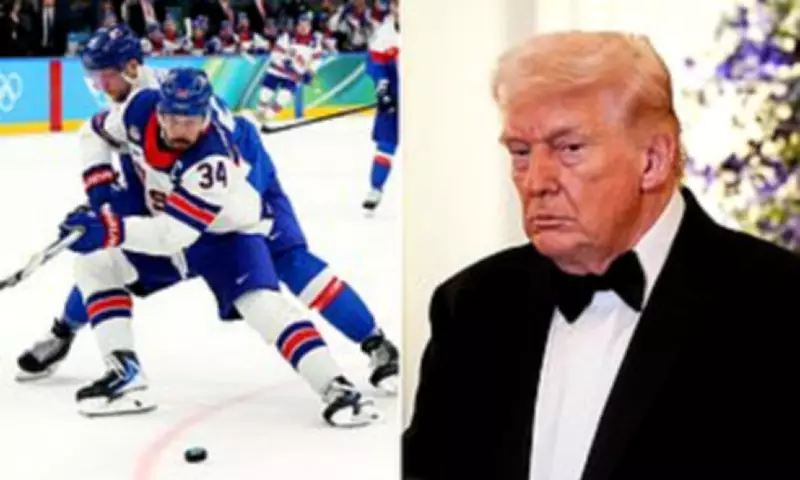
Trump will now remain at the White House on Sunday, with scheduled meetings at 8:00am and 12:00pm Eastern Time directly conflicting with the final match at the Santa Giulia Arena in the Italian capital. Security preparations for the meticulously orchestrated trip had allegedly already commenced, and Air Force One was said to be on standby following the Americans' dominant 6-2 semifinal victory over Slovakia, which secured their place in the gold-medal match.

Supreme Court Conflict and Historic Tariffs
Domestic political affairs have taken precedence, compelling the president to stay stateside as he continues to rail against the Supreme Court. The high court dramatically struck down his 'liberation day' reciprocal levies on Friday, ruling them unconstitutional. Infuriated by this decision, Trump ordered an immediate 10 percent tariff on all imports on Friday.
Subsequently, on Saturday, he escalated the worldwide tariffs to 15 percent—the maximum permissible—under a previously unused trade law. This new tariff is being implemented under Section 122 of the 1974 Trade Act, which authorizes the president to increase levies up to a maximum of 15 percent. This marks a historic moment for the Trump administration, as this provision has never been imposed before. The law permits him to enforce the levy for 150 days, although it may encounter legal challenges.
Rivalry and Political Tensions at the Olympics
Meanwhile, Sunday's gold medal hockey game between American and Canadian rivals is expected to starkly contrast with the spirit of friendship and political neutrality advocated in the Olympic Charter. Beyond Trump's ongoing trade war with Canada and his expressed desire to annex the country as America's 51st state, Team USA's Brady Tkachuk told ESPN that 'there's hatred' between the two teams.
'For us, we want to be in that position, be the best,' the Ottawa Senators star explained to ESPN. 'So it's going to be a game where I think a lot of guys could say, this is the biggest game that they've ever played in.' The United States has not defeated Canada in a gold medal game since the 1996 World Cup of Hockey, where New York Rangers goalie Mike Richter earned tournament MVP honors for stifling a Canadian attack featuring legends like Wayne Gretzky, Mark Messier, and Eric Lindros.
Athlete Protests and Political Backlash
Had it proceeded, Trump's proposed Olympic appearance would have raised eyebrows given the public criticism directed at the president by a faction of Team USA's athletes at the Games. Several competitors have utilized the Winter Olympics platform to protest against Trump and various issues currently dividing America.
Team USA freestyle skiers Hunter Hess and Chris Lillis, along with ice skater Amber Glenn and curler Rich Ruohonen, have all voiced concerns about escalating problems in the US over the past fortnight. Last week, Vice President JD Vance advised athletes to focus on sport and avoid 'popping off about politics' after multiple US athletes in Italy spoke out.
'Yes, you're going to have some Olympic athletes who pop off about politics. I feel like that happens every Olympics,' Vance stated. 'My advice to them would be to try to bring the country together, and when you're representing the country, you're representing Democrats and Republicans.'

He added, 'You're there to play a sport, and you're there to represent your country and hopefully win a medal. You're not there to pop off about politics. When Olympic athletes enter the political arena, they should expect some pushback. But most Olympic athletes, whatever their politics, are doing a great job, certainly enjoy the support of the entire country, and I think recognize that the way to bring the country together is not to show up in a foreign country and attack the President of the United States, but it's to play your sport and to represent the country well.'