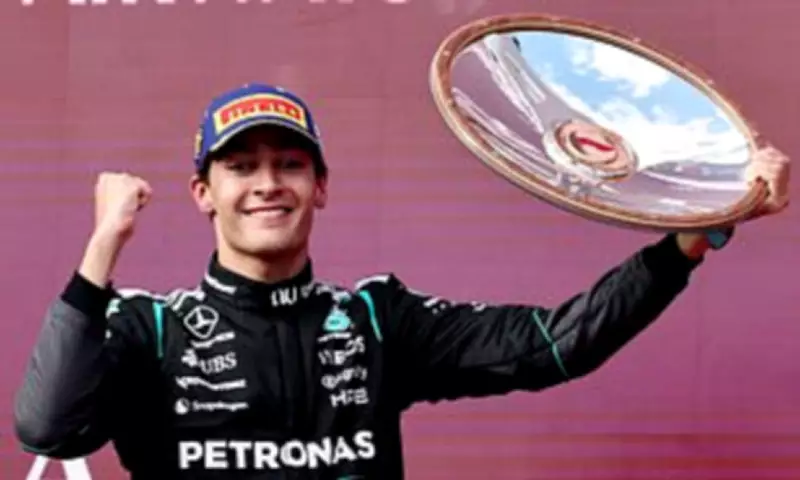
George Russell Secures Dramatic Australian Grand Prix Victory
George Russell masterfully navigated a tumultuous opening phase of the Australian Grand Prix to seize a commanding victory, perfectly launching his world championship campaign in Melbourne. The British driver, starting from pole position, engaged in an intense early duel with Ferrari's Charles Leclerc, with the lead changing hands six times within the first nine laps.
Ferrari's Strategic Misstep Proves Costly
However, the race turned decisively when Ferrari's pit wall strategy faltered during a virtual safety car period. This was triggered after Isack Hadjar's Red Bull emitted a plume of smoke. Russell was called into the pits by Mercedes for fresh tyres one lap after his teammate, rookie Kimi Antonelli.
This proved to be the race-defining move. The Ferrari duo of Leclerc and Lewis Hamilton, who were running first and third in a closely fought battle, opted to remain on track. Hamilton later lamented over team radio, stating, 'At least one of us should have come in.'

By the time Hamilton eventually pitted on lap 29, Russell had already assumed the lead, passing Leclerc who had stopped earlier. From there, the Mercedes driver dominated, building a substantial gap to confirm his status as the early title favourite.
Mercedes Celebrates a Perfect Day Under New Regulations
The result marked a stellar day for Mercedes, with Antonelli securing second place on his debut for the team. Leclerc finished a distant third, twenty seconds behind, with Hamilton in fourth. The race was the first under major new technical regulations, featuring a radically remodelled power unit.
Power is now derived almost equally from an internal combustion engine and electric propulsion, managed via a battery that requires strategic recharging each lap. Drivers can harvest energy through braking, running high revs in corners, and lifting off the throttle.
The new rules created thrilling early battles, as Russell, Leclerc, and Hamilton deployed stored energy for overtaking manoeuvres. Using this 'overtake mode' depletes energy reserves, leaving a driver vulnerable to a counter-attack, which explained the frequent lead changes.
Mixed Fortunes Across the Grid
While the action was compelling, it was not the chaotic spectacle some predicted. The race saw three retirements: Hadjar, Valtteri Bottas of Cadillac, and Fernando Alonso of Aston Martin. Local favourite Oscar Piastri crashed on his way to the grid, disappointing the 137,869-strong crowd.
Aston Martin endured a disastrous weekend. Beyond Alonso's retirement, Lance Stroll finished 15 laps down, a barely credible performance for the big-spending team. Nico Hulkenberg's Audi also failed to start.
Russell's dominance was absolute; he lapped all but the top six finishers. The leading quartet of teams—Mercedes, Ferrari, McLaren, and Red Bull—appeared in a class of their own, highlighting a concerning performance gap to the rest of the field.
Promising Debuts for British Rookies
There were positive notes for British talent, with rookie Arvid Lindblad finishing an impressive eighth on his debut for Racing Bulls. His compatriot Ollie Bearman placed one position higher, taking seventh for Haas.
Ultimately, the day belonged to George Russell. As 'God Save the King' played, he punched the air with a broad smile, a clear signal of his belief that he is now the driver to beat in this new era of Formula 1.