As I wait for my first Cuban salsa class to begin, I have the distinct feeling that I am poorly prepared. I’m wearing heavy jeans, a bulky woollen sweater and boots. I have never done a dance class in my life – or any kind of exercise class. I don’t know anything about salsa, Cuban or otherwise. Standing alone, I notice that everyone has come with at least one friend, and begin to suspect that it takes two to Cuban salsa. There’s no time to find out – the class is starting.
A Weekend of Dance at Rising Festival
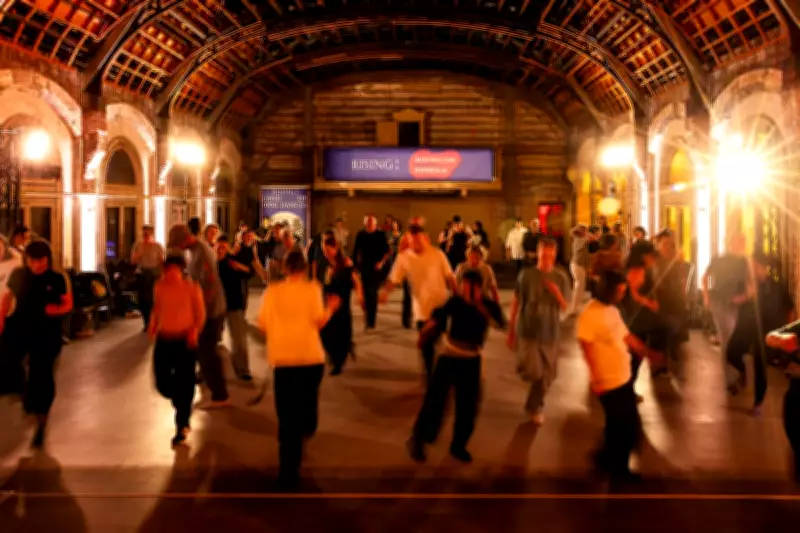
This year, Rising festival – Melbourne’s winter arts offering – has consolidated its longstanding dance focus into a mini-festival: the inaugural Australian Dance Biennale, showcasing Australian and international work. There’s also a series of dance classes, romantically titled The Land of 1000 Dances, held in the romantically decrepit Flinders Street Ballroom. Running daily until 7 June, with classes costing $29 a pop, the diverse schedule includes Afro-fusion, ballroom, voguing, waltz and K-pop for teens and tweens.
As an audience member, I am an avid appreciator of dance; as a participant, I can most kindly be described as “curious” but uncoordinated. What if I went to a bunch of dance classes and then wrote about it?

First Class: Cuban Salsa
Precisely 24 hours before my first class, the misgivings begin – doing my first dance class while dressed for the show I’m seeing directly afterwards sounds like a bad idea. At the ballroom, I am briefly reassured: the crowd is a diverse mix of ages, genders and bodies, and hardly anyone is wearing dance-appropriate clothing.
But the class itself is a blur – sometimes literally – as I try to learn and enact the cucaracha, the guapo and other basic Cuban salsa moves; attempt to locate the beat, my hips, any sense of coordination at all. Every time I feel as though I’m starting to get the hang of something, the instructor adds a new step. Then he corrals us into pairs – and a series of new moves, yelling “change partners!” every three minutes.
Going solo, it turns out, is fine: everyone is friendly; many seem as unsure as I am. Some are nailing it but there’s a sense of camaraderie: we’re all in this together. That said, we’re all a bit too sweaty to be holding each other.
I move from absolute befuddlement, through occasional moments of triumph, to a sense of quiet despair. A move that involves a 360-degree rotation to an eight-count almost breaks my spirit and I consider quitting. To my surprise, this awakens a latent fighting spirit: screw the rules, I’m doing it my way. I experience brief elation. Then we change partners and I find myself in a cursed duet involving four left feet. The elation shrivels.
The class ends and I run to the theatre feeling like a dank, demoralised biohazard. I spend the next hour watching a show by the Irish choreographer Oona Doherty featuring a mix of professional, student and untrained dancers – and I mentally salute them all, with a newfound appreciation for the dark art of dance.
Second Class: Melbourne Shuffle
I approach my next class, Melbourne shuffle, with a sense of dread. Not only do I now know how bad I am but I have agreed to be photographed. And I made the choice without knowing anything about the Melbourne shuffle, mistakenly assuming it was somewhere in the ballpark of the city’s other great cultural tradition: trailing giant balls of red yarn down charming laneways.
Looking at three YouTube tutorials before the class, I am dismayed. This is rave-adjacent – a high-energy offshoot of breakdance that was brewed in late-80s and 90s Melbourne. The moves are harder than Cuban salsa, and the BPM is far higher. I don hiking pants and trainers and head to Flinders Street Ballroom with a sense of resignation.
And then the class starts and something miraculous happens. I still suck, I’m still solo, and I’m sweating buckets – but I’m somehow enjoying myself. I ask the instructors for assistance and, despite their best efforts, I still can’t operate my body – but I don’t really care. After the class I feel as though I’m floating. I message everyone I know; this feeling I am experiencing, I discover, is known as “endorphins”.

Third Class: Afro-Fusion
At my Afro-fusion class the next day – an introduction to the Congolese style Ndombolo, drawing on elements from South Africa and Ghana – I follow the advice of my friend Rudi, a former dancer: enjoy the music, and “be kind to yourself when it feels awkward on your body, coz it’s gonna. Also the more you relax and let loose the more right it will look.” The ebullience of instructors Octaves and Dorcas from Melbourne Afro Dance is infectious and the moves feel good. I have fun!
Rediscovering Joy
Earlier in the day, watching the bubs learning simple cultural dances with the women of Djirri Djirri Wurundjeri Dance collective, I noticed how uninhibited they were; how keen to participate, how unfazed by new kinds of movement. Fearless, quick to find joy.
I think about how most of us loved dancing as children, and many of us, along the journey to adulthood, got shamed out of this way of being in our body. If we’re lucky, we rediscover this simple pleasure at some point. I feel grateful for the chance to experience the pleasure of communal dancing – badly, but without fear. Rising festival continues in Melbourne until 8 June, with dance classes continuing through the week.