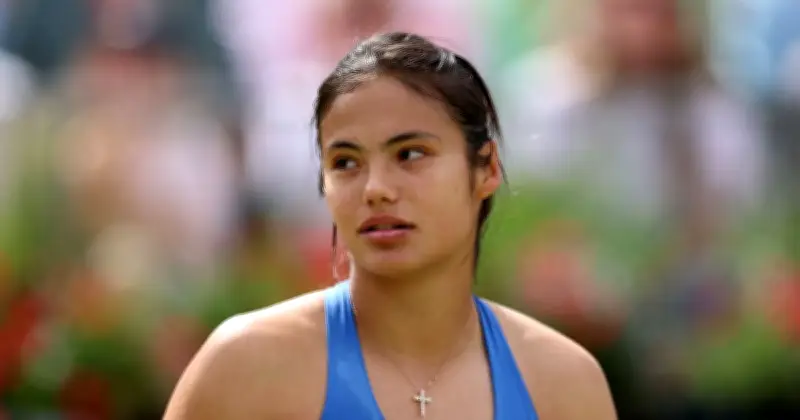
Emma Raducanu could lose her Wimbledon seeding if a controversial proposal to reduce the number of seeds from 32 to 16 is adopted, according to comments made by tennis commentators during the Queen's Club finals.
Proposed Seeding Change and Its Impact on Raducanu
The 2021 US Open champion, currently ranked world No. 32, is expected to be the last seed at this year's Wimbledon, which begins on June 29. However, a reduction to 16 seeds would eliminate her protected position, potentially pitting her against top players like Aryna Sabalenka or Iga Swiatek in the early rounds.
During the men's final at Queen's Club, commentators Andrew Castle and John Lloyd discussed the possibility of scaling down seeds from 32 to 16. Castle said: "I think there should be 16 [seeds] and then we would have better matches in the first week, guaranteed." Lloyd agreed, noting it would create more "interesting" first and second round matches.
Raducanu's Recent Form and Seeding Context
Raducanu, 23, has shown a resurgence after a difficult start to 2026, reaching the final of the Queen's Club where she lost in straight sets to Donna Vekic of Croatia. Her current ranking places her exactly at the cutoff for seeding under the existing 32-seed system.
Castle acknowledged that earning a Grand Slam seed is a result of hard work, but argued for more competitive early matches. "People tend to forget that a slam is two weeks. In the first week, there should be a lot of good matches and sometimes it is guilty of early rounds, particularly from the top seeds, not being great. You stick 16 seeds in there will be some great first and second round matches," he said.
How the Change Would Affect the Draw
If Wimbledon switched to 16 seeds this year, Italy's Luciano Darderi would fill the last seed, while French Open semi-finalist Jakub Mensik and Queen's Club finalists Francisco Cerundolo and Tommy Paul would be unseeded. This could mean rising talent Joao Fonseca might face a former champion like Jannik Sinner or Novak Djokovic in the first round.
According to the LTA, women's singles seeding primarily follows WTA rankings, but a committee may adjust if a player's grass-court credentials are not accurately reflected. In the women's draw, world No. 1 Aryna Sabalenka is expected to be top seed, followed by former champion Elena Rybakina, defending champion Iga Swiatek, Jessica Pegula, Roland Garros winner Mirra Andreeva, last year's finalist Amanda Anisimova, and Coco Gauff.
Historical Context and Debate
Wimbledon has traditionally used 32 seeds since 2001, when it increased from 16. The proposal to revert has been debated periodically, with proponents arguing it would create more excitement in the first week. Critics, however, note that it penalizes players who have earned their ranking through consistent performance.
For Raducanu, the timing is critical. If the rule is not implemented this year, she retains her seed. But any future change could alter her path at SW19, especially if she fails to rise above No. 32 in the rankings.