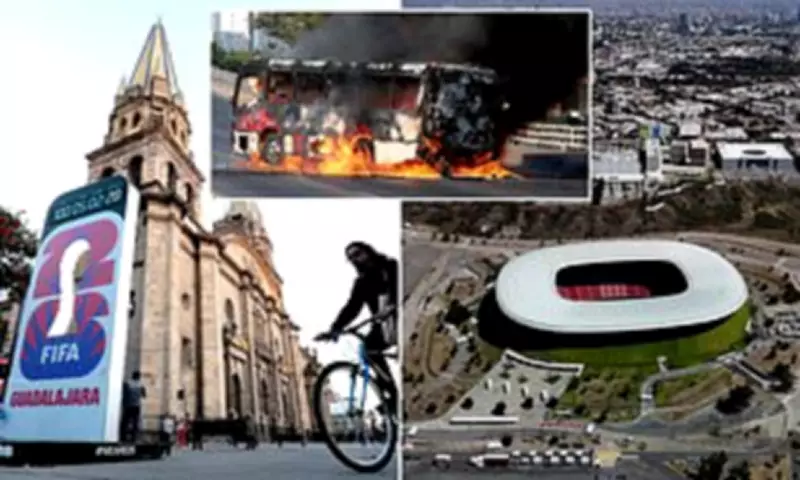
Ticket prices for the upcoming FIFA World Cup play-in tournament in Mexico have experienced a dramatic collapse, with some seats now available for as little as $11.33 (200 pesos). This significant drop coincides with intense military operations against powerful drug cartels in the host state of Jalisco, raising security concerns just months before the global football spectacle.
Security Concerns and Official Reassurances
The inter-confederation playoff tournament is scheduled for March 26-31 in the cities of Guadalajara, the capital of Jalisco, and Monterrey. These venues will also host matches during the main 2026 World Cup across North America. Recent violence erupted near Guadalajara following the death of Nemesio 'El Mencho' Oseguera, a notorious cartel leader, briefly disrupting local sporting events.
Despite the unrest, Mexican President Claudia Sheinbaum has publicly stated there is no danger to international fans traveling to the country. As the countdown to the 2026 World Cup reached the 100-day mark, Jalisco officials emphasized the state is prepared and secure. Juan Jose Frangie, head of the Guadalajara Organizing Committee and mayor of Zapopan, confirmed that state authorities have significantly enhanced security measures.

Frangie added that an additional 2,500 personnel from the National Guard and Ministry of Defense have been deployed to bolster security. He assured prospective visitors, 'We are telling people who are coming to the World Cup that it is a safe state, without problems.'
Wider World Cup Challenges for FIFA
The ticket price crash in Mexico is just one of several complex issues facing FIFA as it prepares for the 2026 tournament. The organization has approximately 7 million seats to fill and reported receiving 500 million ticket requests last month. While FIFA President Gianni Infantino has declared all 104 games sold out, some fans recently received emails offering an extra 48-hour ticket sales window.
FIFA has faced substantial criticism for its pricing strategy, with initial ticket prices in December reaching up to $8,680. In response, FIFA announced it will offer a few hundred $60 tickets for every game to the 48 national federations participating, for distribution to their most loyal supporters. However, most seats on FIFA's official resale platform remain priced well above $1,000.
Logistical and Political Hurdles
Further complications have emerged in the United States. The town of Foxborough, Massachusetts, is demanding a $7.8 million upfront payment to cover police and other expenses before issuing a permit for World Cup matches at Gillette Stadium. The Select Board of Foxborough has set a March 17 deadline, noting the town was not part of FIFA's original hosting agreement with Boston.
Fan festivals, a staple of the modern World Cup experience, are also being scaled back. New York/New Jersey eliminated its planned Fan Fest in Jersey City despite having started ticket sales. Seattle has downsized its original plan to smaller venues, while Boston has trimmed its event to just 16 days. The chief operating officer of Miami's host committee warned during a congressional hearing that its event might be canceled without federal funding within 30 days.
Security funding is another pressing concern. Kansas City Police Deputy Chief Joseph Maybin stated the city has an immediate need for federal funds to prepare. House Republicans indicated that money may be delayed due to a partial government shutdown of the Department of Homeland Security, linked to political disputes over immigration policy.
Geopolitical Tensions and Team Participation
The geopolitical landscape adds another layer of uncertainty. Iran's national team is scheduled to play group stage games in Inglewood, California, and Seattle. However, following recent coordinated US-Israeli strikes in Iran, the team's participation is in question.

'What is certain is that after this attack, we cannot be expected to look forward to the World Cup with hope,' said Mehdi Taj, Iran's top soccer official. Despite this, Iran has not formally withdrawn from the tournament, which would be an unprecedented move for a qualified team in modern World Cup history.
Public Backlash and Criticism
FIFA's promotional efforts have faced a fierce public backlash. A recent social media post marking 100 days until the World Cup kickoff was met with widespread criticism from fans concerned about ongoing conflicts in the Middle East and Mexico's internal security challenges.
'Read the room,' wrote fashion designer and soccer fan Tomi Rikhotso on X. Another commenter added, 'I believe this World Cup would be chaotic and overshadowed by geopolitics.' Many critics also referenced FIFA's controversial decision to award a peace prize to former US President Donald Trump, only for the US to later conduct military strikes in Iran.
FIFA has not immediately responded to requests for comment on whether Iranian federation officials attended a recent workshop in Atlanta. The organization continues to navigate a complex web of security, logistical, financial, and political challenges as it prepares for the largest World Cup in history, set against a backdrop of global instability and regional conflict.