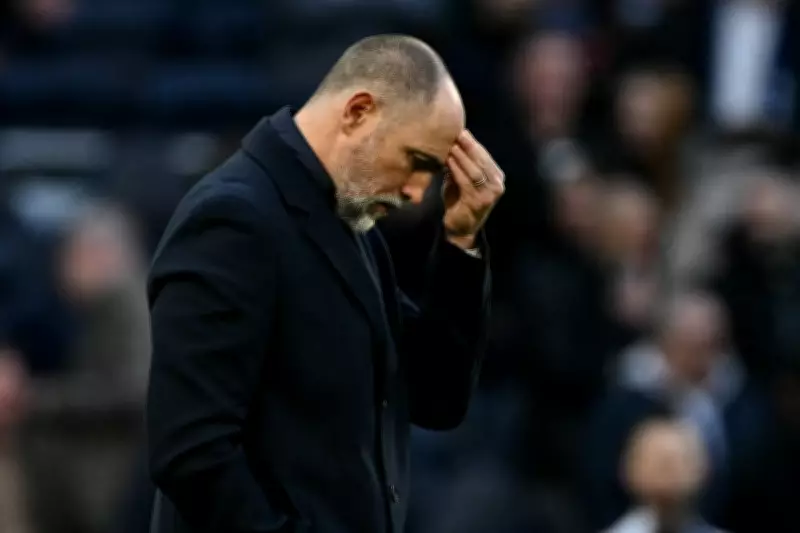
Tottenham Confront Unthinkable Relegation Nightmare
The spectre of relegation now haunts Tottenham Hotspur, creating an atmosphere of palpable dread within the club's hierarchy. Despite being ranked as the ninth-wealthiest football club globally based on revenue, Spurs find themselves embroiled in a desperate battle for Premier League survival that defies all financial logic and modern football economics.
A Club Haunted by Its Own Potential
For all of manager Igor Tudor's attempts to foster forward thinking and self-reflection among his squad, certain images from their recent devastating defeat continue to torment club officials. Players appeared understandably beaten, but those present describe the hierarchy as genuinely "haunted" by the unfolding crisis.
The comprehensive loss to Arsenal represented more than just another derby defeat. It starkly revealed that changing managers wouldn't magically resolve the deep-seated issues plaguing the club. Tudor faces perhaps the most challenging task in Tottenham's history, with no quick fixes available to stem the tide of negativity engulfing the organization.

The Fulham Showdown: A Season-Defining Moment
This weekend's clash against Fulham has emerged as potentially the most significant fixture across English football. While north London derbies capture headlines, this encounter will reveal far more about Tudor's capacity to salvage Tottenham's season and what remains of their collective spirit.
A victory would provide immediate psychological relief, creating breathing space and generating the first positive momentum of the calendar year. Even a draw would demonstrate some measure of progress, though falling short of what the situation truly demands. Any defeat, however, would trigger full-scale alarm bells throughout the club.
The tension would become suffocating, the pressure immense, and the relegation threat would transform from possibility to probability.
Astonishing Underperformance Defies Modern Football Realities
While commentators rightly note that Tottenham's relegation would represent the Premier League's most shocking demotion, more revealing is how the reasons behind this crisis reflect truly astonishing underperformance. Should they actually go down, it would constitute one of football history's most remarkable feats of reverse alchemy—a shocking waste of resources and potential.
Comparisons to Leeds United's 2003-04 relegation miss the fundamental difference: Leeds financially overextended themselves, making decline inevitable. Tottenham have experienced the opposite problem. With their wealth and resources, this crisis should have been impossible rather than inevitable.
In a skewed modern parallel to Manchester United's 1974 relegation just six years after European triumph, Tottenham could face the drop a mere five years after joining the ill-fated Super League—a telling commentary on the modern game's complexities.
A Decade of Unfulfilled Promise
The current crisis becomes even more perplexing when considering recent history. This week marks ten years since Tottenham could have topped the Premier League during Leicester City's fairytale season. Just seven years have passed since their appearance in the Champions League final, which many anticipated would launch the club to sustained elite status.
Instead, that moment has become a haunting memory of what might have been—a peak from which Tottenham have fallen dramatically. For supporters, the greatest frustration stems from the absence of a single catastrophic event triggering this decline. Instead, fans have long warned that ownership approaches made this deterioration increasingly likely.
Ownership Questions and Structural Failures
Persistent questions surround the hierarchy's true ambitions. While representatives of the Lewis family insist success remains the ultimate goal, supporters counter by highlighting limited investment over twenty-five years and questioning whether the club has been treated primarily as a financial asset rather than a sporting institution.

Other Premier League executives believe Tottenham require new ownership for a genuine refresh, citing excessive "baggage" weighing down the organization. As one senior figure observes, clubs can sometimes succeed despite ownership, but leadership outlook fundamentally shapes structure and appointments.
The situation has been complicated by the Lewis family granting former chairman Daniel Levy extraordinary power for decades. Ironically, Levy's departure—long demanded by supporters—has precipitated greater collapse by preventing an orderly transition of responsibility.
Systemic Exposures and Missed Opportunities
The abrupt leadership change has exposed multiple deficiencies: a lack of football expertise, absence of coherent football philosophy, and a mismatched squad conditioned by Levy's policy of maintaining unusually low wage percentages despite available resources.
Insiders describe a squad carrying considerable "scar tissue" despite last season's Europa League success, with speculation mounting about dressing room divisions. Some sources highlight how Tottenham previously employed potentially transformative figures like Michael Edwards, only to see them depart for greater success elsewhere.
Tudor's Unenviable Task and Potential Escape Routes
All these factors leave Tudor attempting to navigate confusion permeating every level of the club. This comprehensive breakdown is what truly haunts the hierarchy—the sudden convergence of every issue under immense time pressure.
The situation isn't yet terminal. Talent remains within the squad, and Tudor believes his formation suits the available players. One victory could transform everything, settling nerves and establishing positive momentum.
Nevertheless, the sheer improbability of this crisis cannot be overstated. One of football's wealthiest institutions, whose hierarchy once felt sufficiently arrogant to join a breakaway league, now depends on a managerial gamble and intangible positive feelings to escape historic humiliation.
The Stakes Beyond Relegation
Discussions are already emerging about relegation's practical consequences. Tottenham carry substantial fixed costs and partner commitments while facing reduced television revenue, altered sponsorship arrangements, and diminished match-day income. Some investors might view demotion as an opportunity to acquire the club at reduced valuation.
More intriguing, should Tottenham survive, is how they might leverage this crisis for long-term improvement. Some football figures see this as a grand opportunity for genuine transformation, given the club's inherent advantages.
This paradox perfectly encapsulates Tottenham's predicament. To manage any potential revival, they first require that single victory to change everything—a result that would begin reversing what has become one of modern football's most perplexing declines.