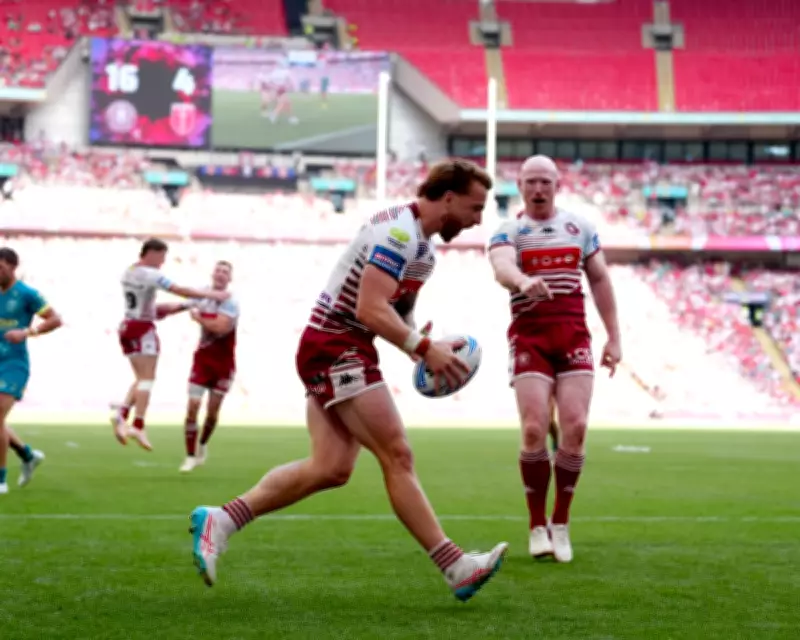
There was more Challenge Cup history under the Wembley arch on Saturday afternoon as Wigan Warriors secured a record-extending victory in rugby league’s most prestigious competition. But there was a slice of more sobering history too.
The Warriors’ demolition of Hull KR was watched by just 56,383 spectators; excluding the two Covid-affected finals of 2020 and 2021, that is the lowest figure for a Wembley Challenge Cup final since 1946. Granted, few sports obsess over attendance figures quite like rugby league but the reality is a statistic that stark is enough to merit a debate about where the sport goes next.
So too is the fact that next year’s Challenge Cup final will be the last one in the sport’s existing deal with Wembley. It leaves the door ajar for the possibility of a relationship that dates back to 1929, when Wigan won their second cup courtesy of victory over Dewsbury, perhaps coming to an end.

Attendances have dwindled over time. The first final at the new Wembley was attended by 82,421 but you now have to go back a decade to find the last decider that had more than 70,000 inside the national stadium. There are a myriad of factors behind the decline, but does Wembley still have the lustre it once did for rugby league supporters?
“We don’t sell Wembley out like we’ve done in the past, but it’s still on the bucket list of players,” said Kris Radlinski, the victorious Wigan CEO and a former Wembley winner himself. “Players still want to go there and play in a big occasion. I’ve grown up watching the Challenge Cup. We’ve got a magic to it, and it’s a great day out.”
The big question would be if not Wembley, where next? Tottenham Hotspur Stadium hosted the 2021 final while Everton’s Hill Dickinson Stadium will stage Super League’s Magic Weekend this summer, having earned rave reviews after hosting an Ashes Test between England and Australia last autumn.
It is much closer to rugby league’s heartlands but Radlinski is right to point out the romance behind Wembley. The sport should not toss aside its history with the stadium nor with London. No game has national cut-through quite like the Challenge Cup final, as the healthy viewing figures from the BBC illustrated, with numbers far exceeding those tuning in for Super League games.
If rugby league can at present attract only about 60,000 to Wembley, what evidence is there that moving would yield more? There is no doubting some fans, albeit a smaller number, go because of Wembley, because of the opportunity to watch a major rugby league game inside London’s most storied sporting venue.
The emergence of the Super League Grand Final at Old Trafford as well as other big events such as Magic Weekend – where 70,000 tickets have been sold – games in Las Vegas and Wigan’s trip to Paris next week to face Catalans are financial quandaries supporters did not historically have, either. Wembley was the big day out once upon a time. Now it is just one of them.
Instead of looking inwards and pondering a smaller venue, rugby league should try lining its proverbial ducks in a row to ensure Wembley has the best chance. For instance, Magic Weekend is taking place in one month’s time. Why couldn’t that be much later in the summer to allow supporters the chance to afford more?
Should Wigan and Catalans really be playing in Paris one week after the cup final? There is no doubting the Warriors’ Wembley support was diminished by that. Perhaps, too, the Rugby Football League could wake up to the decline and give its community clubs a weekend off, resulting in more neutrals falling in love with Wembley again.
In short, there must be a collective effort to save rugby league’s relationship with Wembley, as Radlinski said on Saturday. “I don’t like seeing an empty Wembley,” he said. “If Wembley’s full, then it shouldn’t move. But we can’t be ignorant to the economic challenges within the sport and within society. It costs a lot of money to get down there.
“I would much rather see a Challenge Cup final with a sell-out crowd, but the idea was to sell Wembley out every year. For that to happen, the sport needs to make a concerted effort rather than it just being the competing clubs.”

If that concerted effort does not materialise in 12 months’ time, the sport may be faced with a heartbreaking decision. The time to act is now.