Marie-Louise Eta Makes History as Union Berlin's Head Coach
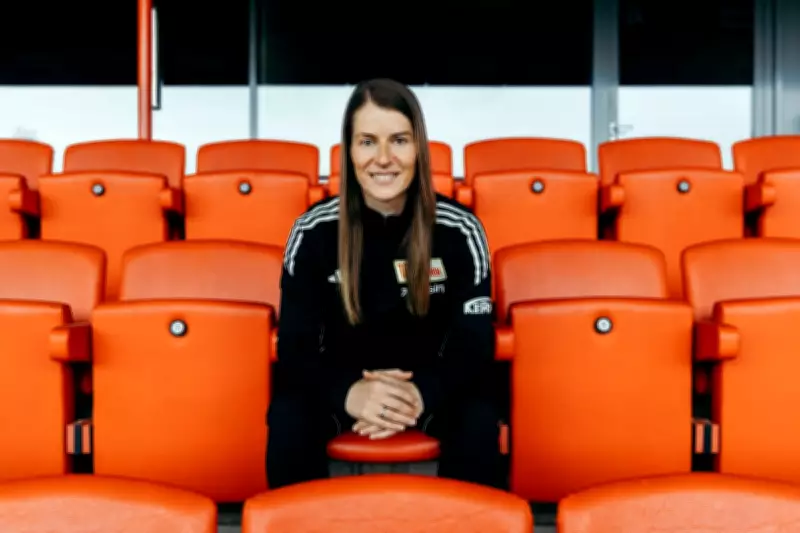
Marie-Louise Eta was immersed in a typical Saturday evening of homework when a sudden phone call catapulted her life into a whirlwind. Union Berlin, grappling with a severe downturn in form, had decided to dismiss their manager, Steffen Baumgart, and urgently needed a replacement. The club turned to Eta, the highly regarded coach of their under-19 team, offering her the interim role for the remainder of the season. This unexpected promotion meant abandoning her preparations for a match against Mainz's youth squad the very next day.
"I was at home on my laptop, deep in preparation," Eta recalls. "Then our president, Dirk Zingler, called and said: 'You're doing it now. I'm counting on you.' The conversation was brief. It wasn't easy to inform our under-19 group chat that I wouldn't be able to lead the game anymore."
Not a PR Stunt: Eta's Appointment Based on Merit
While Eta's appointment as the first woman to manage a men's team in Europe's major leagues has drawn global attention, she emphasises that it was a decision rooted in merit, not novelty. Union Berlin conducted an internal assessment to identify the most suitable candidate for the job, ultimately selecting Eta due to her proven coaching abilities and prior experience as an assistant manager in the Bundesliga.

"The crucial question is: 'Who is the right person for the job?'" Eta states firmly. "In my situation at Union Berlin, I can say I feel trust and conviction. They believe I can keep the team in the Bundesliga. I'm not a PR stunt."
Despite this, the historic nature of her role inevitably attracted widespread media interest. Approximately fifty journalists attended her inaugural press conference, a significant increase from the usual small gatherings. Eta acknowledges the societal importance of her position, even as she strives to be recognised primarily for her coaching expertise.
"I can understand the interest," she says, reflecting on the aftermath of her first game, a 2-1 loss to Wolfsburg. "I'm aware of what it means societally. It creates a responsibility for me whether I like it or not. My primary goal was never to strengthen the role of women; I've always wanted to convince with my performance. I want to be seen as a football coach."
Inspiring the Next Generation and Overcoming Adversity
Eta recognises the importance of visibility for aspiring young girls in football, having grown up in a male-dominated environment in Dresden during the 1990s. She often faced taunts like "Don't let a girl outplay you!" but developed resilience early on.
"I can defend myself, I can tune it out," she asserts. "And I can shout back. It's not all about gender. In competitive sports, everyone has to prove themselves every day. My biggest critic has always been myself."
She dismisses the sexist comments from online trolls, which Union's director of football, Horst Heldt, labelled as "insane," focusing instead on her coaching influences, such as Xavi Hernández and Pep Guardiola. Eta admires their "special style of football—attacking, technically precise, all delivered with flair and creativity."
Adapting to the Challenge: Union Berlin's Relegation Battle
Eta now faces the formidable task of steering Union Berlin away from relegation. The team has secured only two victories in their last fifteen league matches and is perilously close to the relegation playoff spot. She aims to blend her attacking philosophy with the club's traditional strengths of cohesion and discipline.
"You have to know what made you strong," Eta explains. "Cohesion and discipline propelled Union to the top. After a good first half of the season, we're currently going through a difficult period. We need to get out of this."
She notes that the players have already begun implementing aspects of her tactics, which she finds encouraging. "I was able to observe how the lads had already implemented parts of my playing philosophy and our match plan against Wolfsburg, or at least tried to. That's very valuable. Our strength in recent years has been a certain defensive stability. But to win, you also have to create scoring opportunities."

Coaching Philosophy: Beyond Gender Stereotypes
Eta adopts an individualised approach to coaching, rejecting simplistic gender stereotypes. She is expected to take charge of the Union women's team next season, though Heldt has hinted at a potential longer-term role with the men's side.
"I'm dealing with individuals," she clarifies. "You can say women are more sensitive or men are more vain, but for me, those are stereotypes. There are plenty of sensitive men I've had to put my arm around. Conversely, there have been women who, as a coach, you need to give a kick up the backside."
While Germany appears ahead of other top football nations in terms of female representation, with Sabrina Wittmann coaching third-tier Ingolstadt, Eta urges caution. "We shouldn't get too cocky; we still have some catching up to do," she warns.
Reflecting on her journey, Eta advises her younger self to savour the moments. "Take the moment and enjoy it, and also look back sometimes. Don't always just want faster, higher, further. That's a weakness of mine. If I'm not careful, I miss the beautiful moments, the ones where I can simply be proud of myself." For now, however, her focus remains squarely on the immediate challenge ahead.