Manchester United's Midfield Revolution: The £200m Gamble to Fix Years of Neglect
When Manchester United's decision-makers gathered in Iceland last summer, their focus was unequivocal: revolutionise the attack at all costs. The club's hierarchy agreed that every available resource must be channelled into solving their glaring goal-scoring deficiencies. This strategic pow-wow came after a dismal Premier League campaign where United managed just 44 goals, ranking a lowly 16th in the league. Alarmingly, three of the four teams that scored fewer were ultimately relegated.
The Attack-First Strategy and Its Consequences
That summer focus resulted in the blockbuster arrivals of Benjamin Sesko, Bryan Mbeumo, and Matheus Cunha for a combined fee exceeding £200 million. The investment has yielded immediate dividends, with United currently sitting as the third-highest scorers in the league, trailing only title contenders Arsenal and Manchester City. However, this offensive overhaul came at a significant cost to other areas of the squad.
Now, with the confirmed departure of veteran midfielder Casemiro after four years, growing expectations that Manuel Ugarte will seek a new challenge, and ongoing uncertainty surrounding captain Bruno Fernandes's future, United's power brokers are preparing to pivot dramatically. The club is ready to concentrate its financial firepower on the midfield, hoping to engineer a performance transformation as dramatic as last summer's attacking revolution.

Jason Wilcox and Omar Berrada face immense pressure to successfully navigate this critical transition period for the club.
Planning 'Open Heart Surgery' on the Engine Room
To borrow a phrase from former interim manager Ralf Rangnick, United have long recognised the need for 'open heart surgery' in midfield. Sources indicate that previous manager Ruben Amorim privately advocated for midfield reinforcements during the last transfer window. However, the budget was entirely allocated to the forward line, prioritising the urgent goal-scoring crisis.
The responsibility now falls squarely on Ineos and the club's new football structure, including director of football Jason Wilcox and recruitment chief Christopher Vivell. The stakes are extraordinarily high. With United slipping in Deloitte's Football Money League and facing the financial repercussions of a season without European football, the margin for expensive error is virtually non-existent.
This precarious position reinforces a club mantra: the pursuit of Premier League-proven talent. This philosophy, which will also guide the search for a permanent manager, is considered paramount to mitigating risk. For years, United's central midfield, particularly the defensive midfield role, has been the squad's most neglected and underfunded area. This chronic underinvestment has contributed to the downfall of multiple managers.
A History of Missed Opportunities and Failed Investments
The list of midfield targets that got away is a painful chronicle of missed opportunities. David Moyes coveted Toni Kroos and Cesc Fabregas but secured neither. Erik ten Hag's protracted pursuit of Frenkie de Jong ended in failure. More recently, Ruben Amorim identified Carlos Baleba as a key target, but no deal materialised.
Since 2006, United have invested approximately £218 million in defensive midfielders, acquiring Michael Carrick, Owen Hargreaves, Morgan Schneiderlin, Nemanja Matic, Casemiro, and Manuel Ugarte. This sum is strikingly similar to what was spent on just three attackers last summer. The legacy of these signings is mixed at best.
Two decades on, Carrick is now the club's head coach, Hargreaves works as a pundit, Schneiderlin is a sporting director in France, Matic plays for Lyon, Casemiro is departing amid MLS interest, and Ugarte has struggled to justify his £52 million price tag since arriving from Paris Saint-Germain. The Uruguayan is now attracting interest from Turkey, while a proposed loan to Ajax failed to materialise in January.
Further compounding the issue, the departure of Christian Eriksen last summer was not addressed with a replacement. Youngster Toby Collyer is also not viewed as a long-term first-team solution, preparing for his second Championship loan spell.

The Summer Blueprint: Up to Four New Arrivals
Internally, discussions point towards as many as four new midfield arrivals. The final number hinges on several factors: the resolution of Bruno Fernandes's situation post-World Cup, where he has vowed to delay any decision on his United future until Portugal's campaign concludes, and the progress of contract talks with the highly promising Kobbie Mainoo.
One thing is certain: midfield is the unequivocal priority this summer. After years of neglect, the imperative to get this overhaul right has never been greater for the club's long-term prospects.
Identifying the Top Transfer Targets
Within the corridors of Carrington and Old Trafford, it is an open secret that Nottingham Forest and England star Elliot Anderson is the primary midfield target. Anderson's reputation has skyrocketed since his starring role in England's Under-21 European Championship triumph. He is now tipped to start for the senior side at the 2026 World Cup and could command a staggering £100 million transfer fee.
The 23-year-old's continual improvement marks him as arguably the most complete midfielder likely to be available this summer, especially if Forest suffer relegation. His exceptional passing range, mobility, and versatility—capable of operating as a box-to-box dynamo or a deep-lying orchestrator—make him an ideal candidate to replace Casemiro.
Securing Anderson will be fiercely competitive. Manchester City are also known admirers of the former Newcastle United prospect and could offer significantly higher wages. United's ability to secure Champions League football is therefore seen as absolutely crucial. Furthermore, Anderson is contracted until 2029, and Forest have no desire to sell, making negotiations exceptionally challenging.
Elliot Anderson is the number one midfield target for both Manchester United and their city rivals.
The Supporting Cast of Contenders
Carlos Baleba remains high on United's shortlist. The club attempted to accelerate a move for the Brighton midfielder late last summer under pressure from Amorim, who believed Baleba was essential for his tactical system to flourish. Despite a dip in form at club level this season, his impressive displays for Cameroon at the Africa Cup of Nations served as a powerful reminder of his potential.
While Brighton publicly state they have no intention to sell, there is a widespread belief within the league that the Seagulls will cash in on the 22-year-old come June, with a fee likely exceeding £60 million and potentially approaching £75 million. Baleba's physical prowess would significantly elevate United's midfield presence, much as Moises Caicedo did for Chelsea.
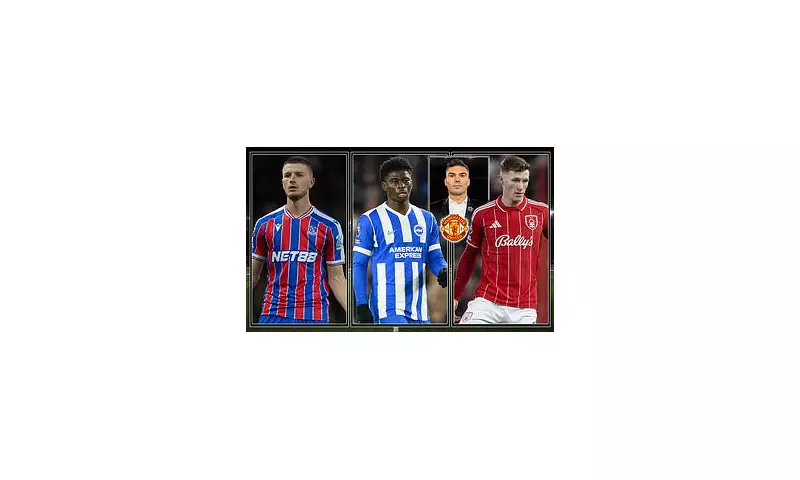
Adam Wharton of Crystal Palace is another highly coveted talent. With Palace anticipating a summer of significant change—including the sale of captain Marc Guehi to Manchester City and the departure of manager Oliver Glasner—Wharton is widely expected to be sold. However, Liverpool are also poised to make the England international a priority, ensuring United face another competitive battle.
Club insiders suggest these three names—Anderson, Baleba, and Wharton—represent the core of United's long-term planning under Ineos. The strategy is methodical and forward-looking. While past deals have collapsed at the eleventh hour, the hope and expectation within the club is that at least two of these three primary targets will be secured before the start of the 2026-27 season.
Smart Spending and Value Alternatives
Recognising that the three main targets could each cost £70 million or more, United's recruitment team is also tasked with identifying value in the market. Several names have been discussed internally as potential smart additions.
- Tyler Adams (Bournemouth) and James Garner (Everton) have been mentioned, with the latter impressing under David Moyes.
- Joao Gomes at Wolves is almost certain to secure a Premier League move if his club is relegated.
- Young talents like Noah Sadiki (Sunderland), Alex Scott (Bournemouth), Mateus Fernandes (West Ham), and Habib Diarra (Sunderland) are expected to attract top-flight interest.
The most astute strategy may involve signing two elite, expensive central midfielders and supplementing them with one or two more affordable additions. This would help flesh out a squad that looks threadbare ahead of an anticipated return to European competition.
Investing in teenage prodigies like Ayyoub Bouaddi (18) and Christos Mouzakitis (19), two of Europe's most promising young midfielders, could also represent shrewd long-term planning.
The Academy's Role in the New Era
A return to more games next season—the current 40-game campaign is the club's shortest in 111 years—should theoretically create opportunities for academy graduates. However, a sudden breakthrough akin to Kobbie Mainoo's is considered unlikely.
Defender Jim Thwaites may find a clearer pathway to the senior side if the team shifts to a back-four system. There are also high hopes for youngsters Sekou Kone and Cristian Orozco, the latter set to join from Colombia when he turns 18 in July.
Nevertheless, with neither Kone (currently on a training stint with Ineos-owned Lausanne-Sport) nor Thwaites having made a first-team debut, expecting them to immediately reduce the need for major investment is unrealistic. The best environment for integrating academy talent is a stable, high-performing midfield that allows a new manager to carefully introduce them in cup competitions.
Recent midfield dysfunction has negatively impacted academy prospects, with players like Jack Fletcher being deployed out of position and exposed by excessive space. Paradoxically, a major, successful investment in the first-team midfield could create the stable platform needed for the next generation to truly flourish.
Envisioning the Future: Potential Line-Ups
As planning intensifies, two potential tactical setups for next season are being contemplated, illustrating the scale of the intended transformation:
In a 4-2-3-1 formation: Lammens; Mazraoui, De Ligt, Yoro, Dorgu; Anderson, Baleba; Mbeumo, Fernandes, Cunha; Sesko.
In a 4-3-3 system: Lammens; Dalot, De Ligt, Martinez, Dorgu; Wharton, Mainoo, Fernandes; Amad, Mbeumo, Cunha.
These speculative XIs underscore the monumental task ahead. After successfully addressing their attack, Manchester United are now betting the house on a midfield revolution. The success or failure of this £200 million gamble will define the club's trajectory for years to come.