The Road Ends Here: Indianapolis Braces for Epic Final Four Showdown
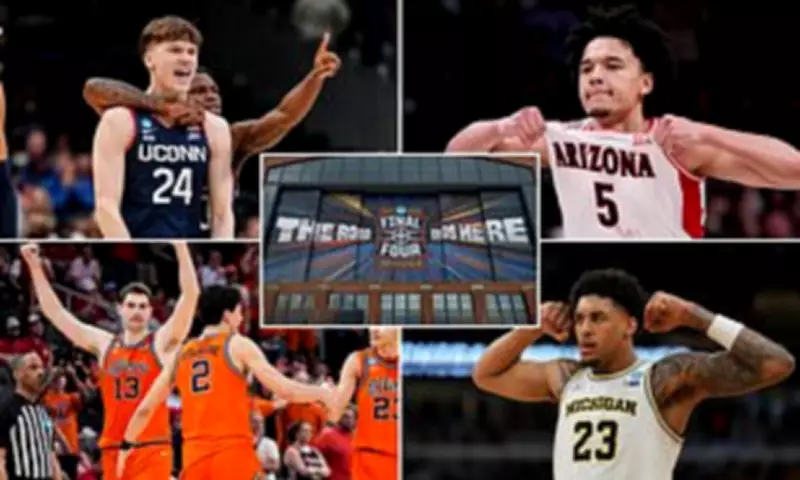
Throughout the streets of Indianapolis, a four-word phrase dominates billboards, street signs, and the giant windows of Lucas Oil Stadium. 'The Road Ends Here' serves as both a promise and a threat for the four elite teams arriving for what promises to be a blockbuster 2026 NCAA Final Four. For three teams, the statement will prove painfully accurate. For one, eternal glory and the coveted title of national champion awaits.
The crowds have already begun gathering in the Hoosier State ahead of this spectacular event, marking a repeat of 2024 with all four participants hailing from the prestigious 'Power Five' conferences. Three of these programs have previously claimed national championships, setting the stage for an unforgettable basketball spectacle. The lowest seed among them enjoys what amounts to home-team advantage, while their opponent staged a monumental comeback to reach their third Final Four in just four years.
Illinois Fighting Illini: The Balkan Contingent Returns
Record: 28-8
Last AP Ranking: No. 13
Best Win: 88-82 @ No. 4 Purdue
Worst Loss: 92-90 (OT) v. Wisconsin
Best March Madness Result: Runner-up (2005)

With only 120 miles separating Indianapolis from the University of Illinois campus, the Fighting Illini are expected to dominate the audience at Lucas Oil Stadium. Their return to this stage after 21 years follows their heartbreaking title game loss to North Carolina under legendary coach Roy Williams.
Illinois boasts several remarkable strengths:
- The tallest team in the country
- The nation's most efficient offense
- Victories by at least ten points in every March Madness game
- Freshman star Keaton Wagler, a projected top-10 NBA pick
The team features what commentators have dubbed the 'Balkan Contingent,' including Andrej Stojakovic (son of NBA legend Peja), guard Mihailo Petrovic, seven-foot twins Tomislav and Zvonimir Ivisic, and forward David Mirkovic. Senior leadership from Kylan Boswell and Ben Humrichous completes this formidable roster.
However, Illinois faces one significant challenge: they possess the worst defensive efficiency of any remaining tournament team, ranking only 20th nationally. Their inability to force turnovers and tendency to foul could prove costly in the final games.
UConn Huskies: Chasing Dynasty Status
Record: 33-5
Last AP Ranking: No. 7
Best Win: 72-40 v. No. 15 St. John's
Worst Loss: 91-84 v. Creighton
Best March Madness Result: National champions (1999, 2004, 2011, 2014, 2023, 2024)
UConn appeared finished during their Elite Eight matchup against hated rival Duke, trailing by 19 points in the first half. Yet the Huskies staged an incredible comeback, holding Duke to horrific second-half scoring before Braylon Mullins hit a miraculous buzzer-beater to secure their third Final Four appearance in four seasons.
Coach Dan Hurley acknowledged his team's inconsistency, stating, 'Our floor this year at times has been low. Our ceiling as a team has been really, really high.' The Huskies have certainly reached that ceiling during the tournament, with center Tarris Reed Jr. delivering a career-defining performance comparable to basketball legends like Shaquille O'Neal and Larry Bird.
Program icon Alex Karaban prepares for his final college run, while shooting guard Solo Ball and transfer point guard Silas Demary Jr. overcome shooting slumps and injuries respectively. The heroics of Indiana native Braylon Mullins have already cemented his place in March Madness lore, though both he and Ball must improve their combined 8-for-45 three-point shooting if UConn hopes to raise a seventh championship banner.
Arizona Wildcats: Seeking Return to Glory
Record: 36-2 (16-2 in Big XII, won Big XII championship)
Last AP Ranking: No. 2
Best Win: 73-66 @ No. 2 Houston
Worst Loss: 78-75 (OT) v. No. 16 Texas Tech
Best March Madness Result: National champions (1997)

Arizona returns to the Final Four after a 25-year absence, their last appearance ending in championship game defeat to one of Duke's greatest teams. History offers an intriguing parallel: the Wildcats' only national title came in 1997, right here in Indianapolis at the old Hoosier Dome.
Coach Tommy Lloyd has assembled perhaps his greatest team in Tucson, blending promising athletic freshmen with experienced seniors to create the tournament's least blemished squad. Projected lottery pick Brayden Burries and forward Koa Peat headline the freshman class, while sharp shooter Ivan Karchenkov utilizes his length effectively.
Senior leadership comes from late-game threat Jaden Bradley, perimeter specialist Anthony Dell'Orso, and junior big man Motiejus Krivas who dominates in the paint. Arizona demonstrates equal strength on both offense and defense, though their reluctance to shoot from beyond the arc (only Texas State and Tarleton State attempt fewer three-pointers) could prove problematic if they fall into an early deficit.
Michigan Wolverines: Efficiency Over Flash
Record: 31-3 (19-1 in Big Ten)
Last AP Ranking: No. 3
Best Win: 101-61 vs. No. 12 Gonzaga
Worst Loss: 91-88 @ Wisconsin
Best March Madness Result: National champions (1989)
Michigan presents a formidable package: height, physicality, the nation's best defense, and a top-five offense. Unlike previous talented Michigan teams that fell short—the Fab Five squads of the early 1990s, the 2013 team that lost to Louisville, and the 2018 team defeated by Villanova—this Wolverines team prioritizes efficiency over flash.
Coach Dusty May typically utilizes an eight-player rotation, but his starting five has demonstrated remarkable consistency throughout the season. The frontcourt features 7-foot-3 Spaniard Aday Mara, underrated sophomore Morez Johnson, and National Player of Year contender Yaxel Lendeborg. Guard Elliot Cadeau has transformed from his struggling days at UNC, while senior Nimari Burnett provides reliable bench production.
Freshman Trey McKinney assumes increased responsibility following the season-ending injury to starting guard LJ Cason before March Madness. This injury, combined with Michigan's ball protection issues, represents their primary vulnerabilities. If the Wolverines can secure possession effectively, they possess every necessary component to claim their second national championship.
Final Four Predictions and Analysis
The Illinois-UConn matchup offers slightly clearer forecasting since the teams previously met in a Black Friday game at Madison Square Garden, where Connecticut prevailed by 13 points despite minutes restrictions for Tarris Reed and Braylon Mullins. Both squads have improved since that November encounter, though Illinois is unlikely to repeat their 32 percent shooting performance. Given UConn's victory under less favorable circumstances, the Huskies appear positioned for another win.
The Arizona-Michigan contest presents greater forecasting challenges, pitting two of the nation's tallest and most physical teams against each other in what could become the season's premier game. Key statistical differences emerge:
- Michigan ranks sixth nationally in effective field goal percentage versus Arizona's 35th
- Michigan plays at a faster offensive tempo (14th) compared to Arizona (50th)
- Michigan significantly slows opponents (311th in average defensive possession length) better than Arizona (55th)
This semifinal promises a down-to-the-wire battle potentially decided by a buzzer-beater. While both teams demonstrate championship credentials, Michigan holds a hair's-width advantage based on their superior defensive tempo control and shooting efficiency. The stage is set, the teams are prepared, and Indianapolis awaits the crowning of a new national champion.