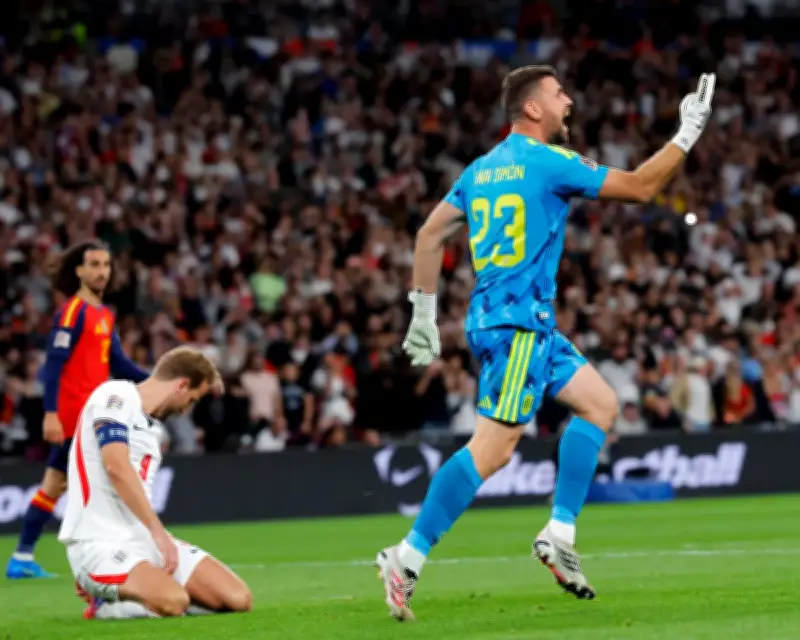
England suffered a 3-2 defeat to Spain at Wembley in their Nations League opener, with the game turning decisively at the 55-minute mark. This mirrors their loss to Argentina in Atlanta in July, but the circumstances and performance were notably different, offering more cause for optimism.
The Witching Hour at Wembley
Before the match, there was general agreement on the desirability of systems, pattern, and repeatability. England's last two significant matches—here and in Atlanta—have both involved taking the lead against World Cup finalists, playing well, and dominating parts of the game until the 55-minute mark. At that point, a kind of voodoo descends, with the final 35 minutes lost 2-0 on both occasions.
In Atlanta, Anthony Gordon put England 1-0 up against Argentina at 55 minutes, after which the team fell apart, reduced to 12% possession and a spooked manager fielding a back five. Here, the game also changed on 55 minutes. England were 2-1 up at that point, having come from 1-0 down, and looked like they might turn the game into an ordeal for Spain.
A Penalty Miss and a Shift in Momentum
The key moment arrived when Harry Kane, who had already scored England's second goal, stepped up for a penalty awarded after a VAR check for a trip on Jude Bellingham. Kane slipped on his standing leg as he planted it and pumped the kick onto the bar. The clock ticked over from 54 to 55 minutes.
From that point, Spain seemed to sense the shift in pressure. The ball began to tick between the red shirts, and Spain regained their familiar sense of control, always with more angles, more space, and a superior geometry. Within five minutes the game was level, and fourteen minutes later Spain were 3-2 up, a lead they would hold onto.
England's Improved Performance
Despite the loss, England were much better here than in Atlanta, and against a better team. Spain scored almost immediately, with a horrible moment for Marc Guéhi and a smart finish from Yamine Lamal. Ferran Torres wasted some outrageously inviting chances, and Rodri shuttled about like a man operating inside his own portable demilitarised zone. But England didn't let them crawl.
There were periods of hard high pressing, with Elliot Anderson aggressive in midfield. On 36 minutes, England scored a brilliant goal, caught on the counterattack by a wonderful three-man surge from box to box, made by Anderson's tackle, Bellingham's surge and pass, and a lovely Gordon finish into the corner.
A Telling Substitution
After the 55-minute fade, England were still better, with no long-ball stuff, no panic, and some decent late chances. But the key moment came on 70 minutes when both teams brought on a midfielder: Pedri for Spain, James Garner for England. Pedri immediately began to do his thing, romping about like a playful little horse.
At that point Spain had Pedri, Rodri, and Dani Olmo—the entire Barcelona midfield—on the pitch. For all England's efforts, it always felt they were being held at bay in those final moments. Spain are the ultimate system team, an expression of a deep, functioning coaching culture, and the footballing nation that tortures England the most. But this was at least some kind of progress.