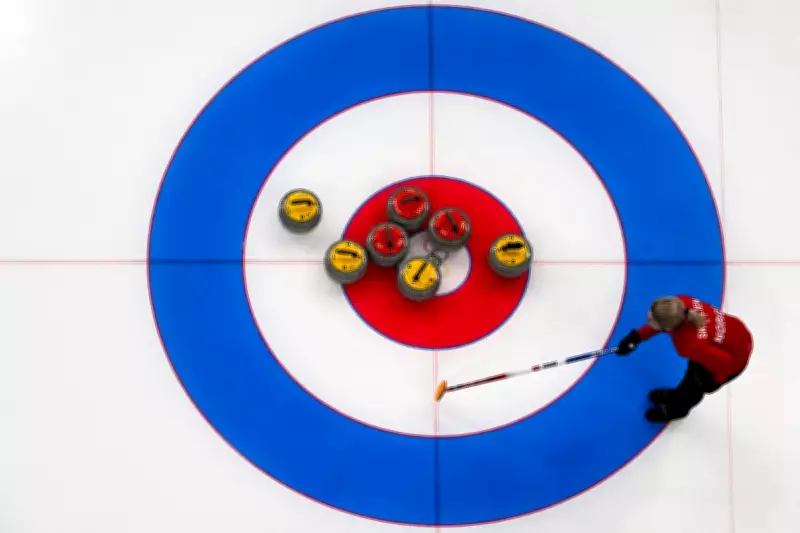
Curling stands as one of the most beloved and tactically demanding sports at the Winter Olympics, where Team GB aims to showcase considerable skill, steady nerves, and intense precision. At the upcoming 2026 Milano-Cortina Games, three medal events will feature, with ten nations competing in each discipline and a total of 112 athletes participating.
The Hammer: A Pivotal Strategic Element
The hammer is a fundamental and crucial aspect of curling, often determining the outcome of matches. This term refers to the Last Stone Advantage, granting the team that holds it the ability to throw the final stone of each end. This position is generally a significant strategic benefit, as it allows the team to assess all other stones thrown and the current scoring situation before making their decisive move.
How Teams Acquire the Hammer
In championship curling, the hammer is decided before a game begins through a process known as the Last Stone Draw (LSD). Two players from each team deliver a stone as close as possible to the centre of the house, with one stone thrown clockwise and the other counter-clockwise. The distance from each stone to the centre is meticulously measured, and the team with the closest stone earns the hammer for the first end.

During gameplay, the hammer transitions between teams based on scoring. Whichever team does not score during an end will receive the hammer in the next round. This rule sometimes leads teams to strategically avoid scoring just a single point, opting instead to retain the hammer and aim for a more substantial score in the subsequent end. If neither team scores, the hammer is retained by the team that held it previously.
Event Formats and Team Dynamics
The mixed doubles format, introduced at the Pyeongchang Games, joins the traditional men's and women's team competitions at Milano-Cortina. Great Britain's mixed doubles team, for instance, comprises Jennifer Dodds and Bruce Moat. Each men's and women's team consists of four playing members and an alternate, ensuring depth and flexibility.
Role of the Skip and Stone Throwing
In the men's and women's events, the final two stones of each end are typically thrown by the skip, who acts as the de facto captain of each rink. The skip is responsible for shaping the team's strategy and must execute shots calmly under intense pressure, making their role critical in leveraging the hammer effectively.
Mixed doubles follows a distinct structure, with five stones played per end. In this format, the same team member throws the first and last stones of each end, while their teammate handles the middle three stones. Teams begin every end with one stone per team pre-placed, creating opportunities to score up to six points in a single end, adding another layer of strategic complexity.
As the 2026 Winter Olympics approach, understanding the hammer's nuances will be key for fans and competitors alike, highlighting how this simple yet powerful rule shapes the thrilling dynamics of curling on the world stage.