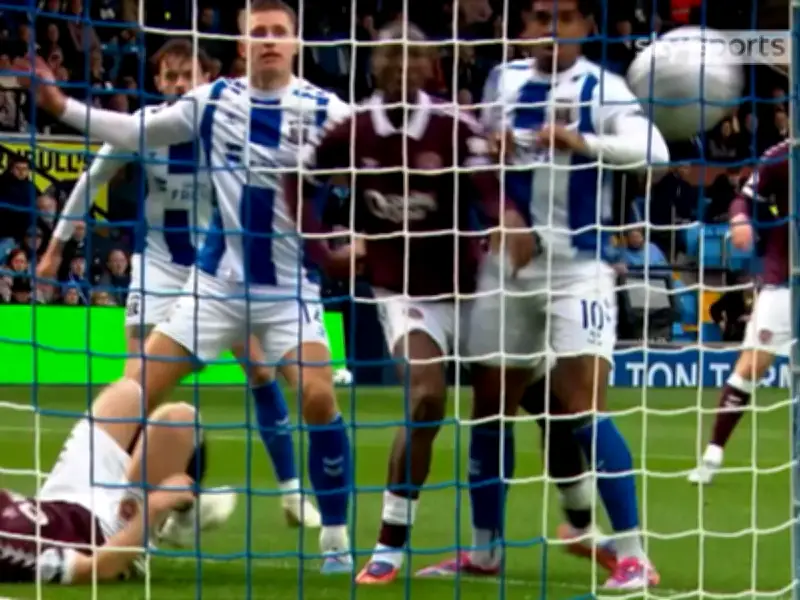
Scottish FA referees chief Willie Collum has insisted there was no comparison between Hearts' disallowed goal at Kilmarnock and Celtic's that stood away to Dundee Utd. Collum said VAR Matthew McDermid was correct to rule out Laurent Mendy's opener for the Jambos at Rugby Park for handball, and was adamant that whether the Frenchman's shot was on target or not was "irrelevant."
Collum defends handball decision
Speaking on the Sky Sports VAR Review Show, Collum said: "It was correct. This decision is fully correct and I'll explain why. Let's look at the law. We spoke about the ball touching the hand and then the player scores. The ball clearly touches the Hearts player's hand so we don't need to get into a debate whether it did or not. He then gains an advantage from that because it's a punishable part of the arm. It's down low on the arm or hand and he then shoots at goal. Where people have been very confused about this decision is absolutely nowhere in law does it talk about the shot being on target. Nowhere."
He classified Cathal McCarthy's header into his own net as a deflection, comparing the defender to a goalkeeper attempting to save a shot. The Tynecastle club demanded answers in the aftermath but were told the Scottish FA supported the decision, which Collum has now reiterated.
Defender's actions like a goalkeeper
Collum added: "Let's talk about the Kilmarnock defender's actions. He reacts like any player would, like a goalkeeper would. This shot is coming in and he doesn't know it's hit the Hearts players' hand. So he needs to try his best to save that. It's a saving action and he's unsuccessful. If you replace him with a goalkeeper and they get a fingertip to it and it goes in, people would still say that goal should be disallowed. So let's not get into this debate of whether it was on target. The ball strikes the hand, drops, player shoots and a goal is scored. In the laws of the game, this is correctly disallowed. We spoke to a few players about this and every one agreed that the Kilmarnock player's actions are the actions of what any defender would do only one metre from the goal line."
Host Gordon Duncan asked if the officials had assumed Mendy was the goalscorer given the ball was going wide and the defender scored an own goal. He compared it to an almost identical incident from the previous week where Harry Maguire handled immediately before an own goal was scored for Manchester Utd, and that was allowed to stand.
No comparison with Celtic's goal
Collum replied: "Because the actions of the Kilmarnock defender are not controlled actions. That's a deflection or a saving action. The example you cite from my colleagues down south - I don't like to talk about other countries' decisions. The reality is that a player shoots, a deflection happens and it still ends up in the net. So under the law for us Gordon, that needs to be disallowed. However, there's one difference before we get confused here. If you replace the Kilmarnock defender with a Hearts attacker - he would be offside but lets not complicate it - and he scores, the goal would stand in that scenario because it's a teammate. One other thing I want to cover is the comparison to Dundee Utd Celtic. We need to remember there that the ball goes to another teammate there, who scores. That's a completely different scenario so they are not comparable."
When pressed on why there wasn't even a discussion over whether it was an own goal or not, Collum doubled down: "Because I don't even think there could be any doubt about that. I want you to move away from this going wide aspect. It's irrelevant. The Kilmarnock player takes the action because he's trying to save a shot. It's nothing about going wide. If we're saying that goal should stand, we would be saying to every defender in the country if they think it could be a handball and think it could be going wide, just avoid touching it and jump out of the way. We need to be fair to defenders here as well."
St Mirren penalty admitted
Collum did admit that officials got it wrong by denying St Mirren a penalty in their 1-0 defeat at Ibrox. Ismeal Kabia went down after Manny Fernandez appeared to catch him on the top of the foot. A brief VAR check produced the verdict that the winger had "run into" the Gers defender and no review was recommended. Collum first of all accepted that the check should have been more thorough before admitting that the wrong decision was reached.
He added: "It should have been a longer check, without a doubt. For us, this is a penalty kick, without question. There will be occasions where attackers in the area and there will be inevitable light contact. Here it's quite clear that this is a reckless contact. It falls into the category of reckless so a yellow card would be expected here for that kind of stepping action on to the foot. So it's simple to say the decision is wrong. We would agree with that. We had a discussion with the Premiership managers after this match and they agreed completely that they would expect a penalty kick for that. We have to work with the VAR team about taking more time to check there, focus on the defender's action in that scenario. We have to work with our on-field referees on these kind of decisions being identified live on the pitch. The key in these incidents is to focus on the defender. Focus on their actions and where the point of contact is. The last thing we want to do is encourage clubs and players to react to something to get the VAR to look at it. The VAR always looks. Here it could have been more thorough and potentially other angles could have been utilised that would have shown the point of contact. I've no doubt when the VAR team look at it and they describe what they think happens. The player runs forward and there's inevitable contact. But when you slow it down, it's clear it's quite a strong step on foot."