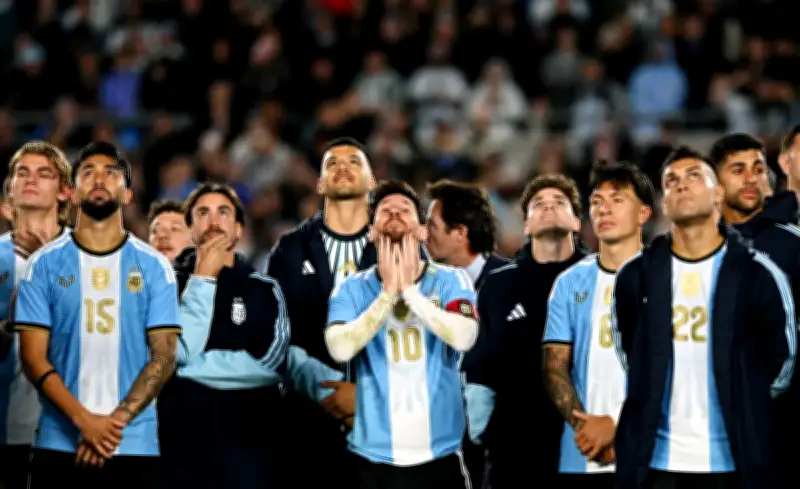
Lionel Messi's Argentina career ended this week, closing a chapter that transformed football into a sacred mystery for many. His final appearance came on Tuesday against Benin at the Monumental Stadium, a farewell that was both rushed and improvised, much like his first youth game for Argentina against Paraguay.
Silence and Complexity
Throughout his career, Messi's silence on various issues drew attention. During this year's World Cup, Brazilian writer Milly Lacombe posted, "What Argentina is doing in this World Cup is of a sacred order." She explored the contradiction of supporting Messi, describing him as "a player who is a God and a man who shakes Trump's hand." Lacombe questioned why Messi did not speak out against racist incidents around the Argentina team, writing, "That's why it hurts so much to see someone with Messi's power choosing to make himself small."
Messi's discomfort with words was well documented. Journalist John Carlin, after interviewing Messi twice, said he would decline a third opportunity. In 2010, Juan Sebastián Verón noted Messi's nervousness when addressing teammates as captain for the first time. His most famous public outburst came at the 2022 World Cup, when he told a Dutch player to "go away."
Triumph and Defeat
Despite his reticence, Messi's impact was profound. Argentina were celebrated when they won the 2022 World Cup, but by the 2026 final defeat to Spain, they had become villains. Lacombe reflected on Argentina's semi-final victory over England: "I started supporting England but by the end of the match I was weeping, surrendered to the commitment, the passion, the love that I saw the Argentina team pour on to the pitch. It's only in that moment of intense passion that we reach the sacred."
The final against Spain lacked sublime power and drew global criticism. Argentinian fans, offended and hurt, faced the possibility of Messi's last appearance. When he confirmed his retirement, a wave of grief and gratitude swept the nation.
From Struggle to Redemption
Messi's journey with Argentina was fraught with difficulty. His father, Jorge, sent videos to then-manager Marcelo Bielsa to expedite his son's inclusion. For years, Jorge asked, "How can we get Argentina to love my son?" Messi faced criticism, including a minute's silence by pundits in protest, backlash for not singing the national anthem, and bouts of vomiting and diarrhoea before matches. Diego Maradona mocked him, saying he was no leader, though he later made Messi captain.
Argentinian journalist Alejandro Wall noted, "What characterized Messi in the national team is that he lost. He lost a lot. He's constituted in defeat." When Messi quit in 2016, a spontaneous show of love reversed his decision. After Maradona's death in 2020, Messi emerged as a more confident leader, leading Argentina to Copa América victory in 2021.
Farewell and Legacy
The farewell match against Benin was not without controversy. The Argentinian FA struggled to secure opponents, and Benin were mocked as unworthy. Burkina Faso sent an Under-23 side, and the stadium was not full. Ticket prices were called "a scam" by diehard fans. Yet, the night was redeemed. Benin's captain gifted Messi a statue of a Dahomey Agojie, and Messi set up three goals and took a penalty, which he did not miss.
Messi addressed conspiracy theories about the World Cup final, saying, "Nothing odd happened. The match against England wore us out at an emotional level." He warned of hard times but emphasized team unity. "We had the dream of fulfilling our dream," he said. "I don't know, I'm talking more than ever. I don't want to leave here. I love you." Argentina loves him back.