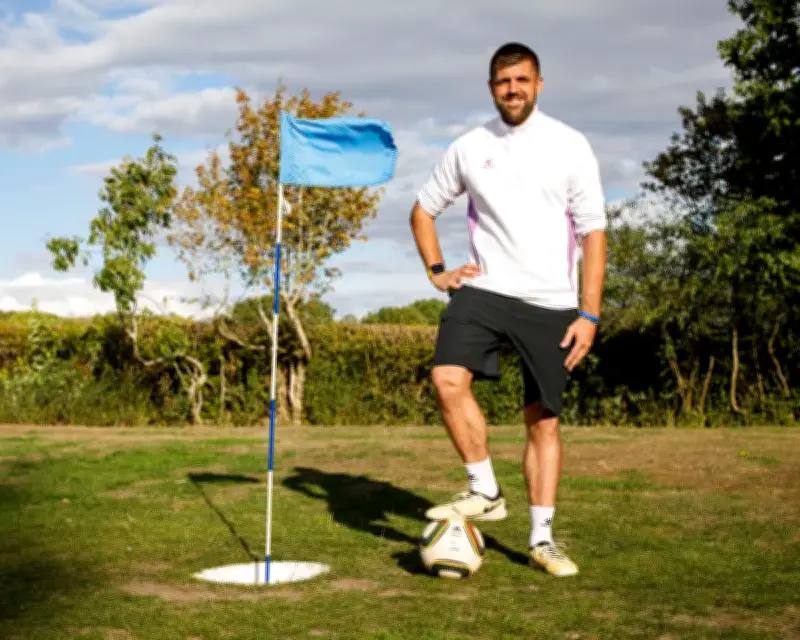
The Adidas Jabulani, widely derided as the worst ball in World Cup history, has found a second life as the prized possession of footgolfers, with boxed models now selling for upwards of £500.
Ben Clarke, the world's leading footgolfer, carefully pumps up his collection of Jabulani footballs about once a month. Like most elite players, Clarke possesses an extensive array of balls, all requiring regular inflation to prevent degradation, even those sitting pristine in their original boxes. Footballs are prime currency in footgolf, a niche sport where players kick a ball around a course into 18 oversized holes in as few strokes as possible.
The Jabulani's infamous legacy
The Jabulani, created for the 2010 World Cup, was once described by Fabio Capello as "the worst ball that I have seen in my life". England goalkeeper David James called it "dreadful", Brazil's Júlio César said it was "like one of those you buy in the supermarket", and Robinho suggested "the guy who designed this ball never played football". Its unpredictable flight at the tournament led to widespread denunciation.
Yet 16 years later, the demands of the world's best footgolfers mean anyone with a Jabulani is sitting on a goldmine. Boxed models go for upwards of £500, and the value is only increasing.
Why footgolfers covet the Jabulani
"It's a bit mad," admits Clarke, who has topped the footgolf world rankings five times. "No one could control the ball in the [2010] World Cup, but here we are using it for a precision sport. We all trust it and rely on it. It's very strange."
The reason lies in the Jabulani's precise engineering defect. Constructed from eight thermally bonded panels—a decrease from the 14 in its 2006 predecessor—the Jabulani reduced seams to a bare minimum, creating the smoothest, roundest ball ever made. When struck with minimal spin at high speeds, it caused a chaotic knuckle-ball effect. For footgolfers, who hit with the inside of their foot to generate consistent spin, the reduced seams help it travel further than any other ball. Only Adidas' offshoots from the same era, including the Teamgeist, Terrapass, Speedcell and original Torfabrik, come close.
Scarcity drives prices up
With none of these models in production for close to 15 years, elite footgolf's demand has coupled with scarcity to send prices soaring. Clarke, who has three boxed Jabulanis, says, "They are getting rarer and more expensive. I haven't bought one for a few years, just because of how expensive they are. You tend to get them off other footgolfers or collectors who sell them because they see the footgolf market. The last one I got was around £250 about three years ago, but they are now £500 or more. It can be an expensive mistake if you kick it into a tree and it bursts."
Sean Rontree, a director of footgolf's governing body in England, has three Jabulanis and three Speedcells in his collection. He foresees an imminent end point: "There will come a time when there won't be any more on the market. Adidas won't entertain making any more. We've had conversations with them, but the numbers they would have to ask for to make it profitable—around 10,000 balls—were out of our reach."
The race to find a successor
The shortage has sparked an arms race. Targeting the 1,200 players who competed in this summer's Footgolf World Cup in Mexico, entrepreneurs are attempting to create a bespoke ball that can challenge the Jabulani. Brands including FGB (Malaysia), Squb (the Netherlands), Triero (Britain) and Birdie (Brazil) have released footgolf-specific balls retailing for about £100.
FGB founder Jeffrey Cottam says, "I think, overall, our ball is superior in terms of quality and not needing repairs. But in terms of trying to beat the Jabu, I don't think anyone is there yet. The hardest bit is distance. Our ball is maybe five, six, seven metres behind the Jabu. We want to replicate the bounce of the Jabu, because that thing continuously bounces down the fairway. I'm trying to bring out a ball next year that beats the Jabu in all departments."
Clarke remains pragmatic, knowing the sport cannot survive forever on a finite, decaying stock. Until a true heir emerges, he will continue his monthly ritual of tending to his dwindling Jabulani flock. "It's bizarre what we have to do to extend the life of a ball, just so it's there when we need it," he says. "One of them gave up on me last week and started chucking air out of one of the panels, so maybe I didn't pump it up enough. The world of footgolf and balls is ridiculous."