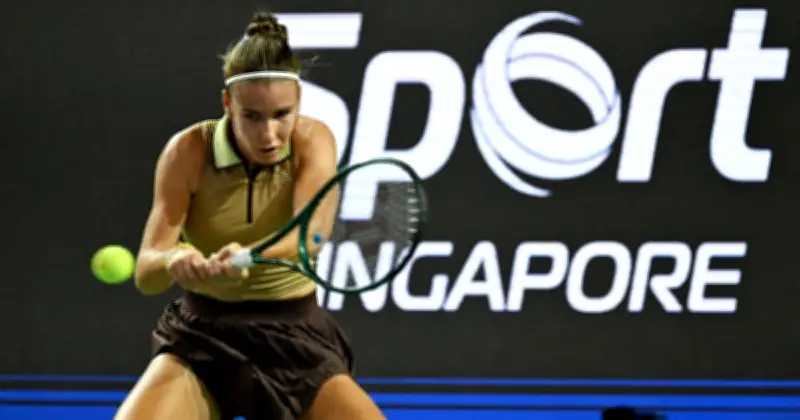
The WTA has defended its concussion protocol after Tatiana Prozorova claimed she was forced to withdraw from the Singapore Open semi-finals against her wishes. The world No. 180 beat Wang Xinyu on Friday and then played a doubles match, where she was accidentally struck in the head by a ball. Prozorova later withdrew from the tournament but issued an explosive statement claiming the decision was made against her wishes.
WTA Statement on Player Safety
The Russian said she had to complete tests with the physios, who followed “a specific WTA protocol” and “pressured the organisers” about her condition. The 22-year-old has now claimed she could be prevented from entering qualifying at the upcoming WTA 1000 event in Beijing, as she has been told to rest for 6 days.
But the WTA has now confirmed that any player who has been diagnosed with a concussion is not permitted to compete, in line with the tour’s rulebook. “Player health and safety is the WTA’s highest priority. Following the incident in Singapore, Tatiana was clinically assessed by the WTA’s on-site sports medicine team and the Tournament Physician,” a WTA spokesperson said in a statement sent to Express Sport.
“Under the WTA Physical Incapacity Rule and Concussion Protocol, a player who is diagnosed with a concussion is not permitted to compete and will be ruled physically unable to do so. The player may only return to competition once they have successfully completed the required graduated return-to-play protocol and have received appropriate medical clearance. This process is designed to protect the player’s health and safety and to reduce the risk associated with returning to competition before adequate recovery.
Prozorova’s Account of the Incident
“We fully understand that players want to compete whenever possible. However, following a head injury, our medical teams have a responsibility to protect player health and welfare and to follow established concussion protocols and internationally recognised guidelines when determining a player’s return to competition.
“Return-to-play recommendations are determined on an individual basis and kept under medical review. We will continue to support Tatiana and wish her a full and speedy recovery.”
The WTA’s physical incapacity rule also states: “During the match, if there is an emergency medical condition, and the player involved is unable to make a request for a PHCP, the Chair Umpire immediately shall call for the PHCP and Tournament Physician to assist the player.
“Either before or during a match, if a player is considered physically unable to compete, or poses a serious health risk to players, officials, or Tournament staff, the PHCP and/or Tournament Physician should inform the Supervisor and recommend that the player be ruled unable to compete in the match to be played, or retired from the match in progress.
“The Supervisor/Referee shall use great discretion before taking this action and should base the decision on the best interests of Professional Tennis, as well as taking all medical advice and any other information into consideration.”
Impact on the Tournament
Prozorova had never reached a quarter or semi-final on the WTA Tour before, and stunned No. 3 seed Alex Eala on her way to the last four. Her withdrawal meant that Talia Gibson was given a walkover into the final.
The Russian star claimed that her “dream week came to an end” and suggested that she only failed part of the physical test because she was tired. “The physio called to the court and insisted on taking me off-court to run a specific test. Unfortunately, I didn’t know I could refuse,” she wrote. “The test wasn’t easy. Given that I’d spent over three hours on court each of the last three days, I was fatigued, and I struggled with some of the exercises – like standing on one leg with my eyes closed. To be honest, even when I’m fresh and well-rested, I find that difficult anyway. I explained this to the physio, too. Of all the exercises, that was the only one they weren’t happy with, even though I passed all the others.”
Prozorova said she “felt great” after completing the doubles match, which saw her and Sofya Lansere lose to Miyu Kato and Ellen Perez, but added: “Unfortunately, the physio was following a specific WTA protocol and pressuring organisers regarding my condition.”