
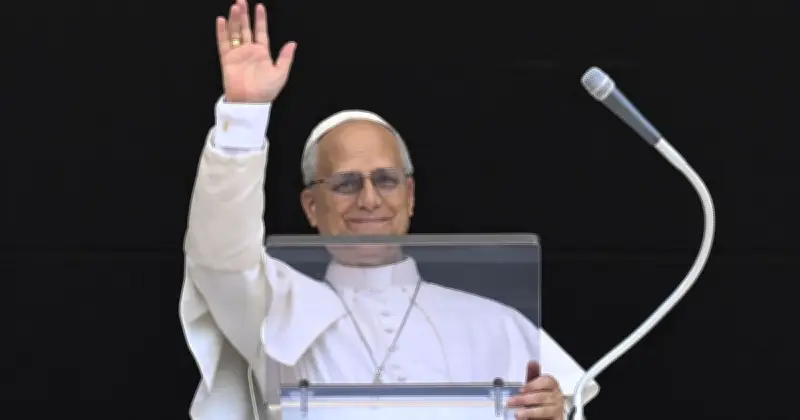
Cardinal Víctor Manuel Fernández, prefect of the Dicastery for the Doctrine of the Faith, accused the European Union of applying international law inconsistently during a closed-door conference convened by Pope Leo XIV. The pope called the meeting to address what he sees as a worldwide “culture of power” that drives modern warfare and to rethink the long-standing concept of a “just war,” which he believes has often been misused to justify violence.
Vatican Criticizes EU's Selective Application of Law
Cardinal Fernández argued that governments increasingly apply moral and legal principles according to political convenience rather than universal standards. He said: "If a country is an enemy, it is condemned as undemocratic and sanctioned in various ways; but if it is an ally, the fact that it lacks freedom of expression, human rights or democracy is ignored."
He also accused the EU of inconsistency in foreign policy, stating: "The European Union, in fact, imposes economic sanctions on one country, and sends financial aid and weapons to another; yet fails to do the same in the face of other, even more serious invasions with even more brutal consequences for entire populations."
Just War Doctrine Under Scrutiny
The cardinal also said that governments have stretched the concept of legitimate self-defence beyond its original meaning, citing Russia, the US, and other powers as relying on broad claims of self-defence to justify military interventions from Ukraine to the Middle East. He warned that the Catholic doctrine of just war has also been manipulated to legitimise "the most unjust wars," saying it should instead be interpreted "in the strictest sense" and rejecting the concept of preventive war.
According to a Vatican summary released after the discussions, many of the cardinals supported moving beyond the traditional doctrine of just war. This evolving position has sparked disagreement with political figures, including US Vice President JD Vance, who defended traditional interpretations of Catholic teaching after Pope Leo raised doubts about whether certain military actions, such as US-Israeli strikes in Iran, could be morally justified under 'just war' principles.
Context of the Iran Conflict
The war in Iran began on February 28, when the United States, alongside Israel, launched large-scale airstrikes on Iranian military, nuclear, and government sites. These strikes killed key leaders, including the then-Supreme Leader Ali Khamenei, and triggered a wider regional conflict. Iran responded with retaliatory missile and drone attacks targeting US bases and allies across the Middle East, including locations in countries such as Bahrain, Qatar, and Saudi Arabia. The fighting quickly spread beyond Iran, drawing in regional groups like Hezbollah and disrupting global oil shipments, especially through the important Strait of Hormuz, which is critical for international energy supply.
A fragile ceasefire was reached earlier this year and, at the end of the G7 meeting, Donald Trump signed a memorandum of understanding which set out the main points for peace in the region. While Iran and the US have since exchanged fire, on Monday US envoys were flying to Doha for new peace talks with Tehran on Tuesday.




