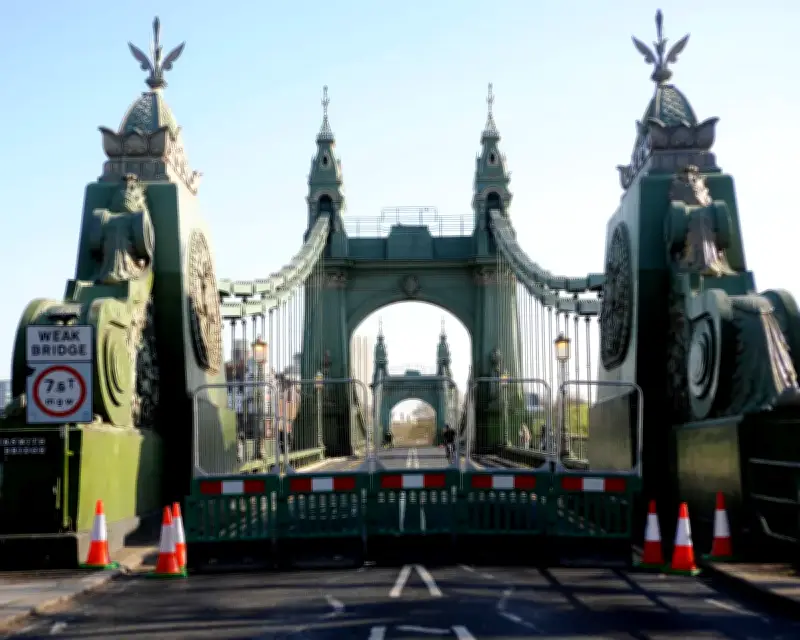
London's Hammersmith Bridge, closed to motor traffic for seven years, stands as a metaphor for the dysfunction in British government, according to Guardian columnist Simon Jenkins. The bridge, located on a bend in the Thames, is guarded by barriers resembling Checkpoint Charlie, and with Albert Bridge also closed, 37,000 extra vehicles seeking to cross the river have brought south London close to perpetual gridlock.
London's Traffic and Infrastructure Crisis
London's congestion is officially rated the worst of any capital in the world. Recent installation of computer-assisted 'smart' lights has cut just 27 seconds off individual bus journeys. A Guardian investigation last month timed trips and found the average speed for a No 22 bus between Putney Common and Oxford Circus was under 6mph, 16% slower than a decade ago.
The principal reason appears to be London's epidemic of roadworks. Estimates suggest vehicles navigate 1,300 roadworks every day, with the total for 2024 at 490,893. There is no evidence of coordination of hold-ups.
The Bridge's Predicament
Hammersmith Bridge legally belongs to Hammersmith and Fulham council, which has decided it 'cannot absorb' the cost of restoring its decaying structure, put at £300m. It claims to have spent £54m on it over seven years. Built by Sir Joseph Bazalgette in 1887, it was one of the world's first iron suspension bridges, and the iron's life has expired.
A growing body of opinion suggests it would be common sense to replace the bridge. Designing a new bridge should be a competitive challenge, respecting the buildings and natural environment of Barnes and Hammersmith on either bank.
Who Should Take the Lead
In any other city, a river crossing would be the responsibility of its mayor. London's Sadiq Khan appears to have no view on Hammersmith Bridge, any more than he does on the capital's roadworks, building conservation or policy on tall buildings.
For paying for a new bridge, there is an answer. The City Bridge Foundation, formed in the middle ages to maintain London bridges, has a charter limiting its responsibility to just five crossings: Tower, London, Southwark, Millennium, and Blackfriars bridges. Its trustee, the City of London Corporation, could amend the charter so it could reinvest in infrastructure. The foundation is one of London's richest charities, with assets in the order of £1.5bn.
The money is there. A new Hammersmith Bridge should rise across the Thames's most exquisite western reaches, and soon.