
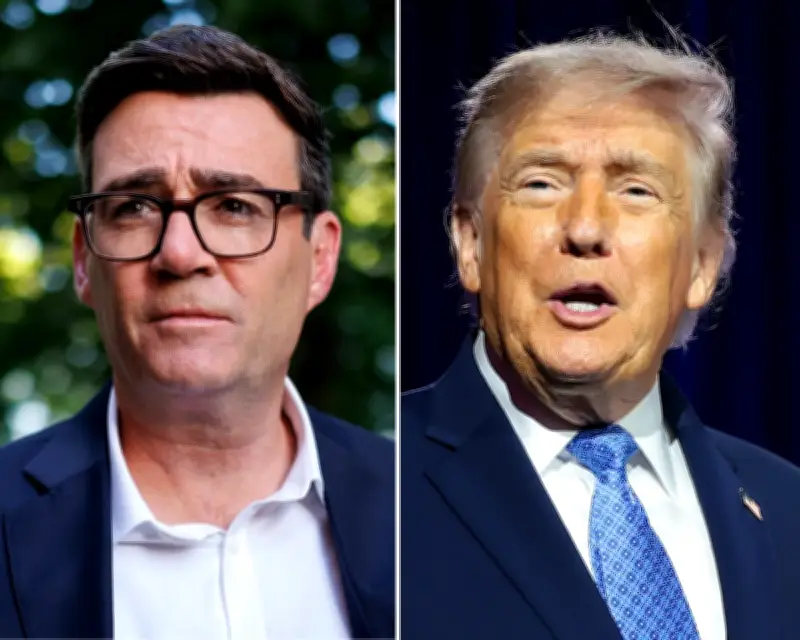
Andy Burnham, the former mayor of Greater Manchester known as the 'king of the north', is poised to become the next British prime minister. One of his first tasks will be handling a phone call with Donald Trump, a president who has been a diplomatic minefield for his predecessors. Trump, whose mother was Scottish, has a nostalgic fascination with Britain but is erratic, transactional, and demanding.
Burnham's Unknown Status Could Be an Asset
Trump appears unaware of Burnham, recently stating: 'I don't know, I think I see that he was, I guess, the mayor of a town. I hear he's extremely liberal, extremely, so that means he probably won't open up the North Sea.' Burnham has near-zero name recognition in the US, but political strategists see this as an opportunity to start afresh. Frank Luntz, a consultant and pollster, said: 'They'll probably think he's a football star. No one in America is going to know who he is. But that's an opportunity to start afresh.'
Lessons from Past UK PMs and Trump
Burnham's predecessors have struggled with Trump. Keir Starmer's early bond soured over Trump's threats to Greenland, denigration of British troops in Afghanistan, and perception that Britain failed to support its war in Iran. Trump's go-to insult became: 'This is not Winston Churchill that we're dealing with.' Theresa May was humiliated, while Boris Johnson found a kindred spirit, with Trump remarking: 'They call him Britain's Trump.'
Advice from Experts: Treat Trump Like a Constituent
Larry Jacobs, a professor of political science at the University of Minnesota, advised: 'The starting point for dealing with Trump is to accept you're dealing with an aberration, a highly unstable, erratic president who has very low self-esteem. If you do anything that kind of disrupts Trump's sense of himself, the relationship is over. My advice to Burnham would be treat Donald Trump like a constituent back home who is poorly informed and quite emotional.'
Sidney Blumenthal, a former senior adviser to President Bill Clinton, warned: 'Prime Minister Andy Burnham will be treated like other British prime ministers by Donald Trump. The special relationship has been replaced by the abusive relationship. He shouldn't take it personally. Keir Starmer was treated abusively but so was Theresa May. Trump has very low esteem for British prime ministers and extreme deference to the King of England. Trump wishes to be seen as royalty and his idea of an equivalent is a king, not a prime minister.'
Potential Strategies: Charm Offensive or Tough Love
Some experts suggest Burnham should follow the example of Zohran Mamdani, the democratic socialist mayor of New York, who has got on well with Trump by focusing on policy rather than personality. Philippe Dickinson of the Atlantic Council said: 'Mamdani is obviously on a very different side of the political spectrum but his identity isn't 'I'm the anti-Trump guy'. It's about his policy platform domestically in New York. For Andy Burnham, there are potentially some lessons there.'
Others urge a 'tough love stance'. Richard Stengel, a former undersecretary of state, cautioned: 'First of all, I wouldn't wear a red tie under any circumstances. A red tie signals that you're lying down. That universal European response of kowtowing to him and sucking up to him just turns out to be a poor strategy. He turns on everybody so even if he forms an early 'Oh, he's my friend', he'll eventually turn on you. Burnham needs a certain distance. I would no longer mention the special relationship. That is a dog that doesn't hunt any more.'
Defence Spending and Deals as Leverage
Dickinson suggests defence spending could be an early win: 'I don't expect he will be coming to Washington any time soon but, when he does, he could come with a story to tell that says, this is my approach to defence investments and this is how it is helping solve a problem for you: we are going to go further on defence.' Joel Rubin, a former deputy assistant secretary of state, advised: 'Burnham needs to come in with an agenda of what he needs from the US to advance his domestic goals, and to be ready to offer up tangible goodies to the US that will help Trump and the American people.'
However, Brendan Boyle, a Democratic congressman from Pennsylvania, warns that bowing to Trump would be domestic suicide: 'Any leader who takes on Trump benefits domestically from doing so. If Burnham says absurd, obsequious things in public, he would get absolutely hammered by his electorate.'
Conclusion: A Fractured Alliance
Burnham faces an uphill struggle, with Trump showing more interest in oil-rich Gulf nations than traditional allies. The 'special relationship' coined by Winston Churchill may no longer apply. As Burnham prepares to take office, the question remains whether the 'town mayor' from Manchester can repair this fractured alliance.




