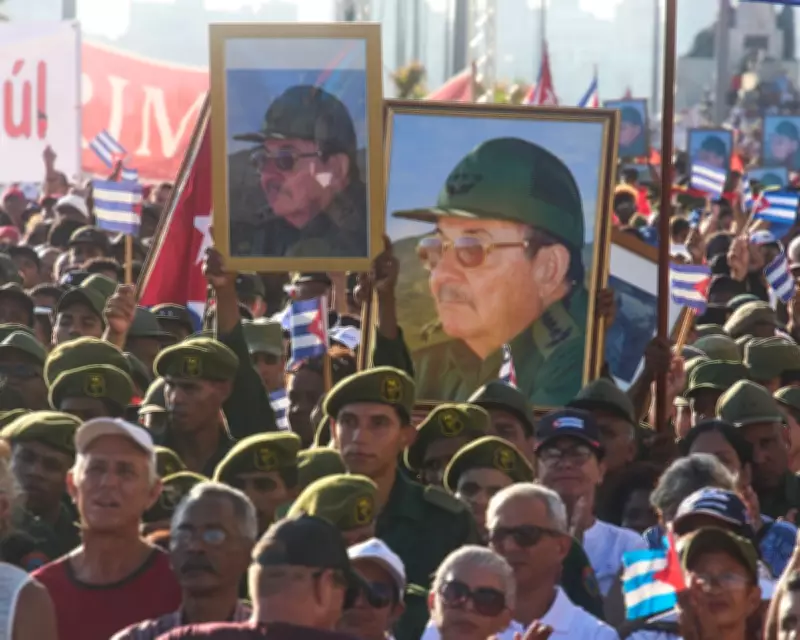
The United States continues to find ways to justify state violence against Cuba, as evidenced by the recent indictment of former Cuban President Raúl Castro. On 20 May, a federal court in Florida indicted Castro for his alleged role in the 1996 downing of two civilian planes piloted by US nationals. Castro, then Cuba's defense minister, faces charges including conspiracy to kill US nationals, destruction of aircraft, and murder.
This indictment was not unexpected. Following the Trump administration's bombing of Caracas and the extraction of Venezuelan President Nicolás Maduro in January, many observers suspected Cuba would be next. The Castro indictment confirms those suspicions, though it remains unclear what action the US will take next—whether a bombing and extraction operation, a full-scale invasion, or merely the threat of force to extract concessions.
However, this indictment is not genuinely intended to protect people from state violence. In any of these scenarios, Cuban civilians would suffer immensely. Indeed, they are already suffering due to US aggression. US policy has long relied on sanctions and embargoes to pressure Cuban leadership, a strategy that disproportionately affects civilians. The Trump administration has intensified these tactics, particularly by cutting off vital oil supplies, leading to severe shortages of food, medicine, and other materials, pushing Cuba into a humanitarian crisis.

The architects of this suffering enjoy impunity because the US legal system has historically justified imperial violence. US imperialism began with the dispossession and extermination of Indigenous nations, continued with the invasion of Mexico in 1846, and expanded through naval force abroad, as seen in Thomas Jefferson's authorization of force against North African states for alleged piracy. The Congressional Research Service's list of US military interventions includes hundreds of examples, with Cuba invaded at least ten times, including multiyear occupations in 1906 and 1917 to protect US interests.
Legal justifications for state violence have evolved over time. The piracy justification, for instance, was recently used to defend the Trump administration's deadly boat strikes, which have killed nearly 200 people on suspicion of drug smuggling. Another tactic involves accusing foreign actors of legal transgressions, demanding indemnities, and attacking when payment is not received—a pattern seen in the 1854 Greytown incident, where the US leveled an entire town after a demand was unmet. The Supreme Court case Durand v Hollins in 1860 affirmed the legality of such actions, and 21st-century justice department memos still cite it to justify foreign interventions.
The Castro indictment fits this tradition. The violence committed by the US is easily excused, while the law provides ample means to accuse foreign actors, justifying further state violence that harms civilians. This reflects a deeper societal problem beyond the Trump presidency. Even if Trump were constrained by law, the imperial legal system offers impunity for atrocious acts of state violence. What is needed is a legal system that prioritizes human rights over imperial prerogatives.
This argument is not a defense of Castro. The 1996 plane attacks were more complex than the indictment suggests. According to declassified documents from the National Security Archive, the US nationals involved were intentionally provoking a confrontation by repeatedly violating Cuban airspace, ignoring warnings from both US and Cuban authorities. Nonetheless, when states kill unarmed civilians, it is morally reprehensible. If the indictment were a good-faith effort to hold government actors accountable, it would be welcome. But it appears to be a pretext for more state violence against Cuba, which will harm an already suffering civilian population.
Undoing the imperial legal system will be a long-term process. The first step is to refuse normalization: it should not be normal for states to terrorize civilians with impunity. Civil society must demand an end to these cycles of violence.