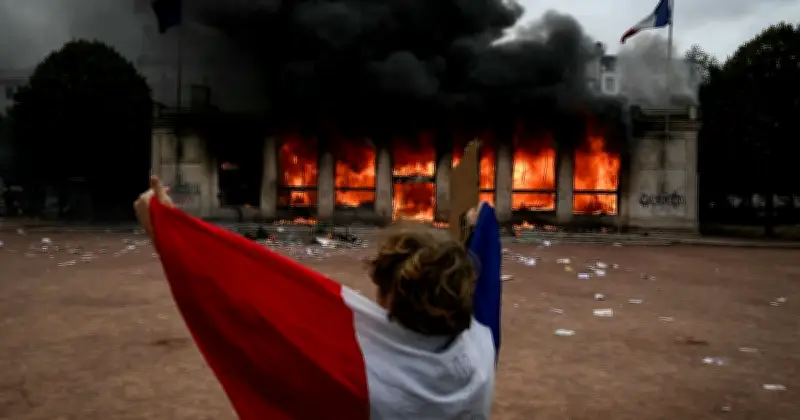
The UK Foreign Office has warned Britons travelling to France that local curfews could be introduced at short notice following some of the country's worst civil unrest in years. Cars were set ablaze, public buildings stormed and a historic city hall engulfed in flames during violent clashes between rioters and police. Around 2,400 people were detained over the weekend, while officials said thousands of businesses had been damaged or ransacked.
Curfews imposed across French cities
The violence overshadowed peaceful demonstrations over rising living costs and inadequate school facilities, which drew hundreds of thousands of people without incident. By Monday evening, several French cities had introduced partial curfews after Prime Minister Sébastien Lecornu gave certain local mayors the authority to impose them.
In Paris, movement in parts of the capital was banned between 11pm local time on Monday and 6am on Tuesday. Nice introduced a nightly curfew for young people from 9pm to 6am local time (8pm to 5am BST), lasting until next Sunday. In Lyon, a curfew ran from 9pm on Monday to 6am on Tuesday local time (8pm to 5am BST).
Foreign Office warning and official response
Young people in Coulaines were banned from being out after 11pm local time (10pm BST). Partial curfews were also reported in Lille, Douai, Wattignies and Denain, running from 8pm to 6am local time (7pm to 5am BST).
The Foreign Office issued its warning last night to Britons planning to visit France in the coming days. It read: "In response to recent events, the French government has announced that local curfews may be introduced at short notice. To find out if you are in an affected area, check local media. Follow the instructions of local authorities."
President Emmanuel Macron condemned "unrestrained violence" by "insurrectionist elements from radical far-left groups, joined by numerous criminals."
Further protests expected
Further unrest appears likely, with secondary school and university student organisations calling for more demonstrations on Thursday and Saturday. The National High School Student Coordination group urged young people to "take to the streets" and backed ongoing blockades and protests. Activists seeking to revive the 2018 "yellow vest" movement against perceived social injustices have also announced nationwide demonstrations for Saturday under the slogan "Macron must go."
Sebastian Roché, a research professor at the Sciences Po Grenoble political institute who specialises in policing, compared the destruction with the yellow vest protests at their height. That movement began in opposition to fuel tax rises and led to repeated demonstrations against Macron's government. Some turned violent, with cars set on fire, shops ransacked and the Arc de Triomphe damaged during clashes in Paris.
"In terms of destruction and damage, it is probably close to the first two weekends of December 2018," Roché said. France also experienced days of nationwide disorder in June 2023 after police killed a 17-year-old outside Paris. Rioters looted shops and set fire to public buildings. Thousands of people were detained and hundreds were injured. In 2005, three weeks of rioting prompted the government to declare a state of emergency.
Roché, who has studied policing and violence for more than three decades, said injuries caused by police equipment set the latest unrest apart. "We have a toll that has not been seen in the past 40 years," he said. According to Roché, six people, including minors, had been maimed during three weeks of protests, losing hands or eyes. Police have faced fierce criticism over their use of grenades and other crowd-control equipment during recent demonstrations.
Authorities have repeatedly blamed some of the violence on groups of "far-left radicals," followed by criminals taking advantage of opportunities to loot. Lecornu described "disorder organized in an unprecedented way." However, Roché suggested the far-left fringe was too small and loosely coordinated to be solely responsible for violence on this scale. He said French intelligence services estimated the movement had around 3,000 members across its various factions, which lacked formal structures.