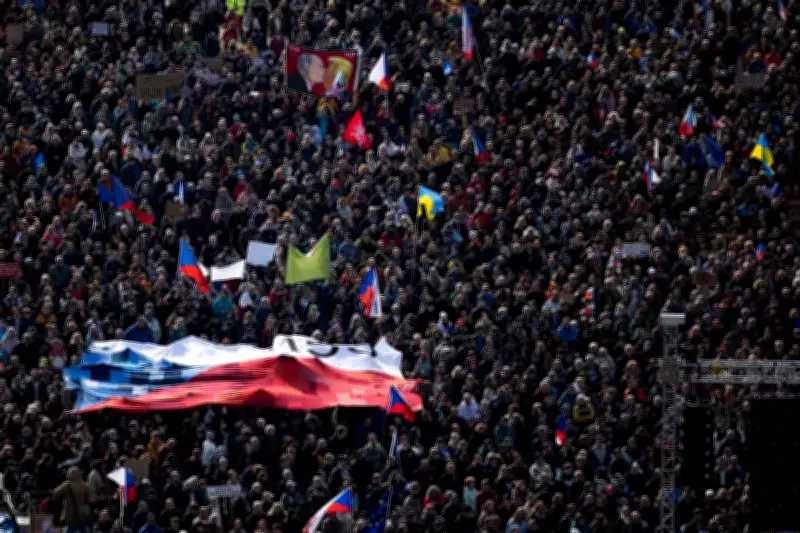
Tens of thousands of demonstrators flooded the streets of Prague on Saturday, converging at the historic Letná park to voice fierce opposition to the policies of the new Czech government led by populist Prime Minister Andrej Babiš. The rally, organised by the Million Moments for Democracy group, drew an estimated crowd of 200,000 people from across the nation, many waving Czech national flags and holding banners with slogans such as "Let's defend democracy." Protesters expressed deep concerns that the billionaire leader and his coalition cabinet are steering the country toward an autocratic path, mirroring trends seen in Hungary and Slovakia.
Historical Significance and Political Context
The choice of Letná park as the protest venue carries profound historical weight, as it was a key site for mass gatherings that contributed to the fall of communism in 1989. Organisers emphasised this symbolism to highlight what they perceive as a new threat to democratic freedoms. Mikuláš Minář, the head organiser, stated, "We're here to clearly stand against dragging our country onto the path of Slovakia and Hungary," referencing the pro-Russia and autocratic leanings of those nations. The protest comes amid significant shifts in the Czech Republic's political landscape following the October election, where Babiš's ANO movement secured a victory and formed a coalition with the Freedom and Direct Democracy party and the Motorists for Themselves group.
Controversial Policies and Allegations
The new government has sparked outrage with plans to introduce a bill inspired by Russian legislation on foreign agents, which would require NGOs and individuals involved in vaguely defined political activities receiving foreign aid to register or face substantial fines. Critics, including Václav Pačes, the former head of the Academy of Sciences, warn that this law "can easily be used to restrict personal freedom." Additionally, the government is proposing changes to the funding of public radio and television, a move many fear would grant the state undue control over broadcasters. These policies align with Babiš's opposition to key European Union initiatives on environment and migration, as well as his rejection of financial aid for Ukraine, placing him alongside leaders like Viktor Orbán of Hungary and Robert Fico of Slovakia.

Legal Immunity and Public Outcry
The rally was partly motivated by a recent parliamentary decision to reject a motion to lift Prime Minister Babiš's immunity from prosecution in a $2 million fraud case involving EU subsidies. This rejection means he cannot stand trial until his term expires in 2029, a move that organisers claim creates a division between "the ordinary people and the untouchables." Lawmakers also refused to allow the prosecution of lower house Speaker Tomio Okamura on charges of inciting hatred, further fuelling public anger. Protesters like 19-year-old student Michael Černohlávek expressed a personal stake in the demonstration, stating, "I came to defend something that is extremely important to me. I know that the system we have, our freedom, can't be taken for granted."
Future Protests and Broader Implications
Organisers have announced plans for additional protests, signalling ongoing resistance to the government's agenda. The event underscores growing tensions in the Czech Republic over issues of democracy, foreign policy alignment, and governance. With Babiš's wealth estimated at over $4 billion by Forbes, his leadership continues to polarise public opinion, raising questions about the future direction of the nation within the European Union and on the global stage.