Paul Barry, the investigative journalist and former Media Watch host, has written a new book, The Big Steal, about the empty promises of steel tycoon Sanjeev Gupta. In an interview with Guardian Australia, he discussed his career, his run-in with Alan Bond, and the challenges facing modern journalism.
A walk through Kamay Botany Bay national park
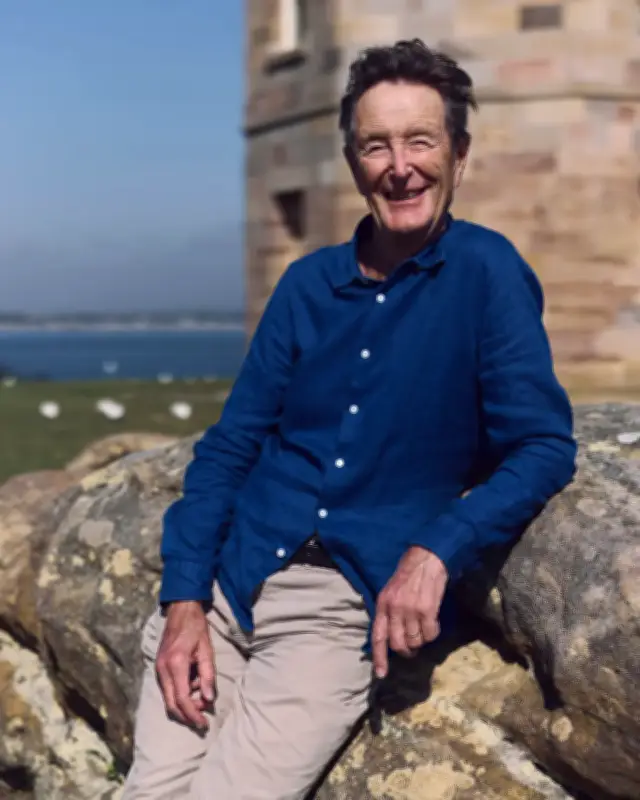
Barry met the Guardian reporter for a hike through Kamay Botany Bay national park in Sydney's La Perouse, choosing the Henry Head walking track. “It's a very restful place,” he said. “You can often see whales breaching.”
Barry, now 74, has six children aged 21 to 48. He moved to Australia from the UK 40 years ago as “a bit of an adventure”, but was also frustrated by his lengthy commute from a village in the Cotswolds to London, where he worked at the BBC on Newsnight and Panorama.
“Then when I got here I thought: you can do both!” he said. “You can work and live near the beach, have a family – and see your family. The weather's good, the people are nice and the place is gorgeous. So why go back?”
Staring down Alan Bond
Barry joined the ABC's Four Corners team as an investigative reporter as soon as he arrived in Sydney. A shining moment in his early career was when disgraced businessman Alan Bond – who was claiming to have brain damage during a criminal trial at the time – stamped on one of his business cards outside a Sydney court.
“He was as fit as a flea and absolutely mentally fine, so this whole thing was a complete pantomime,” said Barry. “We bailed him up as he came up to court and I presented him with a business card and said: 'Do you remember me?' He stamped on it, and I said: 'Ah! So you remember me! So your brain's not that bad.' It was kind of a gotcha.”
Barry and his producer were rapped on the knuckles by the court shortly afterwards. “It was an outrageous thing to interfere with the legal process,” he said. “[But] the legal process was pathetic! Here was a guy who was lying through his teeth, and they could do nothing about it – or did do nothing about it.”
The Big Steal and Sanjeev Gupta
Barry published his first book, The Rise and Fall of Alan Bond, in 1991. He's since written about Kerry Packer, James Packer, the Murdochs, Shane Warne and Bond again. His latest book is The Big Steal, about the empty promises of steel tycoon Sanjeev Gupta.
The British businessman, whose company GFG Alliance owns several steel, aluminium and iron businesses around the world, bought the Whyalla steelworks in 2017 promising to invest US$1bn to save the South Australian town's leading employer. But after mounting debts to suppliers, the collapse of GFG Alliance's main lender, Greensill, and a blast furnace in dire need of maintenance, the SA government forced the steelworks into administration in 2025, appointing KordaMentha as the administrator. Last month it was announced 500 permanent jobs would be lost at the steelworks.
“Gupta was supposedly a saviour; he had this great narrative of him saving the planet, and saving western manufacturing and saving all these communities,” said Barry. “There are probably 4,000 jobs that depend on it out of 8,000 jobs in the town.” Several countries are now investigating Gupta's business dealings, including Asic in Australia. Simply put, “it's a scandal”, said Barry.
The media's role and the future
Barry didn't speak with Gupta for The Big Steal, despite his best efforts, but he did interview several people who worked for him. Some found Gupta “incredibly charming and persuasive”, others called him a narcissist. Why were people – including the media – so willing to believe in the “steel saviour”? “I think they were desperate, and I think he had a vision they wanted to believe in – why wouldn't you believe in saving the planet, saving these communities and saving the steel industry? It was a story that everyone wanted to believe and they just didn't look hard enough.”
Barry doesn't have another book in the works – yet. He would like to write about Gina Rinehart, but “it is a suicide mission”, he says. She's so litigious. “[But] people should not be off limits like that; people in public life like that should be able to be written about and analysed.”
After almost 12 years at the helm of Media Watch (his last episode was in 2024), Barry is critical but empathetic to the work of journalists today. “I think there are a lot of people in the media who are still doing fantastic work,” he said, but “everyone is incredibly stretched, money is short, attention spans of audiences are short, the need to get clicks or drive the figures is enormous, and the pressure on people to produce something is excessive. People are working too hard with too little resources and too little time to really dig and really find out what's going on.”
Australian mainstream media did “a pretty poor job” of covering Gupta, he said. “[They were] not prepared to do the due diligence to see whether any of the story was true, where the money was coming from, if he had any money [and] if the regulators were after him.”
The Big Steal by Paul Barry is out now (Allen & Unwin; $36.99).