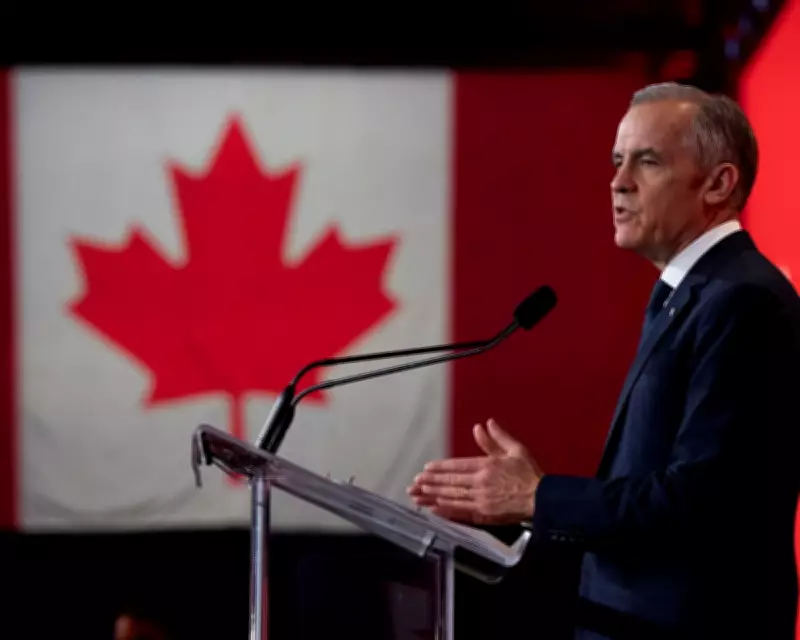
Mark Carney's Unprecedented Bid for Majority Government in Canada
Canada's Prime Minister, Mark Carney, stands on the verge of securing a majority government, with his Liberal party expected to triumph in at least two closely monitored byelections and attract an "almost unprecedented" series of defections from rival political factions. Carney's adeptness at transforming a robust minority into a slender majority through electoral victories and floor crossings has bolstered his image as a pragmatic leader who transcends the typical partisan fray. However, his strategy to incorporate lawmakers from across the political spectrum has ignited intense internal discussions regarding the Liberal party's core values and the potential hazards of amassing greater authority.
Byelections and Defections Shape Political Landscape
On Monday evening, the outcomes of three byelections are anticipated to grant the Liberals control of parliament. Among these contests, two are situated in districts considered safe for the party, while the third is projected to be decided by the narrowest of margins. These electoral events follow a recent surge in floor crossings, with Marilyn Gladu, a Conservative MP, becoming the fourth Tory to defect and align with the Liberals just last week. Additionally, Lori Idlout, a leftwing New Democratic party MP from Nunavut, has joined Carney's ranks, and the deputy leader of Ontario's NDP is set to run as a Liberal in a Toronto byelection, a seat she is favoured to win comfortably.
Scott Reid, a political adviser and former communications director for ex-Liberal prime minister Paul Martin, remarked, "Pulling people from such diverse political origins at a time when the prime minister is vulnerable while leading a minority parliament is almost unprecedented. At minimum, it's really unique and worthy of real reflection. What the hell is going on?" Reid attributes this political shift partly to the lingering impact of Donald Trump, whose threats to annex Canada and multifaceted economic assaults have fostered a desire for stability among Canadian politicians, prompting some to eschew partisanship in favour of a nationalist stance.

Internal Tensions and Conservative Backlash
Reid elaborated, "Trump gave rise to Carney and his unique talents. Now, we're watching another effect of Trump on our politics: a desire for stability. The perception is Carney is a wartime leader. And in so many respects, what we're watching is the quietest assembly of a union government we've ever witnessed." Conversely, Conservatives have voiced strong criticism, with leader Pierre Poilievre condemning the defections on social media, stating, "Mark Carney seizing a costly Liberal majority that voters denied him, and doing so through backroom deals." He referenced Gladu's earlier remarks that floor crossers should face voters in byelections, adding, "I couldn't agree more. She should do so."
The departure of Gladu, a social conservative, deals a significant blow to Poilievre, who is grappling with growing discontent within his party despite a recent leadership review victory. Rumours persist that more Conservatives may consider switching to the Liberals, with Reid warning that this poses a serious threat to Poilievre's political viability. Meanwhile, Gladu's move has provoked friction within the Liberal party over the ideological costs of expanding its coalition, given her support for the "freedom convoy" during the pandemic and anti-abortion views that conflict with Liberal pro-choice policies.
Values Debate and Strategic Risks
Supriya Dwivedi, a columnist and former adviser to Justin Trudeau, questioned the party's adherence to values on social media, while Carney assured reporters that Gladu remains committed to voting with the government on abortion rights, emphasising no change in Liberal values. Gladu later affirmed her support for women's right to choose, stating she would vote accordingly. Jordan Leichnitz, a former senior strategist with the NDP, noted that such value clashes are understandable when the Liberals are perceived as a "pure power broker party," where ideology often takes a backseat to governance.

Leichnitz explained, "Historically and currently, the ability to form and hold government is the primary thing that unites people on the Liberal benches. Ideology has always been secondary to that. But Carney is a compelling figure in this trade war with Trump and a lot of people want to be part of that fight." Polling indicates Carney has extended his lead over rivals since the April 2025 federal election, positioning the Liberals for a potential historic majority if a snap election is called. However, Leichnitz cautioned against overreaching, warning that overtly political manoeuvres, such as accepting defectors with conflicting values, could undermine Carney's brand strength by appearing to prioritise power over principles.