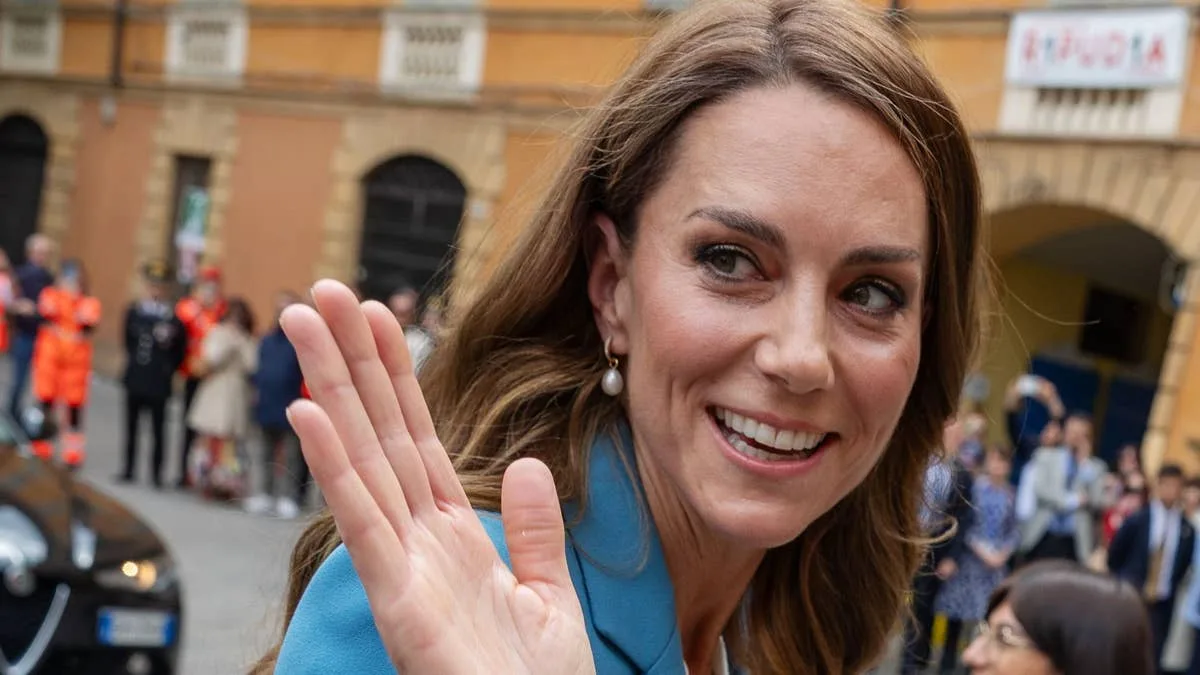
The Princess of Wales surprised fans and etiquette experts alike as she stepped out for her first foreign solo visit in three years yesterday. Catherine, 44, received a rapturous welcome from a crowd of 1,000 people as she arrived for a two-day trip to the northern Italian city of Reggio Emilia to advance her crusade for improving young lives.
A Warm Welcome in Reggio Emilia
Dressed in an elegant blue Edeline Lee trouser suit, the caring princess delighted well-wishers by greeting them with 'Mi chiamo Catarina' and bending down to hug excited schoolchildren and pose for pictures. However, as she lowered herself to the youngsters' eye level, Kate placed her Asprey powder blue handbag on the floor of the Piazza Camillo Prampolini, outside the town hall.
The Etiquette Faux Pas
The lavish sky blue handbag, which retails at £3,995, perfectly complemented her suit, which had a subtle nod to Italian history and culture. Yet for many etiquette experts, placing the handbag on the floor could be considered a mild faux pas, with the act seen as bad luck, dirty, or disorganised. When the princess moved on to her second engagement at the Loris Malaguzzi International Centre, she perhaps noted her brief mishap and instead clutched a large bouquet of striking flowers, leaving the handbag behind.
The handbag dilemma is not unusual for royal women. Queen Camilla faced the same issue just two weeks prior during her US state visit with King Charles. Ahead of the monarch's speech at US Congress, Her Majesty was spotted placing her handbag on the floor to keep it out of sight of cameras, prompting etiquette experts to call it an 'oversight'. Etiquette coach Alison M. Cheperdak told Fox News that it was a 'game-time decision' for the Queen. Meanwhile, the late Queen Elizabeth II was famous for never placing her handbag on the floor in light of such rules.
Significance of the Visit
Kate's visit to northern Italy held vast significance, marking her first overseas official trip since she went to Denmark in 2022, before her cancer treatment. Her first engagement was at the city's town hall, where she met the mayor. Outside, she spent 15 minutes meeting fans who had travelled to see her. Inside, she was awarded the Primo Tricolore, the city's highest honour. In the main chamber, the 'Sala del Tricolore', adorned with Italian flags, she posed for a photograph with the mayor, Marco Massari, and Salvatore Angieri, Prefect of Reggio Emilia, before a short ceremony.
After hearing the translated version of her credentials, the princess put her hand on her heart and said: 'Wow, what an honour. I'm very grateful, it's very gratefully accepted.' She then spent half an hour sitting down with local 'nonnas' who told her of their work spreading the Reggio Emilia method of early years education.
A 'Crowd Bath' and More Engagements
After signing the visitors' book, she stepped out into the square for a walkabout, which the Italians call a 'crowd bath'. Greeted with whoops and shouts of 'bellissima' and 'Kate!', she launched into the crowd, where people had been waiting up to five hours. She told the mayor the warm welcome had left her 'emotional, seeing everyone'.
Kate then visited the Loris Malaguzzi International Centre, where she showed her versatility in an immersive clay workshop. Her final engagement of the day was at Scuola Comunale d'infanzia Anna Frank, a municipal pre-school for three to six-year-olds. She took part in a creative session with the children and joined pupils and parents to discuss the impact of the Reggio Emilia approach.
A Phased Return to Royal Duties
Prior to Kate's arrival, palace aides said the foreign trip was a 'huge moment' for the princess. One source said: 'She's looking forward to being here, she's energised, she's enthused, she's excited to see Reggio Emilia in action and meet the people here too. This is a global mission.' As she begins a phased return to royal duties, aides have remarked that there is a different pace to her work, with one saying she is 'taking it up a gear'. Although the future queen began a slow return to public life nine months after treatment, being officially in remission in January 2025, this is her first overseas work trip.
The visit highlights the origins of the world-renowned 'Reggio Emilia approach' to 'child-led' early years education, similar to Montessori. Following the Second World War, residents—many of them women—financed some of Italy's inaugural nursery schools by selling scrap metal salvaged from equipment left behind by retreating German forces. These pioneering efforts laid the groundwork for an educational philosophy now influential worldwide, aligning closely with Catherine's focus on children's social and emotional wellbeing.