Federal Judge Orders Another Construction Pause on White House Ballroom Project
In a significant legal development, District Court Judge Richard Leon has once again ordered the Trump administration to halt construction on the White House ballroom, while delivering sharp criticism of government lawyers he described as "disingenuous" in their arguments.
Judge Leon's Scathing Order
In a detailed 10-page order issued on Thursday, Judge Leon rejected the administration's claims that his previous injunction didn't apply to ballroom construction due to national security concerns. "It is, to say the least, incredible, if not disingenuous, that Defendants now argue that my Order does not stop ballroom construction because of the safety-and-security exception," the judge wrote in his strongly worded decision.
This marks the second time in just two weeks that Judge Leon has ordered construction paused on the controversial $400 million project. The judge has previously expressed frustration with government attorneys handling the case, and Thursday's order continued this pattern of judicial skepticism toward administration arguments.

National Security Arguments Under Scrutiny
The legal battle centers on whether the White House needs congressional approval for the massive 90,000-square-foot structure. While Judge Leon has consistently permitted below-ground construction related to national security to continue, he has maintained that above-ground ballroom construction requires proper authorization.
Government lawyers had argued to an appeals court that construction delays would undermine national security and "implicate the personal safety" of the president. The appeals court subsequently asked Judge Leon to reconsider these national security implications, leading to Thursday's clarification order.
Contradictory Claims and Underground Facilities
Judge Leon noted that the administration's latest assertions directly contradicted their previous claims that below-ground work on a military-grade bunker was separate from above-ground ballroom construction. This contradiction appears to have influenced the judge's assessment of government arguments as less than credible.
The underground facility has been described by President Trump as including "major medical facilities," a "hospital," and "bomb shelters" - potentially similar to the Presidential Emergency Operations Center that was originally located under the White House East Wing. Last month, the president revealed military involvement in building what he called a "big complex" beneath the ballroom structure.
Specific Construction Permissions and Limitations
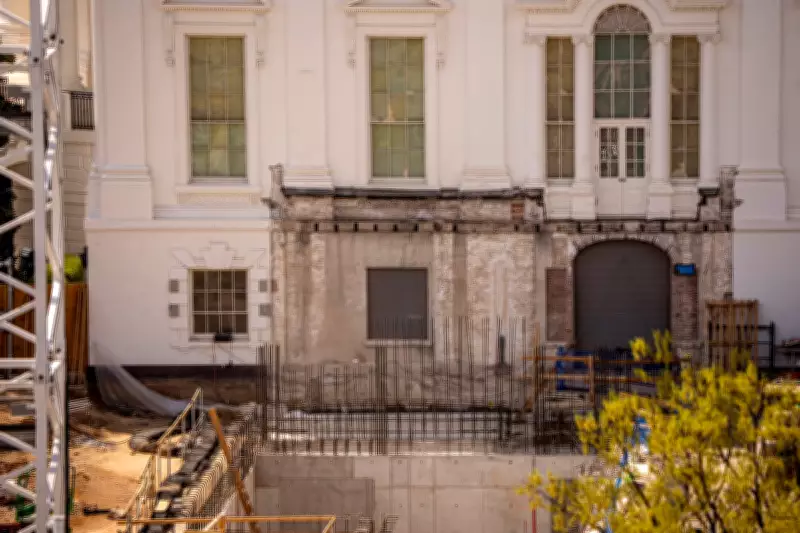
Despite the overall pause, Judge Leon clarified that certain construction activities could continue. These include work necessary for structural integrity and safety, such as "waterproofing, water management, structural reinforcement, and sealing off exposed construction areas" - provided these activities don't effectively "lock in" the above-ground ballroom design.
The judge also permitted below-ground construction and any above-ground work essential to covering, securing, or protecting the underground facility. However, he emphasized that his role was not to become a "construction manager" for the project.
Background and Previous Rulings
The controversy dates back to October when the White House demolished the East Wing to make room for the ballroom without congressional approval. In his original ruling, Judge Leon rejected the administration's broad national security arguments, noting that "the existence of a 'large hole' beside the White House is, of course, a problem of the President's own making!"
Judge Leon concluded his latest order by reiterating his previous rejection of claims that "any construction delay will undermine national security," stating that "Defendants themselves forged ahead and created this 'coordinated and managed safety hazard' on White House grounds."
The legal standoff continues as the administration seeks to advance the controversial project while facing judicial skepticism about both its legal authority and the credibility of its national security justifications.