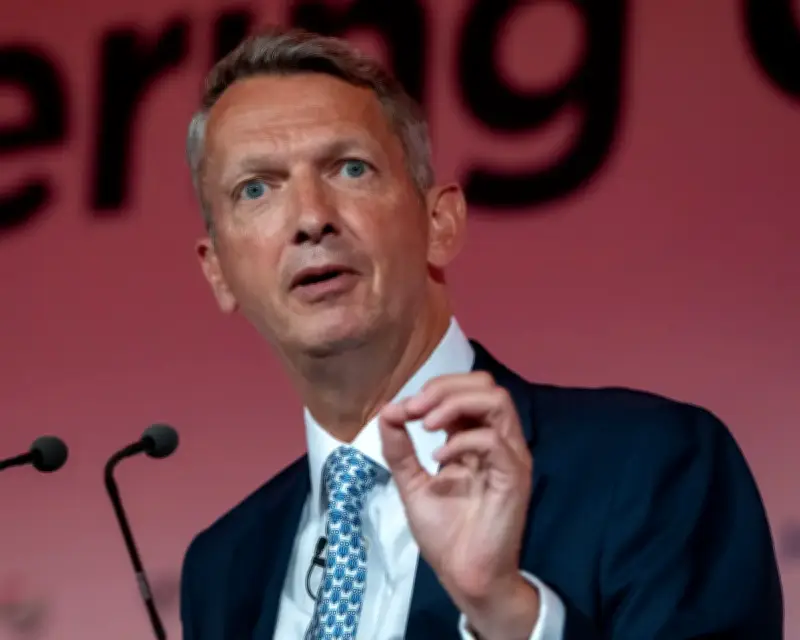
Former Bank of England chief economist Andy Haldane has said the Conservatives' economic policies are "far more likely to succeed" than Labour's, in an article published in the Financial Times.
Haldane, who spent most of his career as an official at the Bank and was viewed there as an independent thinker, had informally advised Andy Burnham at one point in the summer. He was brought up in the north of England and is committed to regional growth, which is one reason Michael Gove hired him as a levelling up adviser.
However, any suggestions that Haldane is a Burnham supporter have now been quashed by the article, in which he argues that the rightward fork on economic policy is "far more likely to succeed" in today's straitened circumstances.
Haldane's analysis of party policies
In the article, Haldane writes: "In the decade since Brexit, both parties have swung simultaneously right on social policy and left on economic policy. The interventionist economic agendas of Conservative prime ministers Theresa May, Boris Johnson and Rishi Sunak would not have been out of place under New Labour. At the 2024 general election, only a vape wrapper separated the parties' economic manifestos. Today, those differences are stark."
He adds: "Andy Burnham's conference speech was a homage to 1950s-style state socialism. Kemi Badenoch's speech was also a throwback, but to the smaller state and lower taxes of the 1980s. Which offers the more likely path to growth? In today's straitened circumstances, the rightward fork is far more likely to succeed."
Criticism of austerity and current fiscal context
Haldane argues the Tories have not always been right, saying George Osborne's austerity policies were a mistake. He writes: "At the time of austerity, UK government debt was not only far smaller than it is today, but the cost of servicing it was lower than at any time in human history. Remarkably, the country's long-term borrowing costs were negative in inflation-adjusted terms for protracted periods. There will probably never have been a better time for public investment. Yet funding was cut and a £2tn investment gap opened up relative to international competitors, stunting growth."
He says veering right was wrong, but in the current circumstances, Conservative policies would be best for growth. He writes: "Today's fiscal environment is fundamentally different. Long-term borrowing costs have risen 4-5 percentage points and now sit above estimates of the UK economy's long-term nominal growth rate. That signals the need for primary fiscal surpluses, on a sustained basis, if the UK's debt dynamics are to stabilise."
Labour's plan and risks
Haldane says the Labour party's plan for an expansive (and expensive) state "sits uncomfortably" with this precarious fiscal backdrop. He notes that public-sector productivity has failed to rise this century, and that both state financial capacity and personnel capability are at present sources of economic weakness, not strength.
He argues that in this debt-laden environment, the pursuit of a larger state is more likely to crowd out than crowd in growth, and runs the risk of a loss of confidence in bond markets that causes borrowing costs to ratchet — think "Liz Truss-plus".
He concludes that the Conservatives' economic plans are better suited to that task, for example through cuts to business and employment taxes and regulation to unleash animal spirits, and by slimming government spending to lower borrowing costs, as the IMF and Bank of England have recently highlighted.