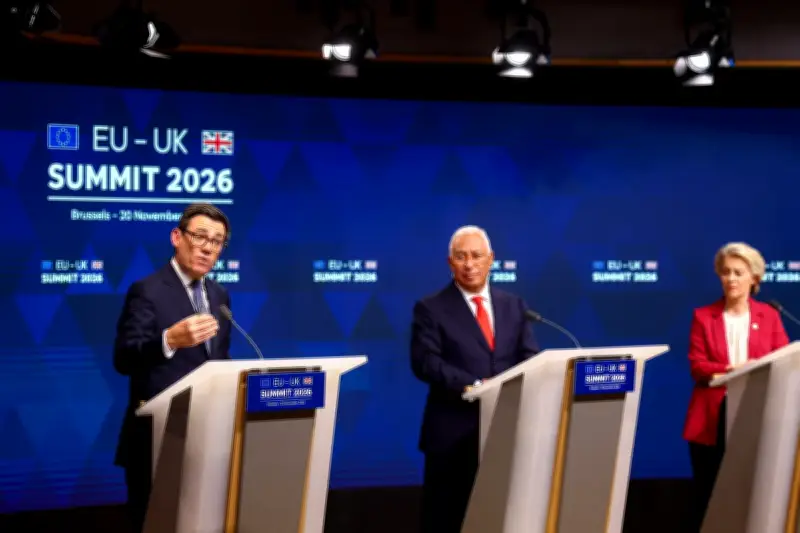
Prime Minister Andy Burnham has said his deal with the European Union will add up to £17 billion a year to the British economy, as he met EU chiefs in Brussels to finalise an agreement covering food, emissions and youth mobility.
Speaking alongside European Commission president Ursula von der Leyen and European Council president Antonio Costa, Mr Burnham called it a “good day for Britain and a good day for Europe”. The package includes a sanitary and phytosanitary (SPS) deal to end most post-Brexit checks on food and agricultural products, linking emissions trading schemes, and a youth experience scheme that could allow 100,000 young Europeans to work temporarily in the UK.
Deal Details and Economic Impact
Under the agreement, most post-Brexit checks on food and agricultural products will be ended. Linking emissions trading schemes will exempt £6.5 billion of British exports, including from steel and aluminium industries, from EU carbon border taxes. The youth experience scheme will allow UK and EU citizens aged 18 to 31 to live and work in each other's jurisdictions for up to three years, with 100,000 visas available.
Mr Burnham said Treasury analysis suggested the deal would add up to 0.5% to gross domestic product by 2040, cut costs for business and help with “the cost of the weekly shop”. He said the next 12 months would be spent “brainstorming” ideas with the EU for the future relationship between the UK and the bloc.
Political Context and Future Relations
The Prime Minister suggested the package agreed with Brussels was “probably the limit” of what could be achieved before the next general election. He has committed to abide by Labour's manifesto red lines ruling out a return to the single market, customs union or free movement.
Mr Burnham said the deal would “draw a line on a decade of drift and division by reconnecting with old friends”, adding: “I think people across Britain can look forward now to a better, more hopeful decade ahead of us.” He has promised to set out options for the future UK-EU relationship, including the possibility of seeking to rejoin the bloc, which would involve an “informal brainstorming process” with the EU.
Tuition Fees Stumbling Block
A potential stumbling block remains over the tuition fees charged to students from the bloc in British universities. A six-month deadline has been set to reach agreement after EU member states called for their students to be charged the same rate as British counterparts, meaning a cut from fees of up to £38,000 a year to £9,970 – something the UK has resisted because of the financial impact it would have on universities.
Mr Burnham said there was “no confusion” over the status of the deal, stating: “There are firm dates for the implementation of the changes to the different policy areas in the deal, and there will be further discussions coming out of it as referenced in the text, around various issues, of which tuition fees is one.”