
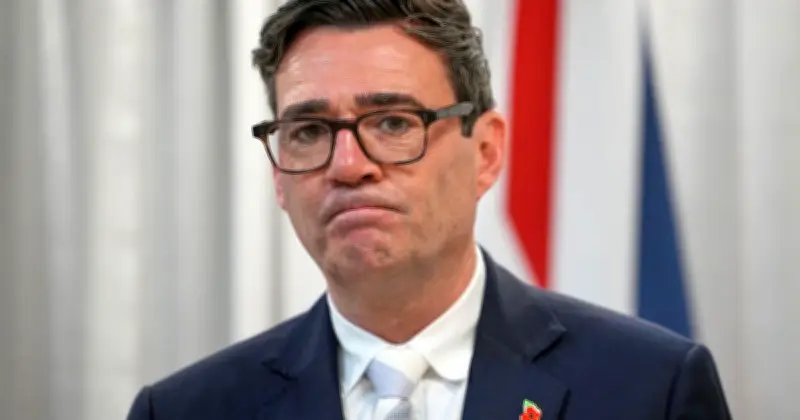
Home Secretary Shabana Mahmood has rejected Prime Minister Andy Burnham's claims that Brexit prevented Britain from returning migrants to Europe, conceding that the Dublin Convention produced few returns.
Ms Mahmood acknowledged that "we didn't return very many people" under the Dublin Convention, which was championed by supporters of the EU. She also admitted Labour is "watching" Brussels' new asylum pact "with interest", warning that "at the moment, there are no meaningful returns at scale".
Labour's internal debate over Channel returns
The intervention is expected to reignite a debate within Labour about how to increase Channel migrant returns, after Mr Burnham suggested closer ties with the EU as a potential solution.
Labour is yet to secure a migrant returns hub agreement, despite promising this in 2024. Deportations to migrants' country of origin remain extremely low.
Former Border Force chief Tony Smith accused Mr Burnham of peddling a "myth" to "try to persuade people that the small boats crisis was due to Brexit and would be fixed by rejoining". He added: "Dublin never worked for us – and the EU Asylum Pact won't either".
Dublin Convention returns data
Ms Mahmood told GB News: "Under the Dublin Convention, we didn't return very many people either.
"Most EU states don't return people from within the European Union [because] pretty much everyone's in the same boat.
"We all want to remove people from our territory [and] nobody really wants to receive people into their territory.
"That's something that the EU is still working on as well, because that system of returns within the EU isn't up and running or working, and it's not something that was available to us even under the Dublin regulation."
Mr Burnham said last month: "The reason the small boats crisis has arisen is because we can't return people, and people know we can't do that in the same way that we used to be able to do".
Only 1,253 migrants were returned to Europe under the Dublin Convention between 2016 and 2020. Over the same period, 3,830 migrants were transferred into Britain.
Low removal rates and data sharing concerns
Fewer than 10,000 Channel migrant arrivals have been removed since the small boats phenomenon emerged in 2018. This means less than 5% of those detected in a dinghy have been removed, heaping more pressure on an asylum system which cost £4.35bn last year.
The Daily Express earlier this year revealed more small boat migrants have been returned to Ireland, 57, than Syria, 55 and Afghanistan, 16. The same number have been sent back to Somalia and Tunisia as the United States of America – all 3.
The Home Office effectively started relying on Labour's one-in-one-out deal with France to deport the most challenging cohorts of migrants, often prohibited from removal by the European Convention on Human Rights.
Border Security Commander Duncan Capps told MPs: "I would say it has been a success. We managed to return 1,631 illegal entrants, all of which were from countries we would have had difficulties returning otherwise.
"Did it scale to the level I would have liked it to? No, it didn't."
Only 3,310 people were removed in the year to June. A third of these were to Albania. The biggest cohorts to cross the Channel – Afghans, Somalis, Eritreans, Iranians and the Sudanese – accounted for fewer than 800. More than 21,000 from these countries arrived over the same 12 months.
The Prime Minister also used his Brexit warning to point out the UK no longer has access to the EU's migration data-sharing processes. Eurodac, to which the UK had full access before leaving the EU, stores the fingerprints of asylum seekers and certain irregular migrants, allowing authorities to identify previous asylum applications in other member states.
Ms Mahmood appeared to agree with the Prime Minister's assessment on cross-continent data-sharing. She told GB News: "There is no doubt, and the Prime Minister is right about this, that losing access to those databases across the European Union has had an impact on our ability.
"One of the things I talked to my EU counterparts about is having more collaboration and data sharing so that we can also track the same people when they're coming into our country.
"We're watching their EU Asylum Pact that they have between them with interest.
"But, at the moment, there are no meaningful returns at scale between EU countries."




