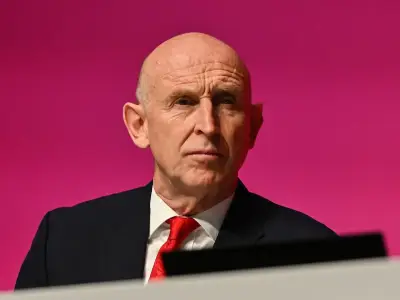
Bank taxes are set to rise by less than some in the industry had feared, as the Chancellor said he was asking “a bit more” from banks to help fund support on energy bills.
Banks will pay an extra 3% on the corporation tax surcharge, John Healey announced in his autumn Budget statement. This will bring the surcharge from the current 3% level to 6%.
Smaller than expected hike
It is a smaller change than the hike to 8% that some reports had suggested he was considering – which would have reversed the tax cut brought in by the former Conservative government.
The measure will also be temporary rather than permanent, kicking in from January 1 and ending on March 31 2028.
This helped deliver a boost to bank shares on Wednesday afternoon, with shares in Britain’s Lloyds Banking Group, NatWest Group and Barclays all up by around 3% following the statement.
Chancellor's message to banks
Mr Healey said he was “asking a bit more of our banks to support ordinary people”.
He told the Commons: “As Chancellor, I want to say directly to our banks, I celebrate and am grateful for the role you play.
“Amid global economic storms, I am looking to our banks to help fund breathing space for British families.”
The surcharge is an extra tax on the profits that banks make. It sits on top of the standard rate of corporation tax which is 25%.
Revenue and industry reaction
Increasing the rate for the 15-month period is expected to raise an extra £1.5 billion, according to the Office for Budget Responsibility (OBR).
But the OBR said this was net of an estimated £190 million reduction in receipts as some banks are assumed to move their profits outside the UK in response to the higher tax rate.
Bosses of the biggest groups representing financial services, including UK Finance and the CBI (Confederation of British Industry), have spoken out against hiking taxes in recent weeks, arguing it will damage the attractiveness of the UK as a place to grow and invest. They say banks are more likely to move their offices outside of the UK and to other financial hubs where the tax burden is lower.
However, some experts said the change is less severe than proposals discussed ahead of the Budget.
Gary Greenwood, equity analyst for Shore Capital, said banks had “escaped relatively lightly, particularly compared with some of the more punitive measures discussed ahead of the Budget”. This included a bigger hike to the surcharge, or alternative measures such as directly taxing the interest banks receive on central bank reserves.
Will Howlett, financials analyst at Quilter Cheviot, said British banks will be “breathing a sign of relief” that the surcharge was increased to 6% and not 8%, and is temporary. But he cautioned that the time limit “should be taken with a pinch of salt” as the tax rate could be extended if the economic environment does not improve.
Paul Nowak, general secretary of the Trades Union Congress (TUC), said doubling the surcharge to help with energy bills support was “common sense”. But he said Mr Healey should be “prepared to extend it and raise it if profits remain sky high”. The TUC had been calling for the surcharge to rise to at least 8%.
The banking sector paid £39.1 billion in tax in the 2025-26 tax year, which was 8.5% more than the previous year, according to HMRC figures. Receipts from the surcharge jumped by a fifth year-on-year, largely because profits across the industry have risen.
Concerns over market leaks
Elsewhere, Treasury Committee chairwoman Dame Meg Hillier said she would write to the Financial Conduct Authority to ask whether there was “any evidence of leaked market-sensitive information” prior to Mr Healey’s speech.
The Labour MP told the Commons: “It seems that some bank shares increased in value and I am concerned, and will be – with the permission of the Treasury Select Committee – writing to the FCA, the Financial Conduct Authority, to see if there is any evidence of leaked market-sensitive information that may have led to that movement, because that would be a very serious issue.”
In her letter to the FCA, Dame Meg referred to a Bloomberg article which was published on Wednesday morning which stated the hike “won’t return it to the previous 8% level”. She said: “This appears to have been more than idle speculation and it had implications for relevant securities.”
In a separate letter to the Treasury, Dame Meg said “an unauthorised release would be deeply concerning”.
A Bloomberg News spokesperson declined to comment.