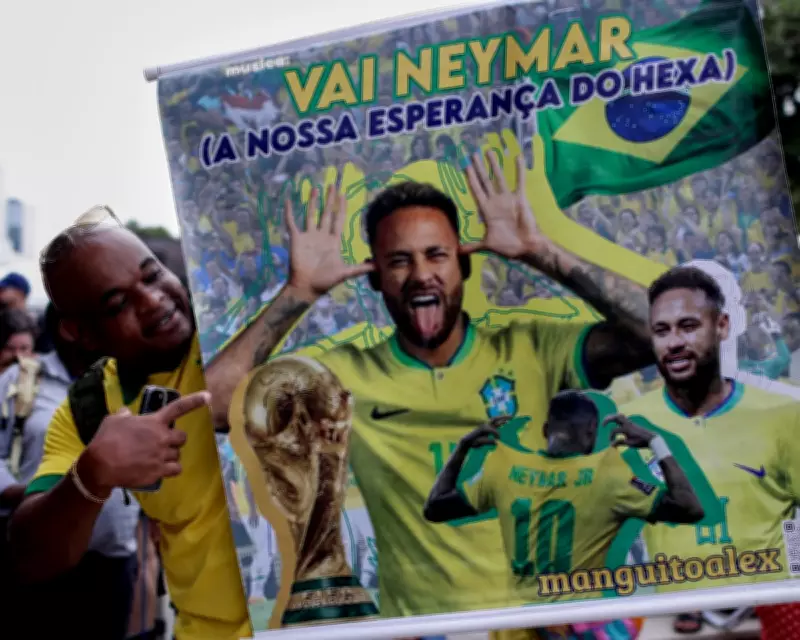
When Neymar was 18, he made his debut for Brazil as part of a rejuvenation after the 2010 World Cup disappointment. At that time, Lionel Messi was 23 and already a star, and Brazil felt they needed their own equivalent. Neymar has been trying to escape the Argentinian's shadow ever since.
Now, news that Carlo Ancelotti has included Neymar in his squad for the forthcoming World Cup feels like a desperate attempt to recreate the narrative Messi enjoyed at the last finals: a last dance long after the body had begun to fade. Messi then was 35; Neymar now is 34. But there are few other similarities between the two cases.
From the start, Brazil needed a Messi of their own, creating a culture of dependency that helped nobody. Neymar is a player who delights some and frustrates others, a vessel for competing narratives. There is an overlooked poignancy to his story: a potential great who was never quite allowed to be himself, whose substance never matched the image.

After Brazil's 2018 World Cup quarter-final defeat to Belgium, Neymar stood alone beside the team bus in Kazan, silhouetted against a vast LED screen, head bowed under the weight of expectation. He was just 26, but even then it felt as if his best chance of winning a World Cup was gone. It was not his fault Brazil lost, yet his presence had created a tactical flaw that Belgium's Roberto Martínez exploited, moving Romelu Lukaku to the right to strike deep into Brazil's soft left flank. Accommodating Neymar demanded compensatory shifts in midfield, but there was no Brazilian Rodrigo De Paul, and an unbalanced Brazil lost.
That had been the problem, emotionally if not always tactically, since the 2011 Copa América. After inspiring Santos to the Copa Libertadores, Neymar arrived in Argentina on a wave of hype that endured until he ran into Venezuela's uncompromising right-back Roberto Rosales. What Rosales began, two encounters with Paraguay's Darío Verón concluded. Brazil went out in the quarter-finals, and the message spread: Neymar really did not like it when opponents one-upped him.
So defenders kicked him, and Neymar began to anticipate contact, exaggerate, feign, and dive. For most of the 2010s, the bullying of Neymar and his pre-emptive evasions were football's most annoying arms race. Some defenders seemed to conclude that you might as well clatter him, as he was going to go down screaming anyway.
That reached a head in the brutal 2014 World Cup quarter-final, where Brazil beat Colombia but Neymar sustained a fractured vertebra after taking a knee in the back from Juan Camilo Zúñiga. The challenge was likely clumsy or overenthusiastic rather than malicious, but such was Neymar's status that Zúñiga found himself condemned by the Brazilian football federation and subjected to social media hate campaigns.
The mood in Rio de Janeiro the following morning was eerily hushed, as if after some great national catastrophe. It is not impossible Brazil might have been more tactically coherent without him, but there was a terrible doubt: how could they beat Germany in the semi-finals without this hyped player? Without the messiah, what would become of his chosen people? David Luiz brandished Neymar's empty shirt during the anthem, hysteria took hold, and Germany ruthlessly scored seven.
A country had collectively lost its mind, building Neymar into a player he simply was not, which was good for neither him nor them. In the group stage of the 2015 Copa América in Chile, Colombia goaded Neymar to the extent he was sent off for a backwards head-butt, earning a four-game ban. Yet just a month earlier, Neymar had combined with Messi and Luis Suárez under Luis Enrique as Barcelona completed a treble by beating Juventus in the Champions League final. That had been probably his greatest season.
Two years later, Neymar inspired Barça's famous comeback against Paris Saint-Germain, prompting their record splurge on him. He may have felt he needed to break free from Messi, that this was his best shot at the Ballon d'Or, but he became the tool of PSG's revenge on Barcelona, the next stage of the great Qatari sports investment project. Ultimately, he was always a cipher for somebody else's dreams and needs.

There was no recreating the great Barça forward line when Messi joined Neymar at PSG; Messi just went off and won the World Cup. Neymar seemed to have his moment in Qatar with a brilliant goal in extra time in the quarter-final, but then he became yet another victim of Croatian doggedness.
Neymar has spent his career chasing greatness, and if he has not lived up to the early hype, that probably says as much about how unrealistic and unfair it was as it does about his lifestyle, although that has not helped. This World Cup is probably his final chance at the sort of transcendental achievement that was expected or demanded but has so far eluded him.
But Messi went into the last World Cup on the back of a half-season in which he had played 18 Ligue 1 and Champions League games, scoring 10 times. Neymar has started 27 league games in the past three years. He had managed only 682 league minutes this year even before sustaining a calf injury this week.
Selecting him is either a great leap of faith from Ancelotti, or an acceptance that there are political demands on the Brazil manager that even the most successful coach in Champions League history cannot escape. Ancelotti is a great believer in talent, but nothing in Neymar's form justifies his selection. It is a pick based on hope rather than logic. Perhaps he can arrive from the bench to make a decisive contribution, but this looks like another example of Brazil's need for Neymar to be their Messi.