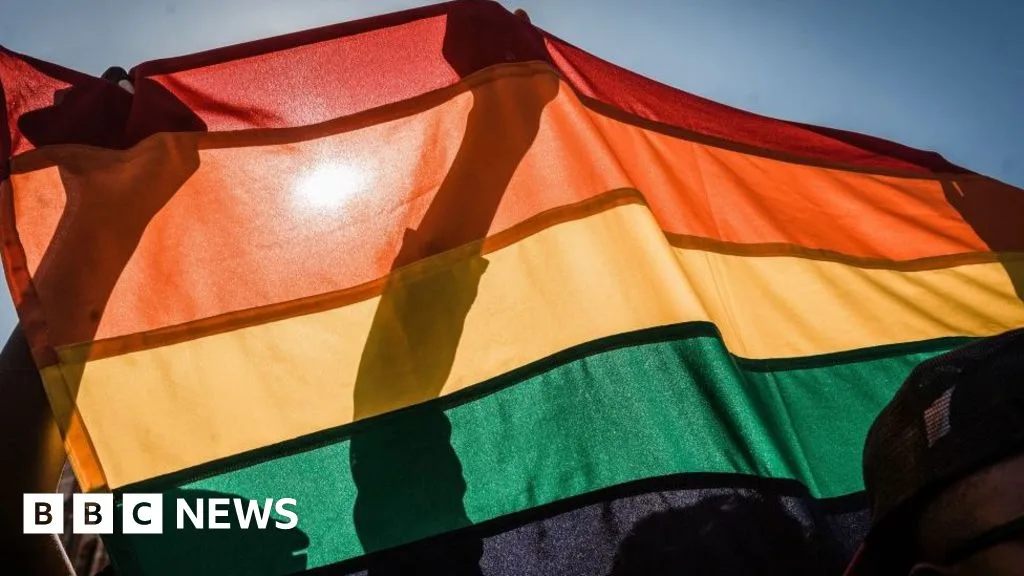
When Abbey Kiwanuka fled Uganda in fear for his life, his hands and legs were covered in cigarette burns as punishment for being gay. Here, he explains why today – to kick off Pride month – he will be marching alongside Ian McKellen to shame the 29 Commonwealth countries that continue to criminalise same-sex relations.
A Legacy of Colonial Laws
When I fled to the UK in 2003 to seek asylum, I arrived with cigarette burns on my palms and legs. There were repeated scars on my face caused by repeated beatings. I had been tortured in my home country, Uganda, because I am gay. I am lucky and grateful to be here. But I still feel conflicted whenever politicians speak warmly about the Commonwealth. Its ideals bear little resemblance to reality for the millions of people who are lesbian, gay, or trans, and who live in the 29 Commonwealth countries that criminalise their relationships and, in some cases, threaten their lives.
Most of these anti-LGBT+ laws are not ancient indigenous legislation, but laws that were introduced under British colonial rule. The British Empire exported Victorian moral codes to Africa, the Caribbean and parts of Asia and the Pacific, through penal systems that criminalised same-sex relationships under offences such as “gross indecency” and “unnatural acts”. These remained embedded after independence. While Britain gradually liberalised many of its outdated, unequal laws, corners of its former empire were left with a vile legacy.
Which is why today, to kick off Pride month, I will be marching through London alongside the likes of Sir Ian McKellen to highlight the homophobia of Commonwealth countries.
King Charles and the Commonwealth Charter
As head of the Commonwealth, King Charles frequently speaks about unity and the strength of the Commonwealth family but has yet to address the continued persecution of millions of LGBT+ citizens. When the Peter Tatchell Foundation wrote to the King, asking him to express regret for the role of previous monarchs in this homophobic tyranny, there was no reply.
The Commonwealth Charter, which sets out its core values, principles and shared aspirations, commits member states to equality and non-discrimination. But those principles ring hollow when LGBT+ people across the Commonwealth continue to face imprisonment, mob violence and exclusion from employment, housing, education and healthcare.
Still, there is hope. The Commonwealth’s new secretary-general, Shirley Ayorkor Botchwey, is a former Ghanaian foreign minister – and I hope she will make clear that the persecution of LGBT+ people is incompatible with Commonwealth values and with the Charter itself. The organisation cannot continue celebrating equality rhetorically while tolerating laws that criminalise people across nearly half its membership, including in Ghana.
The Harsh Reality of Criminalisation
Botchwey knows that 29 of the 56 Commonwealth countries still criminalise homosexuality with punishments ranging from 10 to 20 years imprisonment; in six, being gay or lesbian carries a life sentence. Three have the death penalty. Uganda’s 2023 Anti-Homosexuality Act imposes the death penalty for what the government terms “aggravated homosexuality” – including repeat acts of consenting adult same-sex behaviour and sex involving partners aged 75 and older. Other same-sex relations can lead to life imprisonment, under the old colonial-era laws.
The northern states of Nigeria enforce Sharia law, which can carry the death penalty. Brunei also makes homosexuality a capital offence. A bill currently before the Ghanaian parliament would make it a serious imprisonable offence to identify as LGBT+, and even to advocate for equal rights.
In Nigeria, Cameroon, Malaysia, Kenya, Bangladesh and Tanzania, LGBT+ people face arrest, intimidation, harassment, discrimination and mob violence. Human rights organisations have documented police raids, forced outings and violent attacks carried out with almost no chance of the perpetrators being brought to justice. Indeed, when LGBT+ individuals report violent attacks to the police, they risk abuse, arrest, bashing and sexual assault. Such realities are a world away from Britain, where the battles for equality have largely been won. Yet they are a fact of daily life for millions of LGBT+ people who struggle to survive.
Personal Experience and the Walk of Shame
I was one of them. I remember friends back home in Uganda lowering their voices before mentioning anything related to their sexuality, even in private conversations. I remember hearing about young people forced out onto the streets by their families after rumours spread about them. In Uganda, activists have spoken about living in hiding after newspapers published their names and photographs beneath calls for punishment.
Even where prosecutions are inconsistent, laws like these legitimise a culture in which violence and humiliation become easier to justify. Today’s Commonwealth Walk of Shame, organised by the Peter Tatchell Foundation, will march through central London, starting with a speech at midday from Sir Ian McKellen outside the Nigerian High Commission on Northumberland Avenue, before we head to the high commissions of several of the most homophobic Commonwealth countries. Our call is for Commonwealth countries to uphold their own Commonwealth Charter and for the King and his Secretary-General to lead.
I am disappointed that the huge multi-million-pound LGBT+ charities such as Stonewall have not done more to face the extreme persecution in homophobic tyrannies like Uganda. As it has fallen to small NGOs to push for change, what have they been up to?
If the Commonwealth’s principles are to mean anything at all, they must surely apply to each of its 56 nations. And if not, there’s a gay man from Kampala who grew up terrified of being exposed, beaten and arrested who wants to know why he’s still waiting to be treated with dignity, respect – and equality.
For more details about the Commonwealth Walk of Shame, go to tinyurl.com/commonwealthwalkofshame






