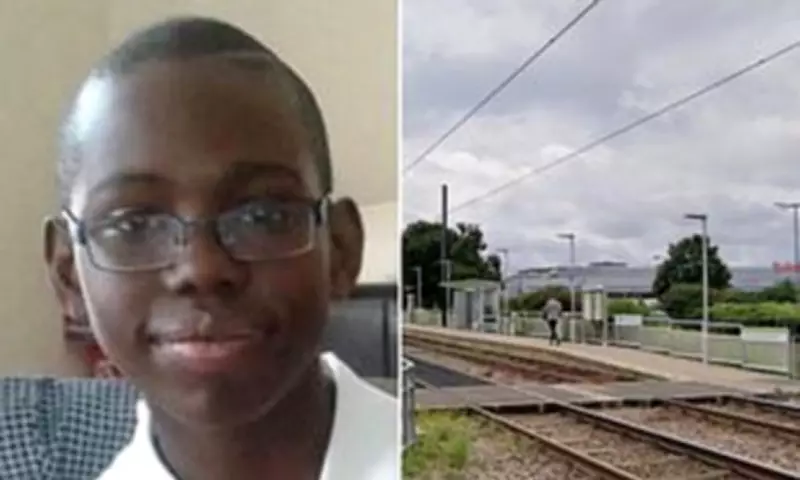
The family of a teenage e-scooter rider who died after being struck by a tram are suing the public transport operator for negligence, with his father claiming the driver was travelling too fast. They assert that Reuben Abakah, 19, was visible to the tram driver 'well before' he crossed the tracks where he was hit by a London Trams service in Croydon on August 22, 2022.
The furniture delivery worker had his hood up and did not slow down as he entered the Waddon Marsh West footpath crossing at the same time as the tram, which was travelling at 37mph. He died in hospital from his injuries three days later.
His family are seeking damages in excess of £200,000 from Tram Operations Limited (TOL), a subsidiary of transport giant FirstGroup, which runs London Trams for Transport for London (TfL). A document filed in the High Court in London on their behalf states that the tram driver, named as Michelle Bishop, failed to keep a 'proper lookout' or recognise the 'developing hazard' as Mr Abakah approached the crossing. She did not operate the tram 'at a safe speed in the circumstances' or use its audible warnings or brakes effectively, according to the family.

The court document describes how the driver first sounded her warning bell 2.0 seconds before the collision, and her horn 1.4 seconds ahead of the crash, which was too late to be 'acted upon'. The sound level emitted by the bell was below the ambient background noise at the crossing, and the levels of both the bell and horn were 'materially below the recommended band', according to the document. She applied the service brake 0.8 seconds before the collision, and the hazard brake 0.1 seconds later.
The speed limit for trams using the crossing has since been reduced from 43mph to 31mph. The crossing features a chicane intended to slow users, but it did not cause them to naturally turn towards the direction of approaching eastbound trams, such as the one which hit Mr Abakah.
His father, Frederick Woode, said his 'one wish is that lessons are learned from this' and 'changes are made before anyone else loses their life'. He went on: 'I know nothing can bring Reuben back, but I believe the tram should not have been travelling as fast as it was. The crossing should also be altered so that pedestrians like Reuben do not have their backs to approaching vehicles.'
An inquest into Mr Abakah's death at South London Coroner's Court in Croydon concluded in August last year that he died as a result of an accident. No legal action is being brought against Ms Bishop.
The family's lawyer, Ben Posford of Osbornes Law, said it 'shouldn't have mattered' that Mr Abakah 'didn't look properly'. He told the Press Association: 'That's not how health and safety works, and hasn't done for a very long time. He didn't look until the last minute and he made an error there. From time to time, people are going to make an error. You have to have health and safety measures in place that account for human error, that account for zoning out.'
Following the 2016 Croydon tram crash in which seven people died, the Rail Accident Investigation Branch (RAIB) recommended that installing CCTV cameras inside drivers' cabs should be considered to aid inquiries into future incidents. Osbornes Law said it has seen no evidence that cameras have been fitted.
Mark Davis, TfL's general manager for London Trams, said: 'Our thoughts and deepest sympathies remain with the family and friends of Reuben Abakah, who tragically lost his life in August 2022 following a collision between his e-scooter and a tram in Croydon. We are aware that the family are currently taking legal action against our operator so we cannot comment further while these proceedings are ongoing.' No written defence to the claim is publicly available. TOL declined to comment while legal proceedings are ongoing.
Seven passengers were killed and 62 were injured, 19 of whom sustained serious injuries, in the Croydon tram crash just after 6am on November 9, 2016. In darkness and heavy rain, the tram derailed and overturned on a sharp bend approaching a junction where the speed limit dropped from 50mph to 12mph as it was heading for Sandilands tram stop in south London. However, the driver, 49-year-old Alfred Dorris, did not slow down enough and entered the curve at around 45mph causing the tram to derail and overturn on its right side.

The side of the tram, which was a New Addington to Wimbledon service, was damaged and several passengers were ejected out through broken windows. The people who died were Dane Chinnery, 19, Philip Seary, 57, Dorota Rynkiewicz, 35, Robert Huxley, 63, and Philip Logan, 52, all from New Addington, and Donald Collett, 62, and Mark Smith, 35, both from Croydon. Driver Mr Dorris was arrested by the British Transport Police (BTP) on suspicion of manslaughter on the same day.
One aspect of the police investigation was whether or not Mr Dorris had fallen asleep, with reports that some passengers said he had blacked out at the controls. After assessing the evidence, the BTP and the Crown Prosecution Service (CPS) decided that neither the driver, operating company nor TfL would face prosecution. The CPS stated that while there was evidence of negligence by the driver, it did not count as 'gross' and so 'manslaughter by gross negligence' could not apply. But the Office of Rail and Road (ORR) announced it would prosecute the driver, Tram Operations Limited (TOL) and Transport for London (TfL) over the accident.
During the 2022 trial, TOL and TfL pleaded guilty to offences of 'failure to ensure the health and safety of passengers on the Croydon Tramlink network, so far as reasonably practicable' under the Health and Safety at Work Act 1974. TOL were fined £4million and TfL were fined £10million with each company also ordered to pay £234,404 in costs and a £170 victim surcharge. Mr Dorris pleaded not guilty to a charge of 'failure to take reasonable care of passengers' and denied he had a 'micro-sleep'. He said he became disorientated in the tunnel on approach to the curve, believing he was heading the other way.
He blamed his confusion on a combination of external factors including poor lighting and signage in the Sandilands tunnel complex, darkness and bad weather. By the time he realised the fatal mistake the tram was already tipping over and he was thrown from his seat, causing him to hit his head and pass out, he said. He was acquitted by a jury at the Old Bailey in June 2023 where he spoke publicly about the tragedy for the first time and tearfully apologised to the victims' families and survivors. He told them: 'I'm a human being and sometimes as a human being things happen to you that you are not in control of. I'm sorry that I became disorientated. I'm sorry I was not able to do anything to stop myself from becoming disorientated. And I'm deeply sorry I was not able to do anything to reorientate myself and stop the tram from turning over. I'm deeply sorry.'