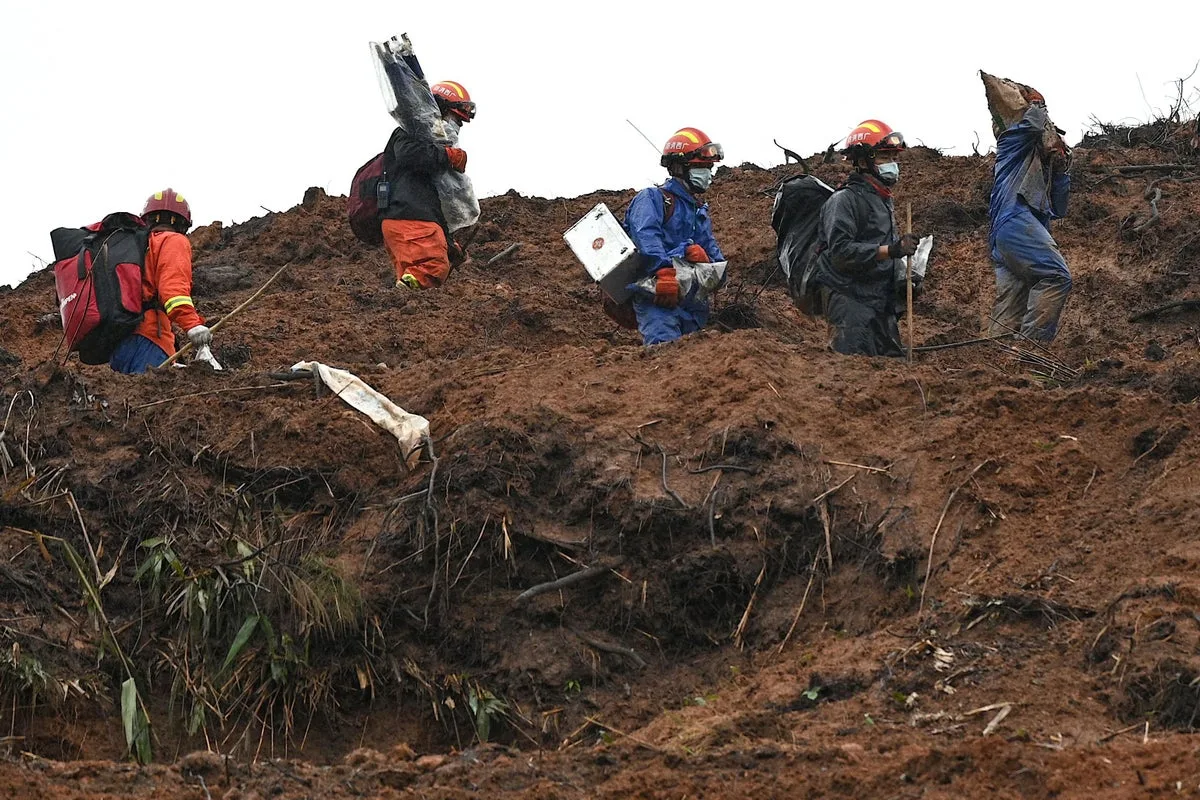
A newly released report indicates that there was a struggle over the controls and fuel to both engines of a China Eastern Airlines plane was cut off mid-flight before it crashed into a mountain in 2022, killing all 132 people on board.
NTSB Report Details
The US National Transportation Safety Board (NTSB) report released earlier this month found that the “fuel switches on both engines moved from the run position to the cut-off position” and that “engine speeds decreased after the fuel switch movement”. The Boeing 737 plunged almost vertically from 29,000ft as a result, indicating that the crash was deliberate.
The jet was flying from Kunming in the southwest to Guangzhou, near Hong Kong, when it went into a nosedive at about 8,800m (29,000ft), appeared to recover but then slammed into the mountain. The crash on 21 March 2022 left a 65ft (20m) crater and set the forest on fire. The crew reported no problems before losing contact with air traffic control. Chinese investigators said no abnormalities were found among the plane or crew or with outside elements such as bad weather.
Evidence of Struggle
The data revealed that after the fuel to both engines was cut off, either by one or both pilots, the plane nosedived and even spun around in the air at least once. This spinning motion means that the pilots’ control wheels were turned to produce that roll. Control wheels inside the cockpit are somewhat similar to steering wheels but are used to tilt and turn the plane.
An aviation expert now believes that there may have been a struggle as the cockpit control data showed the plane’s control wheels moving in a back-and-forth pattern during the dive. Jeff Guzzetti, a former NTSB and Federal Aviation Administration investigator, says this suggests that two pilots inside the cockpit were trying to control the aircraft in opposite directions at the same time.
Mr Guzzetti told Associated Press: “Typically when you want to roll an airplane, it’s a smooth movement of the control wheel in one direction. But here you have it moving back and forth, back and forth, as if someone is trying to counter the initial movement of the roll. So it’s not conclusive, but it sure has the earmarks of a struggle in the cockpit.”
Ongoing Investigation
Chinese authorities have not yet published a final investigation report. The cockpit voice recorder on the plane may provide crucial clues about what happened before the crash, but the NTSB did not release any transcripts. Any further details would need to come from the Chinese authorities.
The NTSB became involved in the Chinese investigation because the plane and engines were made by American companies. The NTSB report was released earlier this month under the Freedom of Information Act. On the subject of the control wheels moving back and forth before the crash, Mr Guzzetti told The New York Times: “Aggressive movements to pitch the airplane down and to roll it dramatically tell me this was an intentional act. It’s the kind of movement you see aerobatic airplanes perform in an air show. It would have been a shock to the passengers because of the forces imparted on them from these drastic manoeuvres.”
John Cox, a retired airline pilot and an aviation safety consultant said: “A pilot can shut off fuel to both engines at the same time by moving the levers from run to cutoff.” He added that the irregular movement of the pilots’ control wheel suggested a struggle, “but the evidence is not overwhelming or totally conclusive”. By design the fuel levers in a 737 cannot be easily bumped or shut off inadvertently – someone has to pull them out to release them before they will move. Cox, who is the CEO of Safety Operating Systems, said the levers lock into place, so it’s likely that someone deliberately moved them both to the cutoff position.






