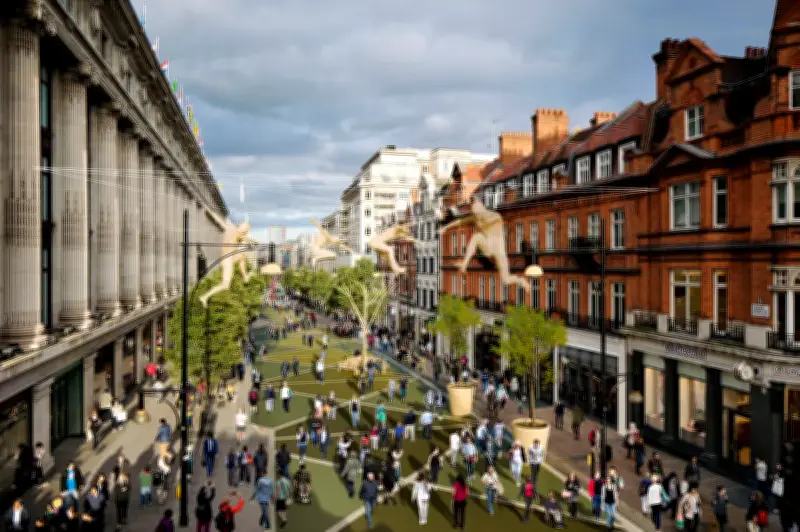
After years of political disputes and multiple proposals that were promoted, criticised and scrapped, Oxford Street will finally be pedestrianised on Monday, October 26 — at least in part. The first phase will close almost a kilometre of the 1.9km shopping street to traffic, from Orchard Street to Great Portland Street, with the eastern and western ends expected to follow in later phases.
Initially, cars, buses, vans and lorries will be barred from the newly pedestrianised "boulevard." Beautifying street furniture will have to wait until after the busy Christmas retail season, when the Oxford Street Development Corporation and its partners have assessed feedback and observed how shoppers, visitors and business users respond to the traffic-free zone. The long-promised transformation, adding seating, planters and trees, should happen next year.
Traffic restrictions and exceptions
Traffic will not disappear entirely from the barred section. Several north-south connections will remain open, allowing drivers to cross Oxford Street. Emergency vehicles will have access at all times, and arrangements are being made for other essential services. Vans and lorries will be able to drive to businesses during specified night-time hours. However, ordinary cars, buses, taxis, private hire vehicles, bicycles, scooters and pedicabs will not be allowed to travel along the central portion of Oxford Street, which includes some of London's most famous stores.
The initiative represents a significant development in the life of the West End. One of the world's best-known streets will be pedestrians-only, marking the beginning rather than the end of efforts to boost footfall in the prime retail street by making it more attractive and safer for shoppers.
From proposal to reality
The transformation has been discussed on-and-off for decades, but the idea hardened when London Mayor Lord Khan proposed pedestrianisation in his 2016 election manifesto. A row ensued with Westminster city council, which opposed the policy. Khan's idea was withdrawn in 2017 but revived seven years later amid the introduction of a broader vision for the West End.
City Hall effectively froze out the council by awarding enhanced powers to the newly created Mayoral Development Area and Oxford Street Development Corporation. Khan's position was bolstered by a public consultation, which received a 66 per cent positive response. He brushed aside objections from councillors about the risk of displaced vehicles clogging the surrounding streets and approved the pedestrianisation on February 26 this year. It has taken exactly eight months to bring that decision to fruition.
In recent years, the street has been dogged by controversy around the prevalence of American candy outlets, vaping stores and tourist-trap discount shops. Crime has been a recurring concern. Some of the once grand names have gone or are shadows of their former selves. As if to underline that message, the pedestrianisation coincided with news that HMV is to shut its flagship store — one of the street's landmark buildings — next March, barely three years after it reopened.
The entertainment retailer first opened there in 1921, closing in 2019 when HMV hit financial difficulties. The reopening was a pivotal occasion, signifying the rebirth of HMV and with it, a possible renaissance for Oxford Street. Phil Halliday, managing director of HMV, said: "This is a special store, it's where we began 100 years ago and bringing it back to life in 2023 was a big moment in our recent history." But, as well as a big rental increase, the group faced a substantial bill for renovations, which combined to make the shop "commercially unviable."
Support and concerns
Khan, for one, is enthusiastic. "Following strong support from Londoners and businesses, I'm excited to see my bold vision for Oxford Street really coming to life… as we start going traffic-free, just in time for the busy Christmas shopping period," he said. "I'm delighted that on October 26 the transformation of the nation's high street into a pedestrian plaza will begin in earnest — a world-class space where flagship retail will sit alongside next-generation workplaces, designed to host exciting retail and leisure experiences from sport to fashion and cultural events in the future."
There may be 66 per cent favourability, but that leaves a solid third against. The Mayor argues air quality and pedestrian safety will also improve. His team points to Ulez zones, where analysis from Imperial College London shows an estimated 40 per cent drop in air pollution-related deaths from 2019 to 2024. Not everyone is so convinced. They struggle with the notion that barred traffic will not jam the side streets as drivers try to find a route across the centre of the capital. Buses, in particular, have the ability to cause widespread chaos. They currently have a straight run along Oxford Street; from Monday they will be turning corners and negotiating narrower roads. Bus stops will be farther away, not directly outside the stores. Likewise, taxi ranks and taxis will be harder to locate.
Against that are repeated studies showing well-executed pedestrian schemes can increase visitor numbers and foot traffic by anything from 10 per cent up to 40 per cent. The Mayor's own test day on Sunday, September 21 last year saw a 45 per cent lift in visitors and a 23 per cent to 26 per cent rise in users of the nearby Tube stations. Some 67 per cent of the stores affected by the one-off event reported similar or higher sales than a typical Sunday.
Retailers and new arrivals
Retailers are anticipating improved takings and landlords are looking forward to higher property and rental values. The Langham Estate, a property management and commercial real estate agency, predicts Fitzrovia, Marylebone and Soho will all benefit: "The move will turn one of the world's busiest shopping corridors into a cleaner, more accessible and experience-led environment, reshaping how people move, shop, and work across the West End. For retailers, landlords, and businesses in nearby districts such as Fitzrovia, Marylebone and Soho, this marks more than a traffic change — it signals a strategic opportunity. The pedestrianisation of Oxford Street is poised to unlock new growth potential for central London's commercial landscape."
Meave Wall, executive director of Selfridges, said: "Selfridges has thrived on Oxford Street for well over 100 years and we're hugely energised by the renewed commitment to make this area more enticing and attractive for locals and visitors from around the world. The community's support and enthusiasm is really encouraging and we are excited to play our part in shaping a brighter future for this iconic shopping and entertainment hub."
New retailers are arriving, persuaded by pedestrianisation. Heritage sports and lifestyle brand New Era is set to open a major outlet at 386 Oxford Street, adjacent to Selfridges, after signing a 10-year lease. Callum White, associate director in retail at Savills, which acted on behalf of the landlord, said: "The momentum on Oxford Street is accelerating, with the upcoming pedestrianisation acting as a powerful magnet for global retailers. New Era's arrival is another vote of confidence in this shifting energy, proving that top brands are eager to plant their flags ahead of a reimagined, traffic-free environment."
Oxford Street, it seems, is about to turn a corner.