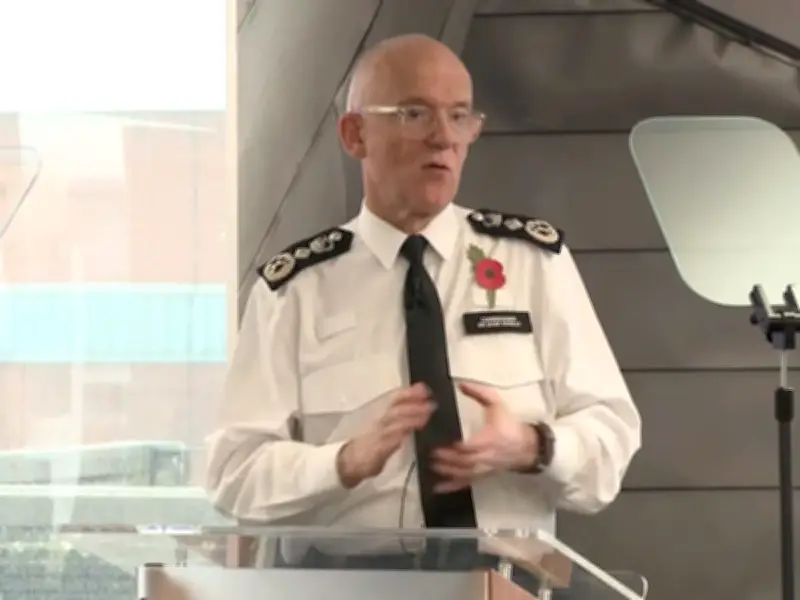
Met Police Commissioner Sir Mark Rowley has warned that policing in England and Wales will fail unless the number of "hollowed out" forces is reduced. He said the current structure is "incoherent" and must be reformed, with 43 forces "trying to do too much with too little" and their number cut to as little as eight.
Home Secretary Shabana Mahmood is preparing to launch the biggest reset of policing in 200 years, creating a "British FBI" while demanding chiefs tackle local crime.
Rowley's warning
Speaking in Manchester, Sir Mark said: "There comes a point when the world evolves beyond the ability of the systems built to service it. British policing has reached that point once again."
He added: "And there's a very real risk to the public if we don't urgently reform to meet that challenge. In short, and it hurts me to say this, policing will fail."
The police chief said: "The cause of our current problems is that policing has tried to keep up and do the best it can to patch over our broken model. But that model is creaking."
Current model under strain
Sir Mark described the national landscape as "incoherent," citing the National Police Chiefs' Council, the College of Policing, the National Crime Agency, and Counter Terrorism Policing, along with a "patchwork of critical national services hosted by individual forces."
He said: "Forces are now so hollowed out by these convoluted arrangements that we now rely on nine regional and many bilateral collaborations to provide capabilities such as major crime investigation and armed policing."
He paid tribute to hardworking officers but said: "I want to be frank today - despite our incredible people, the service that we provide is often not what it should be, and is at serious risk of degrading further."
Impact on crime and confidence
Sir Mark noted: "We are solving less crime nationally. Positive outcome rates are now less than half they were 12 years ago."
He added: "The public see fewer officers, just 11% reporting an officer or PCSO on foot patrol each week—in 2011, that was 39%. Public confidence has fallen, public satisfaction has fallen."
He said: "Even the best-performing forces solve only 22% of crimes, with only 58% of the public saying they do a good job locally. And because crime doesn't fall evenly, and serious incidents don't occur where the capability exists to tackle them, forces can sometimes find themselves overwhelmed and bent out of shape very quickly."
Government reform plans
In January, Ms Mahmood set out proposals to reform the police service for the 21st century, including setting up a National Police Service and allowing larger, regional forces to focus on local crime.
A Home Office spokesperson said: "Our current model of policing has not changed since the 1960s and is no longer fit for purpose."
They added: "A structural overhaul is overdue, and we will deliver the most radical reform of policing in 200 years. Our reforms will deliver strong local policing focused on neighbourhood crime, more resilient forces providing specialist capabilities to tackle serious and complex crime threats, and a National Police Service tackling national and cross-border threats."
Ms Mahmood is reviewing recommendations by one of Sir Mark's predecessors, Lord Bernard Hogan-Howe, on how to restructure policing in England and Wales. The Home Office said this will guarantee responsive local policing, and the funding formula for forces is also currently being reviewed.