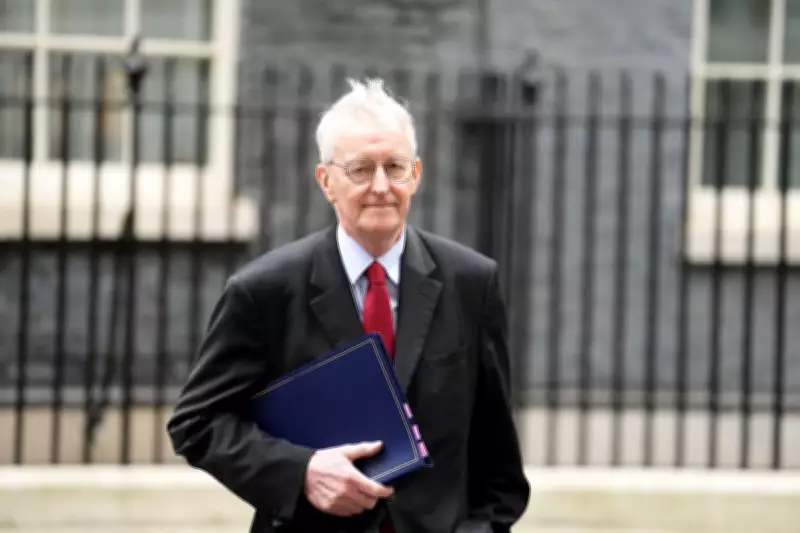
The Irish Government's legacy legislation will be dependent on the UK Government passing its own laws, the Northern Ireland Secretary has been told. Legacy issues were among the main topics discussed during the British-Irish Intergovernmental Conference (BIIGC) at Hillsborough Castle on Thursday.
Conference Attendees and Key Discussions
Northern Ireland Secretary Hilary Benn, Parliamentary under-secretary of state Matthew Patrick, Ireland's Minister for Foreign Affairs Helen McEntee, and Minister for Justice Jim O'Callaghan attended the conference. At a press conference following the meeting, the Dublin side expressed disappointment that the UK Bill to repeal and replace the controversial Legacy Act—introduced by the previous Conservative government—had not yet reached the committee stage.
Irish Minister's Statements
Mr O'Callaghan said the UK legislation must be passed before the Irish Government brings in a complementary Act, expressing hope that the UK legislative process could be “expedited.” He stated: “Late May or early June, I will be going before Government seeking approval for the drafting of a general Legacy Bill that will be able to deal and engage with the legacy commission that is going to be put in place in the United Kingdom. I hope to see that legislation enacted properly thereafter. However, I did indicate to Hilary and Matt that that legislation is very much dependent upon the UK legislation being enacted.”

Among other measures, the Labour Government's Bill will establish a reformed Legacy Commission with enhanced powers. MPs have backed a remedial order that removed the previous Act's provisions for conditional immunity from prosecutions for Troubles-era crimes, as well as scrapping a bar on future legacy compensation cases. The immunity provision had been found unlawful in the courts.
Timeline for Irish Legislation
Mr O'Callaghan noted that drafting the Irish legislation—which would enable the provision of evidence to the reformed legacy commission—could take three to four months. Ms McEntee said she was “disappointed” that the UK Bill had not moved to the committee stage in the latest parliamentary session, but noted that Mr Benn had given “a clear commitment” to progress the legislation.
Mr O'Callaghan also said he was “very encouraged” to hear that committee stage amendments to the legacy legislation will be published in June. He added that he had received commitments from the Northern Ireland Secretary that the legislation will comply with Article 2 of the European Convention on Human Rights.
Concerns from Armed Forces and Veterans
Armed forces and veterans communities have raised concerns over the legislation, with the Conservatives arguing it will reopen “vexatious litigation.” Mr Benn said the UK Government had a duty to ensure that “those who served the State to keep the people of Northern Ireland safe are properly treated during the legacy process.” He stated that the Bill already contains protections for veterans—such as the right to give evidence remotely, to apply to do so anonymously, to have their age and welfare taken into account, and to ensure no cold calling—but said further amendments would be made when the Bill returns to the House of Commons early in the new session.
Mr Benn said the further element of protections under consideration is to make clear there is no equivalence between the security forces and terrorists. “None of those affects in any way the commitments that we gave when we met in this very spot in September to launch the framework agreement between the British and the Irish government.”
Unfinished Business of the Good Friday Agreement
Mr Benn described dealing with legacy as the “unfinished business of the Good Friday Agreement,” adding that it was the “last chance” to “get this done.” The meeting was held while a ruling was being given in the last of the coronial investigations into Troubles-related deaths completed before the May 1 deadline of the existing Legacy Act. A coroner ruled that British Army soldiers did not use reasonable force in the shooting of a Catholic priest, a father-of-six, and three teenagers in two areas of west Belfast on July 9, 1972.

Omagh Bombing Inquiry Bill
Meanwhile, Mr O'Callaghan said he expects the Irish Government's Omagh Bombing Inquiry Bill to be enacted into law by the end of next month, as it cleared the Dail and moved to the Seanad. The International Co-operation (Omagh Bombing Inquiry) Bill 2026 would allow current or former gardai members, members of the Irish army, the Civil Service, or the Government to engage with the inquiry examining the 1998 atrocity in the Co Tyrone town. The Justice Minister added that the Irish Government has provided more than 26,000 pages of information to the inquiry through a memorandum of understanding. “That is a real example of co-operation by the Irish Government with inquiries operating in Northern Ireland in respect of legacy issues.”
Joint Communique and Other Discussions
In a joint communique, the governments said they had also discussed “individual legacy cases” and the review of the Independent Commission for Reconciliation & Information Recovery. They also said they were looking forward to the finalisation of a report into whether there is merit in and support for a formal process of engagement to bring about paramilitary group transition to disbandment, expected by August.
Ministers from both governments condemned the attack on Dunmurry police station at the weekend as well as the attempted attack outside Lurgan police station in March. Elsewhere, the governments committed that any future digital ID solutions will be developed “in partnership” and in a way that ensures the rights of citizens under the Common Travel Area and Good Friday Agreement.
British-Irish Co-operation
On British-Irish co-operation, the governments welcomed “positive discussions” on enhancing energy security through off-shore wind development and a North-South electricity interconnector. There was also discussion on a bilateral approach to “hybrid cross-border working” and consideration of updating aspects of the UK-Ireland Double Taxation Convention. The governments agreed that the British-Irish Intergovernmental Conference would meet again later in 2026.