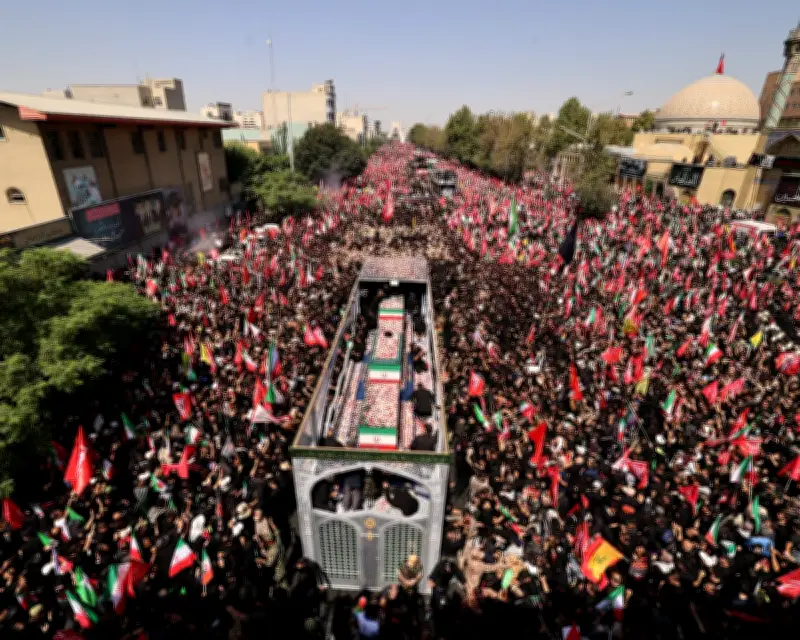
Reports in western media suggest about 12 million people have been out on the streets to mourn the killing of former supreme leader Ali Khamenei. As the multipurpose, multinational funeral moved to the Jamkaran mosque in Qom and then to Najaf in Iraq, Iran's leadership weighed the mandate given by millions who took to the streets of Tehran over three days.
State-Led Mobilization or Genuine Grief?
Some hailed the moment as a referendum showing support for the clerical establishment, calling for intensified confrontation with the West. Others said it reflected wider national pride conditional on demands for change and an end to the war. Government sources believe they successfully organized mass shows of support without disorder or signs of coercive manipulation that western media and social media influencers could not ignore.
In Qom, Khamenei's body arrived by helicopter; the Jamkaran mosque reached capacity seven hours before morning prayers. The prayer was read in a choking voice by Ayatollah Javadi Amoli, a leading Iranian conservative philosopher.
Numbers Game: Turnout Estimates Vary Widely
An inevitable numbers game began over funeral turnout. Estimates for Tehran range from 350,000 to 35 million. The Financial Times reported as many as 12 million, pleasing the government. At a minimum, support in Tehran bore comparison to Ruhollah Khomeini's 1989 funeral, when 5–7 million from a population of 53 million attended.
Under Khamenei's 36-year rule, economic travails and political repression damaged the regime's support base. However, many mourners were highly educated and wanted to show opposition to what they regarded as the extrajudicial killing of their leader, regardless of broader views of the regime.
Analysts: Infrastructure and Real Social Base
Mohammad Ali Kadivar, associate professor at Boston College, said the funeral was "a major episode of state-led mobilisation." He noted: "Since 1979, state-led mobilisation has been one of the central pillars of the regime's power. The state has built dense infrastructure through mosques, the Basij, schools, universities, workplaces, state media, veterans' organisations and war commemoration networks. These institutions help organise public participation and project images of popular support."
Kadivar added: "The Islamic republic also has a real social base. This base is not a majority, but it is large, organised, ideologically committed and consistently open to mobilisation. Funerals make that support visible."
Government Allies: A Civilisation Expressing Itself
Reza Nasri, a lawyer close to the government, said images confirmed the US had "never understood what it was dealing with" when it went to war with Iran. "This was one of the largest human gatherings on Earth. It's a civilisation expressing itself in full, with all its grief, its pride and its cohesion. These are millions who chose, freely and defiantly, to pour into the streets to mourn their leader on their own terms."
He said the Trump administration's strategy "did not radicalise them against their government. Four decades of sanctions, two wars, maximum pressure, currency warfare, and this is what it produced: a people more visibly unified than almost any nation."
Political Science Professor: Beyond Materialism
Hossein Rouyvaran, professor at Tehran University, said: "The biggest problem of the west is all their theories are materialistic, but what happens in Tehran is beyond mundane materialism. Millions sleep in the streets, suggesting a connection between leader and people that is not materialistic." He said the war changed the social contract, bringing even opposition under the Iranian flag.
Some aspects of canonisation bordered on absurd. Justice minister Amin Hossein Rahimi said the judiciary laid groundwork for lawsuits over "mental and psychological harm resulting from the loss of the leader." Rouyvaran said the marches would legitimise the government and give it a freer negotiating hand with the US.
Internal Fractures and Revenge Demands
The government has fractures. Activity around the Strait of Hormuz, including gunfire at Qatari LNG tankers, suggests Iran is not relaxing its grip. Foreign minister Abbas Araghchi, seen riding helmetless on a motorbike to the funeral, acknowledged the crowd's importance. Responding to Donald Trump's threats to annihilate Iran, he said: "Millions of proud Iranians rallied in unity to honour Grand Ayatollah Khamenei and his legacy. Neither them nor our armed forces are moved by any threats. Paragraph 13 of the memorandum of understanding is clear: negotiations will not commence if threats continue."
Abdollah Ramezanzadeh, retired assistant professor at Tehran University, expressed concern over "stage-managing efforts by state TV to seek revenge and reject negotiation and peace." He warned: "If they're a deliberate project by extremists to drag the country into war, stop them."
Hesamoddin Ashna, adviser to former president Hassan Rouhani, said: "If we cherish that national presence, consider the united and diverse nation as the holder of power, and employ justice and rationality to witness the resurgence of Iran."
Some argued that if the funeral affirmed national cohesion, past presidents Mohammad Khatami, Mahmoud Ahmadinejad and Rouhani would not have been excluded. Another absentee was Ali Asghar Hijazi, deputy chief of Khamenei's office, reportedly opposed to elevating Khamenei's son Mojtaba as successor, citing Khamenei's will barring children from politics. The battle for the soul of Iran is entering a new phase.